First Seen
2023-12-11T01:56:33+00:00
simple-description (qwen3.5_2b-q8_0)
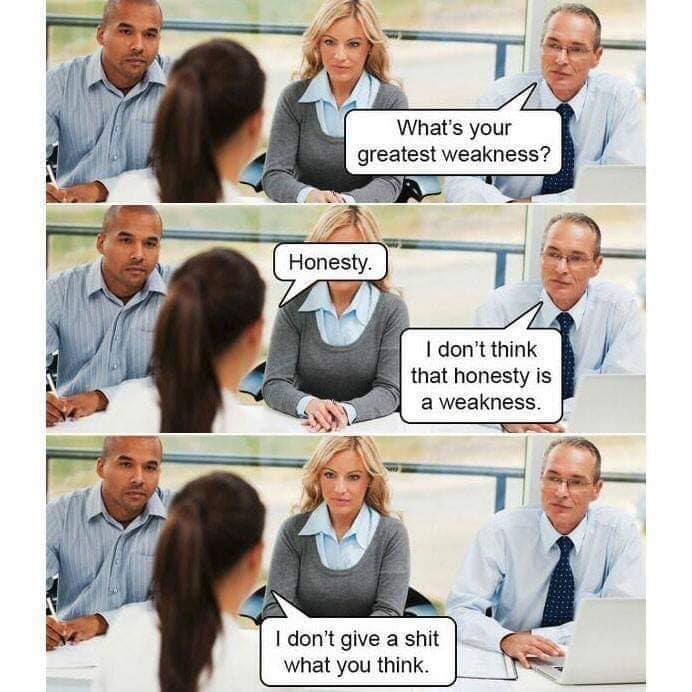
This meme satirizes the traditional capitalist job interview where candidates are pressured to admit a personal "weakness" to prove their value and fit for a position. The woman in the image responds by sarcastically rejecting the premise of the test, stating that "honesty is not a weakness," followed by a dismissive remark that shuts down further negotiation.
simple-description (llama3.2-vision_11b)
This meme is a play on the classic "What's your greatest weakness?" job interview question, but with a twist. The interviewer asks a job candidate to respond with a phrase that is actually a strength, but is phrased in a way that sounds like a weakness. The text in the image reads: "What's your greatest weakness?" "Honesty."
detailed-analysis (gemma3-27b-vision)
Okay, let's break down this meme through a few different theoretical lenses.
Visual Description
The image is a four-panel meme constructed from a still scene, likely taken from a television show or film. It depicts a job interview setting. Three interviewers—a Black man, a white woman, and an older white man—are seated around a table, facing a candidate, whose back we mostly see, with only the top of her head visible. Dialogue bubbles have been digitally added to capture the conversation.
- Panel 1: The older white man asks, "What’s your greatest weakness?"
- Panel 2: The candidate replies, "Honesty."
- Panel 3: The white woman responds, "I don't think that honesty is a weakness."
- Panel 4: The candidate, looking directly at the interviewers, asserts, "I don't give a shit what you think."
The visual contrast between the “conventional” panel responses and the last assertion emphasizes a disruption of norms. The candidate’s body language—facing the interviewers directly—conveys a shift in power dynamic.
Foucauldian Genealogical Discourse Analysis
This meme is rich for Foucauldian analysis. The job interview itself is a discourse—a system of thought, language, and practice that produces knowledge and power. The question "What’s your greatest weakness?" isn’t a genuine inquiry; it's a power play designed to discipline the candidate. It functions as a technology of power, creating a norm against which the candidate is assessed. The “correct” answer is a confession— a self-disclosure of imperfection, that allows the interviewers to categorize and control the candidate.
The candidate's initial answer, "Honesty," attempts to recode the norm. She is redefining weakness as a virtue. This is an initial disruption to the discourse. However, it's the final line, "I don't give a shit what you think," that represents a radical break from the power dynamics inherent in the interview. She refuses to participate in the confession, rejects the power of the interviewers to assess and categorize her, and effectively interrupts the discourse itself.
Genealogically, we can see how this meme resonates with a growing skepticism towards institutional power structures and a desire for authentic self-expression. It's a micro-level resistance against the surveillance and discipline embedded in many social institutions.
Critical Theory
The meme can be interpreted through the lens of Critical Theory, particularly in relation to the concept of domination. The job interview represents a system of domination where institutions (represented by the interviewers) seek to control and categorize individuals (the candidate). The question about "weakness" is a mechanism to expose vulnerabilities and maintain power imbalances.
The candidate’s response is a form of emancipatory interest. She challenges the power dynamic, refusing to be subjected to the judgmental gaze of the interviewers. It’s a rejection of the instrumental rationality of the corporate world, where individuals are reduced to their “skills” and “weaknesses.”
The meme implicitly critiques the ways in which language and discourse are used to reinforce systems of power and control, and it advocates for a form of resistance—a refusal to conform to expectations.
Marxist Conflict Theory
From a Marxist perspective, the job interview exemplifies the class struggle inherent in the capitalist system. The candidate is selling her "labor power" (skills and experience) to the potential employer. The interviewers represent the bourgeoisie (owners of capital), and the candidate represents the proletariat (the working class).
The question about "weakness" is a method for the bourgeoisie to assess the candidate's potential for exploitation. They want to identify vulnerabilities that could be used to control and maximize profit. The candidate’s defiant response can be seen as a micro-level rebellion against the exploitative nature of the capitalist system. She is asserting her agency and refusing to be reduced to a commodity. It also touches on the alienation of labor, as the candidate is asked to perform a self-deprecation to prove their worth.
Postmodernism
This meme fits neatly into a postmodern framework. It deconstructs the traditional notion of the job interview as a rational and objective assessment process, revealing its underlying power dynamics and constructed nature. The candidate's final line is a quintessential postmodern gesture—a rejection of grand narratives (the "proper" way to conduct an interview) and a celebration of subjectivity and individual expression.
The meme also highlights the instability of meaning. The interviewer’s question is open to interpretation, and the candidate redefines “weakness” in a way that challenges conventional expectations. The meme's humor arises from this disruption of norms and the playful subversion of established meanings. The refusal to conform to expectations is a celebration of difference and a rejection of the homogenizing forces of modernity.
Queer Feminist Intersectional Analysis
While not explicitly centered on gender or sexuality, a queer feminist intersectional analysis can illuminate how this meme speaks to broader themes of power, resistance, and the disruption of normative expectations. The candidate's defiance can be read as an act of refusal—a refusal to perform the expected submissive role in a patriarchal and capitalist system.
The meme can also be seen as challenging the expectation that individuals should be “fixable” or “perfect” in order to be valued. The candidate isn’t trying to manage her perceived weakness; she’s rejecting the premise that it’s a weakness at all. This resonates with queer and feminist critiques of normative ideals and the pressure to conform. The candidate's assertive stance also subverts the historically gendered expectation of female passivity and politeness in professional settings.
It's important to note that the meme’s impact derives from its simplicity and broad appeal. It doesn’t necessarily explicitly engage with queer or feminist theory, but it taps into themes of power, resistance, and self-expression that are central to these frameworks.
Hopefully, this detailed analysis covers the meme through several theoretical lenses! Let me know if you’d like me to elaborate on any of these points.
tesseract-ocr
ge 4) A (a ee <r S ‘ JG, wh y aN) Y [ I What's your iY J yy”) i greatest weakness? Ve _— yj a Coal XZ vm, er sm esd oll az’ c= J sc ‘ A Ad a ih | Idon'tthink fj As ¢ | that honesty is : Ne SS ye a WeAMIESS: 5) XK a Pe =<—_— _, a Seeeertt pes git G W i. MH id Hh / ) / Ms a! = be | don’t give a shit = what you think. =
simple-description (llama3.2-vision)
This meme is a humorous conversation between two people, where the first person asks "What's your greatest weakness?" and the second person responds with "Honesty. I don't think that's a weakness, I think that's a strength." The second person then says "I don't think that's a weakness, I think that's a strength. I don't think that's a weakness, I think that's a strength." The conversation then devolves into a series of absurd statements, with the second person saying "I don't think that's a weakness, I think that's a strength. I don't think that's a weakness, I think that's a strength. I don't think that's a weakness, I think that's a strength. I don't think that's a weakness, I think that's a strength. I don't think that's a weakness, I think that's a strength."