First Seen
2024-01-16T01:31:41+00:00
simple-description (qwen3.5_2b-q8_0)
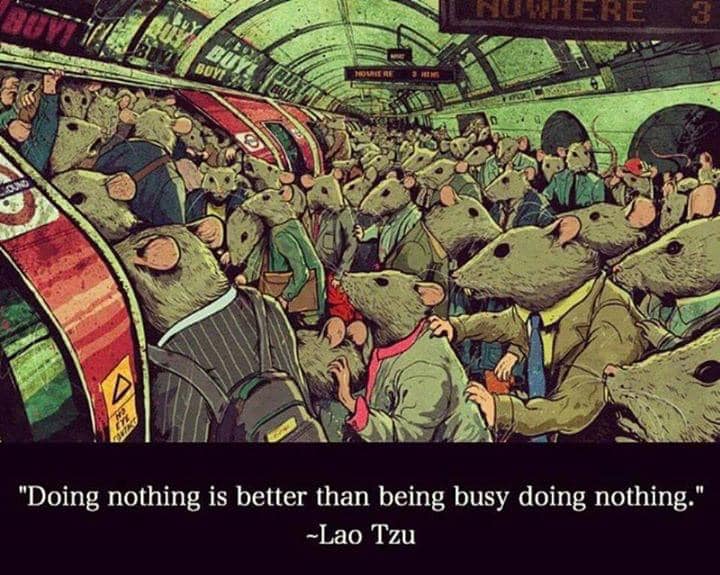
"This meme takes the quote "Doing nothing is better than being busy doing nothing" (Lao Tzu) and applies it to a chaotic subway scene featuring rats in suits. The satire suggests that in a capitalist society, 'productive' work is a distraction, implying that the most valuable time is actually when people do nothing."
simple-description (llama3.2-vision_11b)
The meme is a play on the concept of "doing nothing is better than being busy doing nothing," a phrase attributed to Lao Tzu. The image depicts a crowded subway car filled with people who are all dressed as rats, implying a satirical commentary on the monotony and drudgery of modern work.
detailed-analysis (gemma3-27b-vision)
Okay, here's an analysis of the image, broken down into sections addressing the requested theoretical frameworks, only when applicable. Given the image's satirical and somewhat absurdist nature, several of these lenses will be more fitting than others.
Visual Description
The image is a striking, cartoonish illustration, seemingly inspired by vintage advertising and political cartoons. The scene depicts a subway car entirely filled with rats dressed in human business attire. They wear suits, hats, and carry briefcases, all crammed together tightly, some holding onto the poles or overhead straps. The color palette is muted and grainy, leaning towards greens, browns, and grays, lending a slightly distressed, vintage feel. The composition is claustrophobic, emphasizing the sheer number of rats and the lack of personal space. The background shows blurred advertising billboards with the word "BUY" prominently featured. The overall effect is unsettling and darkly humorous, creating a sense of alienation and overwhelming conformity. Underneath the image is a quote from Lao Tzu, “Doing nothing is better than busy doing nothing.”
Foucauldian Genealogical Discourse Analysis
This image lends itself well to a Foucauldian analysis. The scene can be read as a depiction of disciplinary power. The rats, dressed as businessmen, are forced into a specific, tightly regulated space (the subway) and mode of behavior (commuting, conforming to the expectation of 'productivity'). They are being normalized - their natural rat behavior subjugated to a human capitalist system.
The focus isn't on a single oppressor, but on the systems that create this conformity. The subway itself is a technology of power, structuring and controlling movement and bodies. The crowdedness and lack of space can be seen as mechanisms of surveillance - a constant awareness of being watched and controlled by the unseen forces of the system. The fact that the rats are rats – inherently outside the human system – highlights the absurdity and alienation created by this forced conformity. The "busy doing nothing" line from Lao Tzu becomes ironic; they are engaging in a futile, automated activity in service of an abstract, power structure.
Critical Theory
The image critiques the alienation of modern life, particularly within a capitalist framework. The rats, representing the masses, are reduced to mere cogs in a machine, blindly following a pre-determined route (the commute) toward an unknown destination. This speaks to the Frankfurt School's concerns about the "culture industry" and its role in producing standardized, uncritical consumers. The rats aren't living; they're processing.
The saturation of advertising ("BUY") in the background emphasizes the relentless commodification of life. The image questions the purpose of all this activity. Is it genuinely meaningful, or is it simply a self-perpetuating cycle of consumption and production? The image suggests it's the latter. The quote by Lao Tzu further reinforces this critical view, urging a rejection of pointless busyness and a search for authentic meaning.
Marxist Conflict Theory
A Marxist interpretation sees the rats as a representation of the proletariat – the working class. They are crammed together, exploited in a system that benefits those not visibly present (the owners of the subway, the advertising companies, the overall capitalist structure). The lack of individuality and the sheer number of rats emphasizes the dehumanization inherent in capitalist production.
The rats' clothing (business suits) can be read as a false consciousness – an attempt to adopt the trappings of the bourgeoisie in order to participate in a system that will always keep them marginalized. The conflict isn’t shown within the image, but is implied – the conflict between the rat-proletariat and the unseen capitalist forces that control their lives. The quote underscores the futility of their efforts within this system.
Postmodernism
The image plays with the concept of simulation and hyperreality. The rats are pretending to be something they are not (human businessmen). This blurring of boundaries between reality and representation is characteristic of postmodern thought. The image suggests that modern life is increasingly characterized by surfaces, appearances, and the loss of genuine experience.
The satirical nature of the image, and its blending of different styles (vintage cartoon, social commentary), also aligns with postmodernism's rejection of grand narratives and its embrace of parody and pastiche. The quote by Lao Tzu, placed alongside this absurd imagery, adds to the sense of disorientation and fragmentation.
Queer Feminist Intersectional Analysis
This is the least directly applicable framework for this image, though some interpretations can be made. The sheer density of bodies and the lack of individuality could be seen as representing the pressure to conform to societal norms, particularly for marginalized groups. The lack of visible diversity among the rats (gender, race) could be interpreted as a critique of the way dominant power structures erase difference.
However, this analysis would require further extrapolation. It's not a primary focus of the image, and applying this lens feels somewhat forced.
Let me know if you'd like me to elaborate on any of these points, or explore a different theoretical lens!
tesseract-ocr
pe ed OF e = el e we _ [ss oe Re ee % IN BETS tice NASTY - et Les 7S? \ Re he < Nips Sr Ve 2 Le Ne ey eG Mae Ld a "Doing nothing is better than being busy doing nothing." ~Lao Tzu
simple-description (llama3.2-vision)
This meme features a chaotic and crowded subway scene, with a sea of people all dressed in business attire, but with one key difference: they all have the heads of rodents. The image is captioned with a quote from Lao Tzu, "Doing nothing is better than being busy doing nothing."