First Seen
2024-04-05T21:20:59.273061+00:00
simple-description (qwen3.5_2b-q8_0)
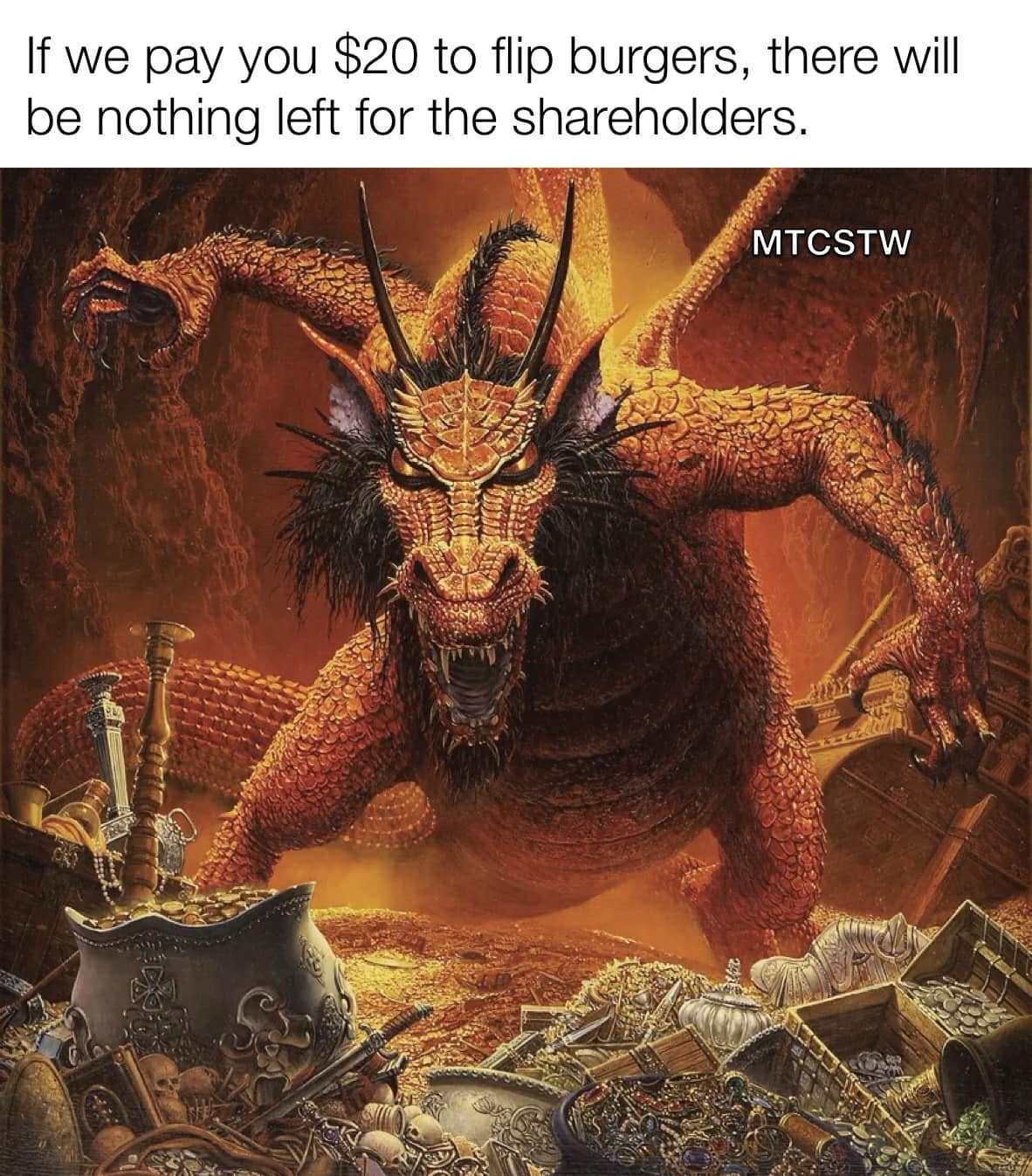
This meme depicts a massive dragon over a pile of treasure, while the text reads, "If we pay you $20 to flip burgers, there will be nothing left for the shareholders." The "MTCSTW" logo argues that the stock market is replacing real jobs with a tiny wage, leaving the workforce with nothing to do because the profits are gone. This critique suggests that the "real job" of flipping burgers has been removed, leaving workers with nothing to earn.
simple-description (llama3.2-vision_11b)
The meme is a satirical commentary on the excesses of capitalism, specifically the idea that corporations are only concerned with making profits for their shareholders, regardless of the impact on employees or the community. The image depicts a dragon hoarding treasure, with the text "If we paid you $20 to flip burgers, we'd be bankrupt in a week" above it, implying that the company's focus on shareholder value is unsustainable.
detailed-analysis (gemma3-27b-vision)
Okay, here's an analysis of the meme, broken down into the requested sections. Please note that the meme's framing is unusual (pairing a dramatic fantasy image with a claim about wage increases and shareholder value) so applying some of these theoretical lenses requires some interpretation and extrapolation.
Visual Description
The image depicts a large, imposing, and menacing dragon amidst a hoard of treasure. The dragon is rendered in shades of fiery orange and gold, suggesting heat, power, and wealth. It has intricate scales, large horns, and piercing eyes, radiating a sense of untamed force. The treasure pile is vast, overflowing with gold coins, jewels, goblets, chests, and even skulls, emphasizing the dragon’s control over material resources. The lighting is dramatic, creating strong shadows and highlights, further enhancing the dragon’s fearsome appearance. The composition centers the dragon as the dominant element, dwarfing the treasure and visually reinforcing its position of power.
Foucauldian Genealogical Discourse Analysis
The meme's text, "If we pay you $20 to flip burgers, there will be nothing left for the shareholders," operates as a discourse that constructs a specific relationship between labor, value, and the prioritization of financial interests. From a Foucauldian perspective, we can analyze how this statement produces a particular truth about economic responsibility.
- Power/Knowledge: The statement doesn't simply describe a reality; it actively creates a framework where shareholder value is positioned as inherently more deserving than fair wages for workers. It’s a claim presented as objective truth, justifying the suppression of worker compensation in the name of profit.
- Genealogy: Examining the historical roots of this discourse reveals that it is linked to the rise of shareholder primacy—the idea that corporations exist primarily to maximize returns for shareholders. This wasn't always the dominant paradigm; it emerged over time through legal decisions, economic theories, and business practices. The meme participates in reinforcing this historical trajectory.
- Discipline: The statement disciplines through a threat—implying that increasing wages (even to a modest $20/hour) will lead to economic ruin for those who deserve the profits. It subtly constructs a narrative of scarcity, suggesting that there isn’t enough to go around without maintaining existing power structures.
Marxist Conflict Theory
This meme is a nearly perfect illustration of core Marxist concepts:
- Class Struggle: The meme explicitly highlights the conflict between the bourgeoisie (shareholders, representing the owners of capital) and the proletariat (workers flipping burgers). The statement frames any attempt to redistribute wealth to labor as a direct threat to the interests of the owning class.
- Exploitation: Implicitly, the meme assumes that the current wage structure is already exploitative. The idea is that a slight increase in pay is somehow unsustainable, suggesting that the current level of profit depends on suppressing worker compensation.
- Surplus Value: The profit shareholders receive is, in Marxist terms, surplus value—the difference between the value created by workers and the wages they receive. The meme indicates that any attempt to claim a larger share of this surplus value for workers is unacceptable.
- Alienation: The “burger flipping” job is presented as a menial task, stripped of any meaningful purpose beyond generating profit for others. This reinforces the Marxist concept of alienation, where workers are separated from the products of their labor and from their own creative potential.
Postmodernism
The meme’s pairing of a medieval fantasy image with a modern economic argument is inherently postmodern. It blurs the boundaries between seemingly disparate domains—fantasy and finance, mythology and capitalism.
- Pastiche and Irony: The image of the dragon, historically associated with greed and hoarding treasure, is used as a visual metaphor for the shareholders. This is a form of pastiche—a playful, ironic blending of cultural references.
- Deconstruction of Metanarratives: The meme implicitly challenges the dominant "metanarrative" of trickle-down economics or the inherent goodness of capitalism. It presents a cynical view of economic priorities, suggesting that profit is valued above all else, even basic human needs.
- Simulacra and Simulation: The image of the dragon isn’t a real representation of shareholders. It's a simulacrum—a copy without an original—that evokes a particular set of associations and emotions. The meme operates on the level of symbols and representations, rather than objective truth.
Critical Theory
The meme serves as a potent example of how ideology operates to maintain existing power structures.
- Ideology: The statement, “If we pay you $20 to flip burgers, there will be nothing left for the shareholders”, is not a neutral economic observation; it’s an ideological claim. It naturalizes the prioritization of shareholder interests as inherently justifiable, framing any attempt to improve worker wages as a threat.
- Hegemony: The meme taps into the hegemonic belief that profit maximization is the primary goal of businesses. By presenting this as a self-evident truth, it reinforces the existing power structures and discourages critical questioning of the economic system.
- Commodification: The “burger flipping” job is reduced to a commodity—a means to an end (profit) rather than a meaningful form of work. This commodification is characteristic of capitalist systems, where everything is valued in terms of its exchange value rather than its intrinsic worth.
Queer Feminist Intersectional Analysis (A bit of a stretch, but possible)
While not immediately obvious, a queer feminist intersectional lens can uncover some subtle dimensions:
- Exploitation and Marginalization: The "burger flipping" job is likely held disproportionately by marginalized groups—women, people of color, LGBTQ+ individuals—who are already facing systemic inequalities. The meme’s prioritization of shareholder value can be seen as perpetuating this cycle of exploitation and marginalization.
- Devaluation of Labor: The assumption that even a modest increase in wages is “unsustainable” reflects a broader societal tendency to devalue work that is traditionally performed by women and people of color.
- Deconstruction of Normative Economics: The meme challenges the normative assumptions of mainstream economics, which often ignores the social and emotional costs of prioritizing profit over people. A queer feminist perspective would emphasize the importance of valuing all forms of labor, and of creating economic systems that are more just and equitable.
Let me know if you'd like me to elaborate on any of these sections, or if you'd like me to apply different theoretical frameworks.
tesseract-ocr
If we pay you $20 to flip burgers, there will be nothing left for the shareholders. ; ar ri re ai ee e hoe ee | Ue 2 ee ee Re eee a od FN) * 3 IRs Ze ah 4s ee Me See Rh ee Se Hs rae tne ES TS Bnet ie ae ae |< . DM - RN OE ae in Ss Fr Ph a e SS Mig) 2 3 : " ee - ee ch a oe By pe NS eee oe RN yt od mec oft HES ACLS Na 2 WA “a SE oe we doe GRAN alec aN: &
simple-description (llama3.2-vision)
This meme is a humorous image that juxtaposes a fantastical creature, a dragon, with a mundane scenario. The text above the image reads: "If we pay you $20 to flip burgers, there will be nothing left for shareholders." The image itself depicts a dragon standing amidst a treasure hoard, surrounded by gold, jewels, and other precious items. The dragon appears to be enjoying its spoils, with a satisfied expression on its face.