First Seen
2024-05-26T03:01:25.414124+00:00
simple-description (qwen3.5_2b-q8_0)
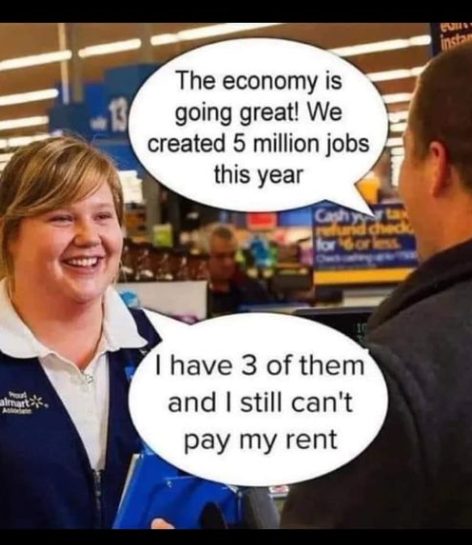
This meme critiques the capitalist system by contrasting a narrative of economic success with a personal tragedy. The top bubble claims millions of jobs were created, suggesting the economy provides free labor for billions, while the bottom bubble reveals that the employee is actually unemployed. It highlights the absurdity of a world where the economy tells you there are plenty of jobs for everyone, yet a single individual remains unable to pay rent.
simple-description (llama3.2-vision_11b)
The meme is a humorous take on the idea that the economy is doing well, but the speaker is still struggling to make ends meet. The image shows a person responding to a news headline about the economy, saying "The economy is doing great, I just can't afford to pay my rent."
detailed-analysis (gemma3-27b-vision)
Okay, let's break down this meme using the requested theoretical frameworks. Note that some frameworks will be more relevant than others, and I will indicate where a section isn't particularly strong due to the meme's limited scope.
Visual Description
The image features a woman wearing a Walmart uniform, smiling brightly while operating a self-checkout machine. Above her head is a speech bubble stating, "The economy is great! We created 5 million jobs this year." Beneath the woman, seemingly emanating from a customer utilizing the self-checkout, is another speech bubble: “I have 3 of them and still can’t pay my rent.” The setting is within a Walmart store, with shelves of merchandise visible in the background. The color palette is typical of Walmart – bright, functional, and slightly sterile. The overall composition presents a sharp juxtaposition between the proclaimed economic success and the lived experience of financial precarity.
Marxist Conflict Theory
This meme is deeply rooted in Marxist conflict theory. It visually represents the core tension inherent in capitalist systems: the exploitation of labor. The "5 million jobs created" represents capital accumulation for the owners of capital (Walmart, in this case), while the customer’s statement (“I have 3 of them and still can’t pay my rent”) reveals the reality of wage stagnation and the increasing gap between productivity and wages.
- Class Struggle: The meme embodies a micro-level depiction of class struggle. The smiling Walmart employee represents the face of the system proclaiming its success, while the customer represents the working class experiencing the consequences of that success not being shared.
- Alienation: The customer’s reliance on multiple jobs for survival is indicative of alienation from the product of their labor. They are working, but the fruits of their labor are insufficient to cover basic needs. The self-checkout, arguably, adds to this alienation, removing human interaction and highlighting the commodification of labor.
- Surplus Value: The meme subtly implies the extraction of surplus value. Walmart profits from the labor of its employees, and the customer's struggle to make ends meet suggests this profit comes at the expense of fair compensation.
- False Consciousness: The proclaimed “great economy” could be seen as part of a larger ideology used to maintain the status quo. The proclamation hides the very real struggles of many workers, potentially creating a false consciousness about the actual conditions of economic life.
Foucauldian Genealogical Discourse Analysis
This meme can be analyzed through a Foucauldian lens by examining the discourses surrounding work, economic success, and poverty.
- Power/Knowledge: The assertion that the economy is "great" is not an objective truth but a statement of power/knowledge. Those who define economic success (like corporations and policymakers) control the narrative, and this narrative shapes how we understand and experience the economy. The customer’s response challenges this discourse, offering a counter-narrative based on lived experience.
- Discipline: The multiple jobs held by the customer can be seen as a form of disciplinary power. The worker is compelled to work increasingly long hours and take on multiple roles simply to survive, reflecting the pressures of neoliberal economic policies.
- Genealogy of "Work": We could trace the historical development of the concept of "work" and how it has evolved to become tied to concepts of individual responsibility and moral worth. The meme challenges this connection by suggesting that even those who work diligently can still fall into poverty.
- Biopower: The meme, while subtle, highlights how economic systems affect the very conditions of life and survival, exerting power over the population's bodies and their ability to sustain themselves.
Critical Theory
This meme aligns with critical theory's concern with uncovering systems of domination and revealing how these systems are maintained through ideology and cultural norms.
- Ideology: The "great economy" statement is a clear example of ideology – a set of beliefs that serve to legitimize and maintain the existing power structure. It masks the underlying inequalities and injustices of the capitalist system.
- Commodification: The self-checkout machines underscore the commodification of labor. Work is reduced to a transaction, and the human element is removed.
- Rationalization: The focus on quantifiable metrics like “5 million jobs” reflects the rationalization of economic life, where everything is measured and optimized for efficiency and profit. However, this process often disregards the social and human costs.
- Domination: The meme subtly suggests the dominance of economic interests over the well-being of individuals. The customer is trapped in a cycle of work, despite their efforts, highlighting the power of the system to control their lives.
Postmodernism
While the meme doesn't fully embody postmodernism, elements can be identified.
- Deconstruction: The meme implicitly deconstructs the narrative of economic success. It challenges the idea that aggregate statistics accurately reflect the lived experiences of individuals.
- Irony: There's a layer of irony present in the juxtaposition of the two statements. The cheerful assertion of economic prosperity is undercut by the stark reality of the customer’s situation.
- Fragmentation: The meme fragments the dominant narrative, presenting a counter-narrative from the perspective of the working class.
- Hyperreality: While not prominent, the “great economy” statement could be viewed as a constructed reality, a hyperreal representation divorced from the material conditions of life.
Queer Feminist Intersectional Analysis
This framework is the least applicable to the meme as presented. However, intersectional analysis could be used to consider who is most likely to be holding those three jobs and unable to pay rent.
- Intersectionality: The customer could be a member of a marginalized group (e.g., a single parent, a person of color, a member of the LGBTQ+ community) who faces systemic barriers to economic opportunity. These barriers compound their economic vulnerability.
- Care Work: A queer feminist lens might emphasize the unpaid or underpaid care work often disproportionately performed by women and LGBTQ+ individuals, leaving them with fewer resources to participate in the formal economy.
- Precarity: The meme highlights the precarity of working-class life, particularly for those who face multiple forms of discrimination and oppression.
- Gendered Economics: While not explicit in the meme, economic precarity often disproportionately impacts women and gender non-conforming individuals, who are often concentrated in low-wage jobs.
I hope this breakdown provides a thorough analysis of the meme through the requested theoretical frameworks! Let me know if you'd like me to elaborate on any particular aspect.
tesseract-ocr
i a The economy is “yam a mi goinggreat!We aia created 5 million jobs E 4 Vy i this year i ~ ~\a Paris a’ io 2. So > ae oo pe — e 7 ’| have 3 of them rs and | still can't la pay my rent fo
simple-description (llama3.2-vision)
This meme is a humorous exchange between a Walmart employee and a customer. The employee says, "The economy is doing great, we just created 5 million jobs this year," to which the customer responds, "I have 3 of them and I still can't pay my rent." The customer's sarcastic comment highlights the irony of the employee's optimistic statement, implying that the economy's success is not translating to individual financial stability.