First Seen
2023-07-21T09:46:09+00:00
simple-description (qwen3.5_2b-q8_0)
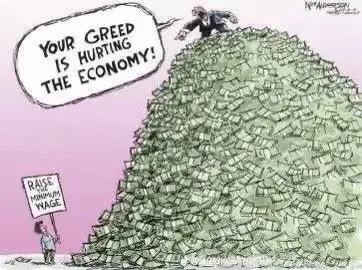
This anti-capitalist cartoon mocks the wealthy for dismissing labor demands. A massive pile of money, representing capital, mocks a worker holding a "RAISE MINIMUM WAGE" sign by claiming they are guilty of "YOUR GREED IS HURTING THE ECONOMY!" The image argues that demanding higher wages is a form of greed that threatens the broader economy.
simple-description (llama3.2-vision_11b)
This meme depicts a person holding a sign that says "I'd rather be unemployed and poor than work for $7/hour" in front of a giant pile of money. The image is a commentary on the struggles of low-wage workers and the exploitation of the working class by the wealthy. The text on the sign is a sarcastic statement that highlights the absurdity of being forced to choose between poverty and exploitation.
detailed-analysis (gemma3-27b-vision)
Okay, let's break down this political cartoon through several theoretical lenses.
Visual Description
The cartoon depicts a stark contrast in scale. A small female figure is shown standing with a protest sign reading “Raise the Minimum Wage.” In the background, a massive, towering pile of money (represented by stacks of banknotes) dominates the frame. On top of this pile of money stands a silhouetted figure of a man in a suit (presumably a wealthy or powerful figure). A speech bubble above the man states "Your greed is hurting the economy!". The background is a muted pink or purple. The artwork is a simple, black-and-white sketch with shading for emphasis. The overall impression is one of extreme disparity and a critique of wealth concentration.
Marxist Conflict Theory
This cartoon is strongly aligned with Marxist conflict theory.
- Class Struggle: The image fundamentally illustrates class struggle. The small, protesting woman represents the working class, specifically those earning minimum wage, while the man atop the mountain of money symbolizes the capitalist/bourgeoisie class.
- Exploitation: The mountain of money inherently represents the surplus value extracted from the labor of the working class. This surplus value, according to Marx, is the source of capitalist profit and the foundation of inequality.
- Capital Accumulation: The sheer size of the money pile demonstrates the principle of capital accumulation – the drive of capitalism to constantly increase wealth in the hands of a few.
- False Consciousness/Critique of the System: The man's statement – "Your greed is hurting the economy!" – can be interpreted as ironic. Marxists would argue that the system itself, driven by greed and the pursuit of profit, inherently creates economic instability and harm. The statement is projecting blame onto a presumed external force ("your greed") rather than acknowledging the inherent contradictions within the capitalist system.
Critical Theory
This cartoon also engages with themes central to Critical Theory (rooted in the Frankfurt School).
- Power Dynamics: The disproportionate size of the figures and the mountain of money visually emphasize the vast power imbalance between the wealthy elite and the working class.
- Ideology: The statement from the man on top of the pile is a form of ideological maneuvering. It attempts to shift the blame for economic problems away from the systemic issues of wealth concentration and onto the supposed “greed” of others. It’s a rhetorical tactic to maintain the status quo.
- Domination & Oppression: The image suggests a system of domination where the wealthy control resources and exert power over those at the bottom. The working class is symbolically “underneath” the weight of capital.
- Critique of Reason: The cartoon could be read as a critique of the “rational” pursuit of profit at the expense of social and economic justice.
Foucauldian Genealogical Discourse Analysis
A Foucauldian reading focuses on the discourses at play in the cartoon.
- Discourse of Economic Growth: The mountain of money itself is a visual representation of the dominant discourse around economic growth. This discourse often prioritizes accumulation of wealth as the primary measure of success, ignoring social and environmental costs.
- Discourse of Blame: The man’s statement ("Your greed is hurting the economy!") demonstrates a discourse of blame, which serves to normalize the system and deflect attention from the structures of power.
- Power/Knowledge: The image implies that those in power (represented by the man on the pile) control the narrative. They are able to shape the discourse and define what is considered “greedy” or “harmful” to the economy.
- Genealogy: A genealogical analysis might examine the historical evolution of the concept of "greed" and how it has been used to justify or obscure economic inequality. The cartoon challenges the conventional understanding of greed by highlighting how the system itself is based on an insatiable drive for profit.
Postmodernism
While not as central as the above theories, a postmodern reading could focus on:
- Deconstruction of Narratives: The cartoon deconstructs the traditional narrative of economic progress, revealing the underlying power dynamics and inequalities.
- Rejection of Grand Narratives: It questions the notion of a universal "economy" and suggests that economic systems are constructed and contested, not neutral or objective.
- Focus on Representation: The image itself is a form of representation that challenges the dominant ways of seeing and understanding economic issues.
Queer Feminist Intersectional Analysis
While not immediately apparent, an intersectional analysis could be applied. It’s important to note that the cartoon doesn't explicitly depict gender or sexuality.
- Representation & Marginalization: The small, female figure protesting can be read as highlighting how marginalized groups (women, low-wage workers, people of color) disproportionately bear the brunt of economic inequality. The image can be linked to the feminist idea that care work and low-wage jobs are often dominated by women.
- Intersection of Class and Gender: The cartoon implicitly points to the intersection of class and gender. Women are statistically more likely to earn lower wages and be trapped in precarious employment.
- Critique of Power Structures: Intersectional feminism would focus on how the systems of power that create economic inequality are interconnected with other forms of oppression, such as sexism and racism.
- The figure of the protestor is implicitly othered: Given the lack of visual detail, her marginalized position is heightened against the silhouette of power.
I hope this detailed breakdown is helpful! Let me know if you'd like me to elaborate on any of these theoretical lenses.
simple-description (llama3.2-vision)
This meme is a humorous illustration of a wealthy person on a mountain of cash, with a speech bubble saying "Your greed is killing the economy!" A smaller figure at the base of the mountain is holding a sign that reads "Raise the minimum wage". The image is meant to be ironic, implying that the wealthy person's greed is the root of economic problems, and that increasing the minimum wage would help address these issues.
tesseract-ocr
REED Pe ‘ f yor? Gane ot! “gee Fae 9 EconON faite ee at (deh as & Gee ie oT eR Re Sirs ee oe eee. oe eet, fea Ae (| Pee ep ail Bie aaa as << ae oe ree