First Seen
2023-05-10T20:59:59+00:00
simple-description (llama3.2-vision_11b)
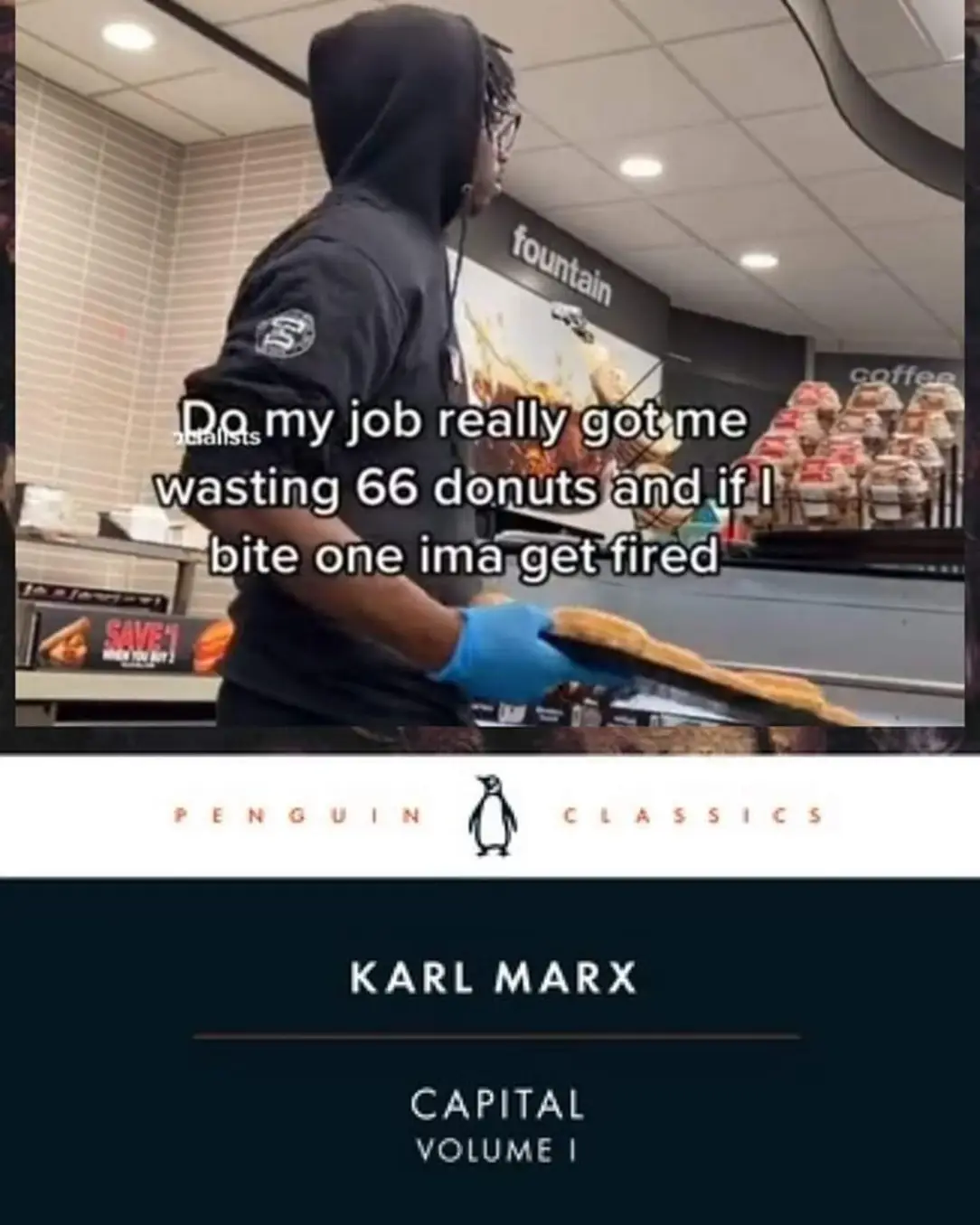
This meme is a commentary on the exploitation of workers in capitalist systems. The image shows a person in a fast food job, with the text "I got fired for eating 1 donut" implying that the worker is being punished for a minor infraction, highlighting the absurdity of a system where workers are penalized for minor mistakes.
detailed-analysis (gemma3-27b-vision)
Okay, here's an analysis of the image provided, broken down into the requested theoretical frameworks, focusing on those that truly apply to the content. I'll explain why certain frameworks are less relevant.
Visual Description
The image is a TikTok screenshot superimposed over the cover of Karl Marx's Capital, Volume I. The TikTok screen shows a person wearing a hoodie, appearing to be an employee in a Dunkin’ Donuts. They are looking down at a display case filled with donuts. A gloved hand reaches into the display case, presumably towards the donuts. Overlaid text reads, "Do my job really got me wasting 66 donuts and if I bite one ima get fired." The overall aesthetic is a stark juxtaposition of labor and theoretical critique.
Marxist Conflict Theory
This image is highly relevant to Marxist conflict theory. Here’s how:
- Alienation of Labor: The core of the image demonstrates alienation. The worker isn't connected to the product of their labor (the donuts). They are witnessing and participating in systematic waste, a direct result of the demands of a capitalist system aiming for overproduction and profit. This disconnect from the value they create is a key tenet of Marx's argument.
- Exploitation: The worker’s fear of being fired for taking a single donut speaks to the exploitative nature of labor under capitalism. The sheer quantity of wasted product (66 donuts) highlights the prioritisation of profit over the basic needs of potential consumers and the worker’s own needs. The worker doesn't have access to the value they are surrounded by.
- Class Struggle: The contrast of the everyday labor of a Dunkin' employee with the intellectual work of Marx (represented by the book cover) implicitly points to class struggle. The worker is part of the proletariat, and the waste represents the excesses of the capitalist class. The image invites us to consider the unequal distribution of wealth and power.
- Commodification of Food/Waste: The donuts, while a source of potential nourishment, are treated as disposable units of profit. Their value is tied only to sale, not to their nutritional value. The immense waste is a symptom of a system driven by overproduction and disposable consumerism.
Foucauldian Genealogical Discourse Analysis
This framework is relevant but needs careful application.
- Discipline and Surveillance: The fear of getting fired for taking a single donut highlights the mechanisms of power/knowledge described by Foucault. The worker is under constant (implied) surveillance. The threat of punishment (job loss) disciplines their behaviour and reinforces the power dynamics of the workplace.
- The “Normalizing” Gaze: The expectation that the worker shouldn’t take even one donut, despite the enormous waste, is a form of normalization. It establishes a standard of behaviour that serves the interests of the employer.
- The Discourse of Value: The way the donuts are treated (as waste, as potential profit, as forbidden fruit for the worker) demonstrates a specific discourse of value. This discourse shapes how we understand the relationship between labor, production, and consumption.
- Genealogy of Waste: A genealogical approach could explore how the practice of overproduction and planned obsolescence (leading to donut waste) came to be accepted as standard business practice. This requires tracing the historical development of economic systems and the ideologies that support them.
Critical Theory
Critical theory, broadly, builds on Marxist ideas and offers a relevant lens.
- Critique of Instrumental Reason: The image implicitly critiques the pursuit of efficiency and profit at the expense of human needs and ethical considerations. The overproduction of donuts is a result of prioritizing instrumental reason (maximizing profit) over other values.
- Domination and Control: The worker’s fear and the waste itself demonstrate the dynamics of domination and control inherent in capitalist systems.
- Culture Industry: (A more nuanced link) Could be seen to connect to the "culture industry". Dunkin' Donuts creates desires (for donuts) and the worker is trapped in a system of producing and discarding those desires.
Why certain frameworks are less relevant:
- Postmodernism: While postmodernism deals with fragmentation and deconstruction, the image doesn’t inherently lend itself to that analysis. It’s not about a questioning of grand narratives or a celebration of simulacra; it’s about a concrete socio-economic issue. While some could attempt to apply it, it feels forced.
- Queer Feminist Intersectional Analysis: This framework focuses on the overlapping systems of oppression based on gender, sexuality, and other social categories. While it’s possible to add a layer of analysis connecting the worker's potentially marginalized identity to their exploitation, the image itself doesn’t primarily speak to these issues. A queer feminist analysis would need additional context beyond what’s presented in the image.
Let me know if you'd like me to elaborate on any of these points or explore a different angle!
simple-description (llama3.2-vision)
This meme is a humorous image of a person in a fast food restaurant, wearing a name tag that says "I'm not arguing, I'm just explaining why I'm right." The text overlay reads, "I'm not arguing, I'm just explaining why I'm right."
tesseract-ocr
7 ae a) — a.my job really,gotyme ase ' wasting 66 Tus hl eal] == Pi Cwent Tanke las Gia = PEO Rie el a KARL MARX CAPITAL VOLUME |