First Seen
2025-07-11T20:19:28+00:00
detailed-analysis (gemma3_27b-it-q8_0)
Okay, let's break down this image through the lens of "Anti-Capitalism - Minimum Wage" using the requested theoretical frameworks where applicable.
Visual Description
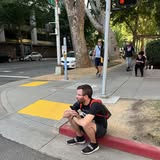
The image depicts a man sitting on a curb, appearing somewhat dejected. He's wearing casual clothing, a backpack, and looking off into the distance. He’s positioned on the edge of a sidewalk, near a crosswalk with yellow tactile paving for the visually impaired, and a busy street with cars in the background. The scene suggests a public space, likely urban. The overall feeling is one of quiet desperation or exhaustion. The mundane setting and his everyday appearance make his situation relatable.
Marxist Conflict Theory
This image is strongly resonant with core tenets of Marxist Conflict Theory.
- Alienation: The man’s posture and gaze suggest alienation from the surrounding environment and possibly from his own labor. Marx argued that capitalism alienates workers from the products of their labor, from the process of labor, from other workers, and from their own human potential. Sitting alone on a curb suggests this separation.
- Class Struggle: The image implicitly highlights the power dynamic between capital and labor. He may be waiting for work, or have just finished a shift. It is a visual representation of those struggling to navigate the demands of a system built to extract surplus value from their work.
- Exploitation: A low (minimum) wage, is a means by which workers are exploited - receiving far less value for their labour than the value they create. The man's posture may represent a kind of resignation to that exploitation.
- The Reserve Army of Labor: The presence of the busy street and other pedestrians hints at the wider labour market. The man’s situation could represent one of many in the ‘reserve army of labour’ – those readily available to be employed at low wages, keeping overall wages suppressed.
Critical Theory
Applying a Critical Theory lens:
- Dominant Ideology: The image challenges the dominant ideology that frames work as inherently fulfilling or that economic success is solely determined by individual effort. The man’s posture suggests the limitations imposed by systemic economic structures.
- Power Dynamics: Critical theory focuses on how power operates in society. The image demonstrates the power that economic systems (and those who control them) have over individuals, dictating their ability to meet basic needs.
- Emancipation: While the image is depressing, it can be interpreted as a call for emancipation from oppressive structures. It encourages viewers to question the norms that lead to situations like this, prompting reflection and potential action towards economic justice.
Foucauldian Genealogical Discourse Analysis
Foucault's work analyzes how power operates through discourse and institutions. Here's how it applies:
- Discipline & Biopower: The image speaks to the ways in which neoliberal capitalism disciplines individuals. The requirement to work, even at a minimum wage, contributes to a form of "biopower"—the regulation of life and bodies by the state and capitalism. This man's existence is shaped by the demands of this system.
- Normalization: Sitting on a curb, possibly because of economic hardship, becomes normalized in a society that accepts economic inequality as inevitable. Foucault would argue that the very acceptance of minimum wage as an acceptable standard is a result of disciplinary power.
- Genealogy of the Minimum Wage: Examining the historical development of the minimum wage itself—how it was conceived, contested, and implemented—could reveal the power dynamics and discourses that shaped its current form. A genealogical approach would question why the minimum wage is so low and the rationale behind its limitations.
Postmodernism
Postmodernism is less directly applicable, but we can consider it:
- Deconstruction of Grand Narratives: Postmodernism challenges “grand narratives” like the idea of progress or the inherent goodness of capitalism. The image offers a counter-narrative, suggesting that the promise of economic prosperity is not universally realized.
- Subjectivity and Relativism: The image invites individual interpretation. There is no single “truth” about the man's situation. It could be caused by a multitude of factors beyond just the minimum wage.
- Fragmentation: The image reflects the fragmentation of modern life – the individual isolated in an urban environment.
Queer Feminist Intersectional Analysis
While not immediately obvious, an intersectional lens adds complexity.
- Marginalization: Individuals who also experience marginalization based on race, gender, sexual orientation, or disability are likely to be disproportionately affected by low wages and economic insecurity. The man's specific identity is unknown, but recognizing that these intersections exist is vital. A Black man, a transgender woman, or a disabled worker would likely face additional systemic barriers.
- Gendered Labour: The labour market is gendered – with women historically concentrated in low-paying jobs.
- Precarious Work: Minimum wage jobs are often characterized by instability, lack of benefits, and limited opportunities for advancement. This precarity disproportionately impacts marginalized communities.
In conclusion, this image is a potent visual statement about the realities of living under capitalism. It speaks to alienation, exploitation, and the power dynamics that shape our economic lives. While the man's specific story is unknown, his posture and the setting invite us to critically examine the social and economic systems that contribute to such moments of quiet desperation. The strength of the image comes from its relatable simplicity.
simple-description (llama3.2-vision_11b)
The meme is a photo of a man sitting on the sidewalk, looking dejected. The image is captioned "When you realize the minimum wage is not enough to live in the city you want to live in".
detailed-analysis (gemma3-27b-vision)
Okay, here's an analysis of the image, broken down into sections based on the theoretical frameworks you requested. Note that some frameworks may be more relevant or lend themselves to a stronger analysis than others, given the image's content.
1. Visual Description
The image depicts a man seated on a red concrete barrier at a street corner. The man is wearing athletic shorts, a black shirt, and running shoes. He's looking to the side, appearing to be occupied with something on his phone. The barrier is part of a pedestrian crosswalk, with visible yellow pavement markings. In the background are trees, a street, parked cars, a streetlamp, and a traffic light. There are also pedestrians walking in the background. The time of day appears to be late afternoon/early evening based on the lighting. The setting seems urban, potentially a residential or commercial street.
2. Foucauldian Genealogical Discourse Analysis
This image lends itself well to a Foucauldian reading. We can analyze the discursive formation around the concept of "public space" and "waiting/leisure."
- Power/Knowledge: The infrastructure – the street, the curb, the crosswalk, the traffic light – all represent systems of power and control. The man's position within this infrastructure, waiting, illustrates how these systems shape and regulate behavior. He's not "disrupting" anything, but his positioning suggests a negotiation with the structures meant to control movement and time.
- Genealogy: Examining the historical development of pedestrian infrastructure and urban planning could reveal how concepts of public space have evolved. For example, the rise of the automobile influenced street design, impacting pedestrian experience. This image captures a moment within that historical trajectory.
- Discipline and Surveillance: While not explicitly visible, the potential for surveillance (streetlights, possible cameras) operates as a subtle form of control. The man's position is visible, meaning he's subject to the gaze of others (and potentially, authorities).
- Normalization: The image might appear commonplace, but it normalizes a certain type of urban existence. Sitting on a concrete barrier isn’t explicitly forbidden, but it’s also not designed for. It's an adaptation, a coping mechanism within a prescribed environment.
3. Critical Theory
Critical Theory, specifically drawing on the Frankfurt School, examines how power structures create and maintain societal inequalities.
- Alienation: The man sitting on the curb can be interpreted as a symptom of modern alienation. He’s physically present in a public space but seemingly disconnected, absorbed by his phone. This disconnection reflects the broader alienation inherent in capitalist systems where individuals are often reduced to consumers and functional units.
- The Culture Industry: His phone usage points to the role of the "culture industry" in shaping his experience. The content on his phone, driven by commercial interests, occupies his attention and potentially distracts him from a more direct engagement with his surroundings and other people.
- Commodification of Time: The fact that he is “killing time” waiting, potentially for something, can be seen as indicative of the commodification of time within a capitalist framework. Time isn’t experienced as inherently meaningful, but as something to be used productively or filled with consumption.
4. Marxist Conflict Theory
A Marxist analysis would focus on the class dynamics potentially embedded in the image.
- Spatial Inequality: The access to (or lack of) comfortable seating, rest areas, or public amenities can be indicative of spatial inequality. If this is a relatively affluent area, the lack of such amenities might reflect a prioritization of vehicle traffic and commercial interests over pedestrian comfort.
- Commodification of Public Space: The very organization of the street corner, with its focus on vehicle traffic and commercial activity, demonstrates the commodification of public space. It's less a space for people and more a space through which people move to consume or work.
- Labor and Leisure: The man’s activity (waiting, potentially after work or before another activity) highlights the relationship between labor and leisure in a capitalist system. Leisure time is often limited and shaped by the demands of work.
5. Postmodernism
A Postmodern reading would emphasize the fragmentation and ambiguity within the image.
- Simulation & Hyperreality: The man's engagement with his phone could be seen as an immersion in a "simulacrum" – a copy without an original. He's experiencing a mediated reality, disconnected from the “real” environment around him.
- Deconstruction of Meaning: The image itself lacks a single, coherent meaning. The viewer is invited to project their own interpretations onto the scene, and the image resists a definitive reading.
- Loss of Grand Narratives: The image doesn't offer a "grand narrative" or overarching truth. It's a fragmented moment in time, devoid of inherent significance.
6. Queer Feminist Intersectional Analysis
This framework is the least directly applicable without further context. However, we can consider:
- Spatial Politics: The design of public space often disproportionately serves certain demographics (e.g., able-bodied, affluent). Analyzing how this corner doesn’t accommodate diverse needs (e.g., seating for elderly, accessibility for disabled) can reveal biases embedded in urban planning.
- Gendered Space: How does the design of this street corner implicitly reinforce gender norms? Are there safety concerns that might affect women or gender-non-conforming individuals differently?
- Intersectionality: Without further information about the man, it's difficult to apply an intersectional analysis. However, the image invites us to consider how his experience is shaped by his multiple social identities (race, class, gender, sexuality, ability).
Let me know if you’d like me to elaborate on any of these points or focus on a specific theoretical framework in more detail!
simple-description (llama3.2-vision)
The meme depicts a man sitting on a curb, looking dejected and defeated. The image is captioned "When you're 30, still live in your parents' basement, and your only job is to sit on the curb and look sad." The meme is likely meant to be humorous and relatable, poking fun at the idea of being an adult who is still living with their parents and having a job that is not very fulfilling.