First Seen
2025-07-11T20:19:29+00:00
simple-description (qwen3.5_2b-q8_0)
The meme "Anti-Capitalism - Minimum Wage" satirizes the political idea that government intervention is impossible without actually paying workers their living wage. It suggests you can't have a free-market capitalist system where everyone gets rich; otherwise, workers would starve and society collapses.
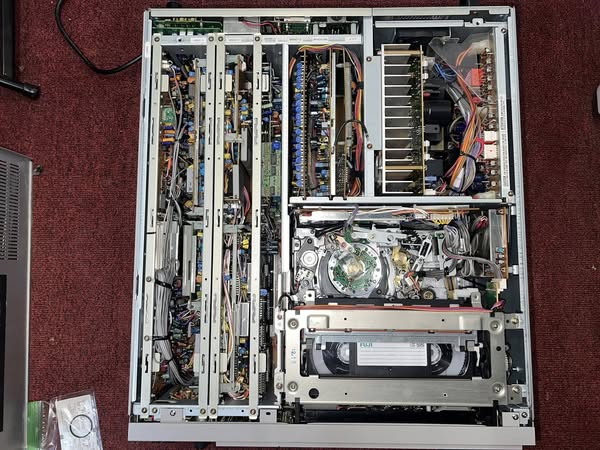
When applied to this image, the humor comes from imagining trying to run such an expensive piece of computer hardware ("anti-capitalism") while also having to pay engineers for their time (minimum wage). This older-looking motherboard features integrated audio-visual circuitry (indicated by the blue capacitors) and a VHS tape player slot at the bottom right. The joke is that just as you can't eliminate private profit entirely without spending money, you can't make this complex electronic system work without paying for its parts—like the expensive component in the silver tray labeled "M2754".
detailed-analysis (gemma3_27b-it-q8_0)
Okay, let's break down this image – an open computer case revealing a dense, complex interior – through an anti-capitalist lens focused on minimum wage. It's a surprisingly potent visual metaphor.
Visual Description
The image depicts the interior of an older computer. It’s not sleek or modern; it’s a chaotic arrangement of circuit boards, wires, drives, slots, and connectors. Everything is densely packed together. It appears highly complex and intricate, but simultaneously, somewhat dated and possibly fragile. There's a floppy disk drive and CDs on the floor, further indicating the age of the system. The red carpet underneath offers a stark contrast to the metallic interior, grounding the technical chaos. The overall impression is overwhelming complexity.
Marxist Conflict Theory
This image functions as a powerful metaphor for the modern labor market, particularly regarding minimum wage.
- The Machine as Capital: The computer represents capital – the means of production. It embodies the investment, technology, and infrastructure that drive economic activity. It's a tool that creates value.
- The Internal Complexity as Abstracted Labor: The chaotic internal workings represent the abstracted labor of countless individuals. Each component, wire, and connection is the result of someone's labor – design, manufacturing, assembly, logistics, etc. However, the final product (the computer) obscures the specific, concrete contributions of these workers. The complexity is there, but the specific labor that created it is largely invisible to the end-user.
- Minimum Wage and the "Hidden" Labor: Minimum wage workers are positioned as the “wires” and “connectors” – essential components for the system to function, but often unseen, undervalued, and disposable. They contribute to the overall functionality and profit, but their individual contributions are minimized and their compensation is disproportionately low compared to the value they generate. The image highlights that even a seemingly simple end-product (a functioning computer) relies on a vast network of labor, much of which is underpaid and exploited.
- Surplus Value: The difference between the value created by the computer (its sale price) and the total cost of labor and materials is surplus value, which is appropriated by the owners of capital. The image emphasizes the scale of this surplus value—the inherent inequality within the system. The intricacy of the components screams “value,” while the implied undervaluation of the labor required to create it speaks to exploitation.
- Alienation: The worker is alienated from the product of their labor. They don’t see the entire machine, nor do they directly benefit from its success. They’re a small, almost anonymous component in a massive system, reducing worker agency.
Critical Theory
Building on the Marxist framework, a Critical Theory approach helps us understand why this situation persists.
- Instrumental Rationality: The computer's design embodies instrumental rationality – an emphasis on efficiency, calculability, and control. Capitalism, according to critical theorists like Horkheimer and Adorno, prioritizes this kind of rationality to the detriment of other values (e.g., human dignity, fairness). The machine functions optimally only by maximizing efficiency, often at the expense of worker well-being.
- Commodification: Everything within the computer, including the labor it represents, has been commodified – reduced to an exchangeable value in the market. This process dehumanizes labor, turning people into mere inputs for production.
- Ideology: The seamless functionality of the computer can be seen as a reflection of the ideological power of capitalism. It presents itself as natural, inevitable, and efficient, obscuring the underlying power dynamics and exploitative relationships. The very appearance of order within the chaos is an ideological trick.
Foucauldian Genealogical Discourse Analysis
Michel Foucault’s work on power/knowledge is also relevant.
- Discipline and Control: The internal organization of the computer represents a form of “discipline” imposed by the logic of capital. Every component must conform to specific standards and operate in a predetermined manner for the machine to function. This echoes the disciplinary mechanisms of the workplace – the rules, regulations, and surveillance that control workers.
- Power/Knowledge: The knowledge required to build and maintain this computer is concentrated in the hands of engineers, designers, and owners of capital. This creates a power imbalance. Those who control the knowledge control the means of production and, therefore, the labor force.
- Genealogy of "Worth": A genealogical investigation might ask how the value assigned to different kinds of labor was constructed historically. Why is the work of a software engineer so highly valued, while the work of a fast-food worker is often devalued? This is not a natural state of affairs, but a product of social and historical processes.
In essence, the image of the computer’s interior serves as a stark visual metaphor for the complexity of the capitalist system and the often-invisible labor of those who make it function, particularly those earning minimum wage. It highlights the inherent inequalities and exploitative relationships that characterize this system. It begs the question: how much unseen labor is required to keep the machine running, and at what cost?
simple-description (llama3.2-vision_11b)
The meme is a humorous image of a computer's internal hardware, with a label on the motherboard that reads "Minimum Wage". The image is meant to be ironic, implying that the computer's hardware is so underpaid that it's only earning the minimum wage, a common joke about the struggles of low-income workers.
detailed-analysis (gemma3-27b-vision)
Okay, here's an analysis of the image of the open computer tower, broken down into sections, focusing on the requested theoretical frameworks. I will include only sections where the framework seems meaningfully applicable, and prioritize more in-depth analysis for those sections.
Visual Description
The image depicts the interior of a desktop computer tower, with the side panel removed. The internal components are visible, including a motherboard populated with RAM sticks, expansion slots containing cards (likely sound, network, and possibly graphics cards), a power supply, and optical drives (CD/DVD-ROM). Wiring and cables are abundant, creating a dense and complex network within the case. The overall aesthetic is one of exposed functionality – a utilitarian glimpse into the underlying structure of a digital device. Dust is visible on many components, suggesting the computer is older or hasn't been opened recently. The case is silver/grey, and the background is a reddish/brown carpet. Several CD/DVD cases are visible at the bottom corner, suggesting use and storage.
Foucauldian Genealogical Discourse Analysis
This image lends itself to a Foucauldian analysis due to its representation of technology as power/knowledge. Michel Foucault argued that power is not solely repressive, but productive, and operates through discourse – systems of thought, language, and practice that shape our understanding of the world. The open computer tower is a discourse, revealing the complex networks of power embedded within digital technology.
- Archaeology of Knowledge: Examining the components, we can trace a history of technological development. The presence of optical drives (CD/DVD-ROM) immediately places this computer within a specific historical context. These were standard components in the late 1990s/early 2000s, showing a genealogy of hardware advancement. The motherboard layout and slot types reveal specific eras of computing.
- Power/Knowledge: The computer is not merely a tool but an apparatus for constructing and disseminating knowledge. The very design and functionality of these components enforce certain ways of thinking and organizing information. The standardized interfaces and protocols produce a certain kind of user and a certain kind of knowledge. The physical layout of the internal components suggests a logic of control and organization. The intricate network of wires creates the potential for surveillance.
- Discipline & Panopticism: The internal structure of the computer, while seemingly chaotic, is inherently organized and controlled. It embodies a kind of ‘technological panopticon’ – the ability to monitor and control the flow of information. It’s a micro-level example of how digital infrastructure enables broader systems of surveillance and control.
Critical Theory
From a Critical Theory perspective, notably drawing on the Frankfurt School, this image represents the instrumentalization of reason and the commodification of knowledge.
- Instrumental Reason: The computer’s internal structure is designed solely for efficiency and functionality. All elements are geared towards achieving a specific purpose – processing information. This prioritization of function over form, and efficiency over aesthetics, exemplifies the instrumental reason that Max Horkheimer and Theodor Adorno critiqued. The machine's logic dictates its form, leading to a dehumanizing effect.
- Commodification of Knowledge: The computer is a product of capitalist enterprise. Each component is manufactured and sold as a commodity. The knowledge embedded within the hardware and software is itself a form of capital. The open case reveals the material basis of this knowledge economy.
- Alienation: The complexity of the internal structure, inaccessible to most users, creates a sense of alienation. The user interacts with the computer through a simplified interface, obscuring the underlying mechanisms. This separation reinforces the user’s powerlessness and dependence on the technology.
Marxist Conflict Theory
The open computer tower can be viewed through a Marxist lens as embodying the contradictions inherent in capitalist production.
- Means of Production: The components represent the “means of production” in the information age. Ownership of these components and the knowledge to operate them creates a power imbalance.
- Exploitation of Labor: The manufacturing of these components, particularly in developing countries, often involves the exploitation of labor. The image is a metonym for a globalized system of production where profit is prioritized over workers' rights.
- Technological Determinism vs. Social Shaping of Technology: The image prompts debate about whether technology is an autonomous force (technological determinism) or is socially shaped by the values and interests of those who control its development. The prioritization of efficiency and profit over other considerations suggests the latter.
Postmodernism
Postmodernism finds a subtle resonance in the image through the themes of fragmentation, simulation, and the erosion of grand narratives.
- Fragmentation: The open case presents a chaotic, fragmented image. The various components are interconnected but also separate entities. This reflects a postmodern sensibility that rejects unified structures and embraces multiplicity.
- Simulation & Hyperreality: The computer’s function is to create simulations of reality. The image itself can be seen as a simulation of the inner workings of a digital machine. The lines between the real and the simulated are increasingly blurred.
- Erosion of Metanarratives: The computer, once seen as a symbol of progress and technological utopia, is now often viewed with skepticism. The image acknowledges the limitations and complexities of technology, challenging the idea of a single, overarching narrative of technological advancement.
I hope this multi-faceted analysis provides a thorough interpretation of the image through these theoretical lenses. Let me know if you would like me to elaborate on any particular aspect or explore other frameworks.
simple-description (llama3.2-vision)
The image shows the inside of a computer case with various components such as wires, circuit boards, and a hard drive. The text "BROKEN" is written in red letters on the top left corner of the image, suggesting that the computer is no longer functional or is in the process of being repaired. The overall atmosphere of the image is one of disarray and chaos, with components and wires strewn about in a way that suggests the computer has been opened and tampered with.