First Seen
2025-07-11T20:19:30+00:00
simple-description (qwen3.5_2b-q8_0)
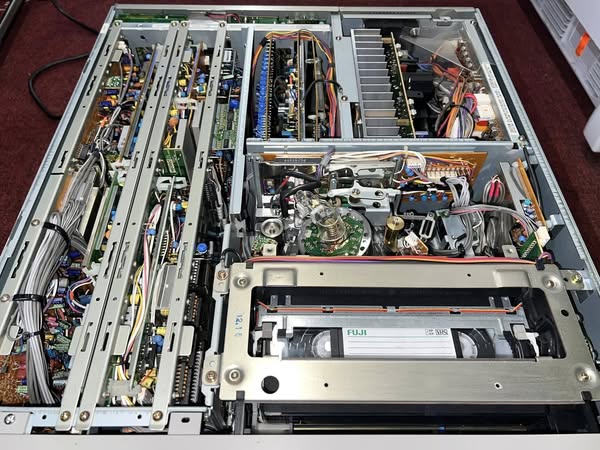
This image displays an older computer interior with messy cables and components, which serves as an example of expensive machinery that was once used for jobs. The meme about anti-capitalism usually jokes that when you lose your freedom to choose (like getting fired), the government tries to force you onto its "train" system instead of letting you drive your own car. Here, the computer represents those cars; by showing a room full of it without you controlling them, it illustrates how people are forced into a specific economic system just because their ability to leave it alone is gone. Inside the bottom cassette slot, there is text that reads "FUJI," likely referring to a label or serial number on an old part that was kept around by those who no longer have the money to replace it.
detailed-analysis (gemma3_27b-it-q8_0)
Okay, let's break down this image as a meme within the "Anti-Capitalism - Minimum Wage" category, employing relevant theoretical frameworks.
Visual Description
The image shows the internal workings of an old, complex piece of machinery—likely a large-format tape drive from a professional video or data storage system. It's a chaotic tangle of circuit boards, wires, mechanical components (gears, rollers, and heads), and housings. It’s visually dense, overwhelming, and almost impossible to comprehend without extensive technical knowledge. The inclusion of the FUJI tape and the “MS” marking suggests it is a professional-grade piece of technology. The machine looks largely outdated, possibly obsolete.
Marxist Conflict Theory
This image is exceptionally potent when viewed through a Marxist lens, particularly in relation to minimum wage. Here's how:
- Alienation of Labor: The sheer complexity of this machine represents the increasing complexity of modern labor, yet the vast majority of people interacting with the outputs of this technology (the videos or data it processes) have no understanding of its inner workings. Labor becomes increasingly alienated from the product it creates, and from the process of creation itself. This alienation is intensified under capitalism, where the worker’s contribution is reduced to a tiny, often invisible part of a much larger system.
- The Value Gap: The image embodies the tremendous gap between the value created by labor (the creation, maintenance, and operation of such a complex machine) and the wage paid to the vast majority of workers. The machine represents significant capital investment and a high degree of skilled labor to create and maintain. Yet, many workers who ultimately rely on or are affected by its output are paid minimum wage or near-minimum wage, receiving only a tiny fraction of the value generated.
- Commodification of Knowledge: The intricate workings of the machine signify specialized knowledge. This knowledge is commodified under capitalism – meaning it is owned, controlled, and exploited for profit. Those with the knowledge required to build, maintain, and operate the machine have a distinct power dynamic over those who do not. Minimum wage workers are excluded from access to this knowledge (and thus this power) which perpetuates cycles of economic inequality.
- Technological Unemployment: The obsolescence suggested by the machine hints at the increasing threat of automation and technological unemployment. This further exacerbates the issue of minimum wage because if jobs are lost to automation, the demand for labor decreases, potentially driving down wages.
Foucauldian Genealogical Discourse Analysis
Michel Foucault's work focuses on power structures and how knowledge creates and reinforces them. The image can be interpreted as follows:
- Discipline & Control: The intricate internal workings of the machine enforce a specific order and control over data or video. This reflects how capitalism disciplines and controls labor. The machine operates according to pre-defined rules and parameters, mirroring the regimented routines and expectations of the workplace.
- Power/Knowledge: The machine represents a concentration of power/knowledge. Those who understand its workings possess the power to control the system. This knowledge is not equally distributed; it’s often held by engineers, technicians, and managers – those in positions of authority. The wage disparity (minimum wage vs. the wages of those who create/maintain the technology) is a manifestation of this power imbalance. The discourse of “technical expertise” is used to justify this imbalance.
- Genealogy of the Wage: By looking at the genealogy (history) of the wage system, and machines like this one, we can see how the wage has become disassociated from the actual value of labor. Early forms of payment were often tied to skill and craftsmanship. As technology advanced and labor became fragmented (as depicted by the machine's complexity), the wage became increasingly detached from the worker's contribution, and thus exploitable.
Critical Theory (Frankfurt School)
The Frankfurt School’s critical theory examines how culture and ideology are used to maintain the status quo.
- Instrumental Reason: The machine embodies “instrumental reason”—a focus on efficiency and functionality at the expense of human values. Capitalism prioritizes maximizing profit through efficient systems (like this machine), often neglecting the well-being of workers.
- Culture Industry: The outputs of this machine (video, data) are part of the "culture industry," which, according to Adorno and Horkheimer, creates standardized products that pacify and control the masses. The disconnect between the complexities of production (the machine) and the consumption of the products (the videos/data) is a key component of this control.
- Reification: The machine is a perfect example of reification – the process of treating abstract concepts (like labor or economic processes) as concrete, objective things. The machine appears to be an objective tool, but it's actually a product of human labor and subject to the power dynamics of capitalism.
In essence, the meme using this image suggests that the modern economy is a bewildering, complex system designed to obscure the exploitation inherent in low wages and the unequal distribution of wealth. It points to a system where the vast majority of people are disconnected from the creation of the products and services they consume and are left to grapple with the consequences of a system that prioritizes profit over human well-being.
Important Note: The effectiveness of this meme relies on the viewer's awareness of the connection between the complex technology and the realities of wage labor. It is a sophisticated critique that requires some degree of pre-existing understanding of these concepts.
simple-description (llama3.2-vision_11b)
The meme is a humorous illustration of a computer's internal components, with a 3.5-inch floppy disk being used as a "minimum wage" sign. The text "Minimum Wage" is written on the disk, and the image is captioned "I'm not paying you until you're a 3.5" disk". This meme is likely used to poke fun at the idea of a low-paying job, using the outdated technology of a 3.5-inch floppy disk as a humorous example of a "minimum wage" sign.
detailed-analysis (gemma3-27b-vision)
Okay, here's an analysis of the image of the opened video tape machine (VTR) broken down into the requested theoretical sections. It's important to note that applying complex theoretical frameworks to a single image is often interpretive and relies on extrapolation. I'll attempt to do so reasonably, noting where connections are more speculative.
Visual Description
The image presents the fully opened interior of a professional-grade video tape machine (VTR). It's a complex and densely packed arrangement of circuit boards, mechanical components, wiring, and connectors. The dominant colors are grays, silver, and various brightly colored wires.
- Components: Prominent are several densely populated printed circuit boards (PCBs) along the sides, a complex arrangement of gears and rollers in the center, and a tape transport mechanism at the bottom.
- Complexity: The sheer density of components suggests a sophisticated and precisely engineered device. The tangle of wiring and connections indicates intricate internal processes.
- Tape: Two VHS tapes, labeled "FUJI," are partially inserted into the transport mechanism.
- State of Disrepair: While not visibly broken, the machine is open. This suggests either repair, maintenance, or deconstruction. It’s a view of the “inside” normally hidden, and implies that the machine is not currently operating.
- Materiality: The image emphasizes the physicality of the device - its weight, the metal casings, the tangible wires and boards – a stark contrast to the ephemeral nature of the information it once processed.
Foucauldian Genealogical Discourse Analysis
Foucault's genealogy examines how power operates through discourse and knowledge formations. The VTR, as an object, represents a specific historical moment in the development of media technology, and its internal workings reflect a particular exercise of power/knowledge.
- Discipline & Control: The VTR is a tool that enables the recording and playback of media. This allows for the capture, preservation, and dissemination of information - but also, crucially, for control over that information. Who controls the recording? Who has access to playback? These are questions of power.
- Episteme: The VTR's technology embodies a specific episteme (a historical way of knowing and organizing knowledge) of the late 20th century. The reliance on magnetic tape, complex analog circuitry, and precise mechanical components contrasts sharply with the digital, solid-state technologies of today. This shift in technology reflects a broader shift in how we understand and interact with information.
- The Panoptic Machine: The recording/playback loop itself can be seen as a miniature panoptic device. The recording "sees" and captures an event; the playback allows for constant surveillance and re-examination of that event. The power relationship isn’t simply in the machine, but in who uses it and how.
- Deconstruction: The fact that the machine is opened and displayed (as opposed to being sealed and functioning) can be interpreted as a deconstruction of the "black box" of media technology. It reveals the intricate and often hidden workings of a device we typically treat as opaque.
Critical Theory
Applying a broadly critical theoretical lens (drawing from the Frankfurt School, etc.) reveals the VTR as a product of instrumental rationality and a reflection of broader socio-cultural forces.
- Instrumental Rationality: The VTR exemplifies the pursuit of efficiency and control through technological means. Every component is designed for a specific function, contributing to the overall goal of capturing and reproducing moving images. However, this pursuit of efficiency can come at the expense of other values, like artistic expression or human connection.
- Culture Industry: The VTR is a tool that facilitated the development and dissemination of the "culture industry" (Adorno & Horkheimer). It played a crucial role in the mass production of media content, which can contribute to the homogenization of culture and the suppression of critical thought.
- Alienation: While seemingly empowering (allowing anyone to record and share their experiences), the VTR can also contribute to a sense of alienation. The process of mediation – capturing reality through a technological device – separates us from direct experience.
- Reification: The sheer complexity of the machine reifies the act of recording - making it appear as a technical process detached from its social, political, and historical context.
Marxist Conflict Theory
From a Marxist perspective, the VTR represents a material artifact embedded in class relations and struggles over control of the means of production.
- Means of Production: The VTR itself is a means of production in the realm of media. Access to this technology (initially expensive and limited) was unevenly distributed, reinforcing existing power structures. Those who controlled the technology controlled the narrative.
- Class Struggle: The shift from large, expensive VTRs controlled by broadcasting corporations to more affordable consumer VCRs was a form of technological democratization. However, the control of content production and distribution (e.g., film studios, music labels) remained largely in the hands of the capitalist class.
- Commodity Fetishism: The VTR (and the tapes it consumes) are commodities whose value is obscured by the labor and resources required to produce them. We tend to focus on the perceived utility of the device rather than the exploitation that underpins its creation.
- Control of Discourse: Access to VTRs gave the potential for counter-narratives to be recorded and disseminated, challenging the dominant ideology. However, the capitalist class could also use the technology to reinforce its own messages.
Postmodernism
A postmodern reading sees the VTR as a symbol of the breakdown of grand narratives and the embrace of fragmentation and simulacra.
- Simulation & Hyperreality: The VTR captures and reproduces reality, but the reproduction is never perfect. This leads to a blurring of the lines between the "real" and the simulated, creating a hyperreality where representations become more important than the original.
- Fragmentation & Deconstruction of Meaning: The VTR enables the manipulation and remixing of media content, leading to a fragmentation of meaning and a rejection of linear narratives.
- Loss of Authenticity: The VTR encourages the creation of multiple copies and versions of the same content, eroding the concept of a single, authentic original.
- The Death of the Author: The ability to easily record and redistribute content shifts the focus from the "author" (the creator of the original work) to the viewer/consumer.
Queer Feminist Intersectional Analysis
This lens examines how the VTR, as a technology, intersects with systems of oppression based on gender, sexuality, and other marginalized identities.
- Access & Representation: Historically, access to media production technology (including VTRs) was limited for women and LGBTQ+ individuals. This lack of access resulted in underrepresentation and misrepresentation of these groups in mainstream media.
- Controlling the Narrative: The VTR allowed for the creation of independent media by marginalized communities, giving them a voice and challenging dominant narratives. This was a powerful tool for activism and social change.
- The Gaze & Objectification: The VTR could be used to perpetuate harmful stereotypes and objectify women and LGBTQ+ individuals. The male gaze, for example, could be amplified through media production.
- Subversion & Reclamation: Marginalized communities used VTRs to create counter-narratives that challenged oppressive systems and celebrated diverse identities. This reclamation of the technology was a form of resistance.
- Intersectional Power Dynamics: Understanding how gender, sexuality, race, class, and other identities intersect to shape access to and control over media technology is crucial for dismantling systems of oppression.
It's important to remember that these are interpretations and that different theoretical approaches could yield different insights. The image of the VTR is a complex cultural artifact that invites a variety of critical analyses.
simple-description (llama3.2-vision)
The image is a photo of the inside of a computer, specifically the motherboard and other internal components. The text "I'm not a [ ]