First Seen
2025-07-11T20:19:30+00:00
simple-description (qwen3.5_2b-q8_0)
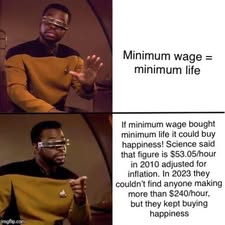
This meme displays two images of a man in a yellow turtleneck with one hand raised, set against contrasting light blue and black backgrounds. The text features the phrase "Minimum wage = minimum life" and claims that despite inflation, wages have remained high enough to buy happiness. From an anti-capitalist perspective, the caption suggests that rising costs make low fixed wages increasingly difficult to meet basic living standards.
detailed-analysis (gemma3_27b-it-q8_0)
Okay, let's break down this meme through the lens of anti-capitalist thought, drawing on the specified theoretical frameworks where relevant.
Visual Description
The meme features a two-panel format, utilizing a still image of LeVar Burton (Geordi La Forge from Star Trek: The Next Generation) as the core visual.
- Top Panel: Burton, wearing his VISOR, looks contemplative with a raised hand as if in explanation. The text reads: "Minimum wage = minimum life." This frames the initial premise.
- Bottom Panel: Burton's expression is one of incredulous disbelief, almost exasperation. The text presents a counter-argument referencing "science" (without specific source citation) asserting that a living wage, adjusted for inflation, would be $53.05/hour in 2010 and in 2023 would be more than $240/hour. Despite this, the statement claims people "kept buying happiness." The implication is that people are willingly participating in a system that doesn’t provide them a true living wage.
The use of Burton as the visual element is likely intentional, referencing a science fiction setting that often critiques social structures and explores questions of value and societal well-being. The VISOR itself could be interpreted as representing a "clearer" view of reality – uncovering the underlying truth about the economic system.
Marxist Conflict Theory
This meme operates very directly within a Marxist framework. The core premise highlights the inherent exploitation within the capitalist system. Here's how:
- Labor Value: Marx's Labor Theory of Value posits that the value of a commodity is determined by the amount of labor needed to produce it. The meme implies that the value produced by labor is far greater than the wages received by workers. The astronomical figures mentioned for a true living wage (adjusted for inflation) demonstrate this disparity.
- Alienation: Marx argued that capitalism alienates workers from their labor, the product of their labor, other workers, and themselves. The meme subtly touches on this. The "buying happiness" line suggests a form of self-deception or a coping mechanism for the alienation caused by inadequate wages and the broader system. Workers are forced to seek fulfillment outside of their work, because work itself is not fulfilling.
- Class Conflict: The meme highlights the conflict between the capitalist class (owners of the means of production) and the working class (those who sell their labor). The capitalist class benefits from keeping wages low, maximizing profits, while the working class struggles to survive. The statement "kept buying happiness" can be read as a critique of the working class willingly supporting the system that exploits them.
- False Consciousness: The “buying happiness” claim could be interpreted as reflecting the concept of false consciousness. This is where the working class accepts ideologies that serve the interests of the ruling class, preventing them from recognizing their own exploitation. In this case, the idea is that people are distracted by consumerism and the pursuit of individual happiness, failing to address the systemic issues that cause their economic hardship.
Critical Theory
This meme also resonates with Critical Theory, particularly concerning the idea of ideology and power structures.
- Ideology Critique: Critical Theory challenges dominant ideologies that legitimize existing power relations. The meme critiques the ideology that the current minimum wage is "fair" or "sufficient." It questions the narrative that individual effort alone is enough to achieve a good life, instead exposing the systemic barriers that prevent workers from thriving.
- Domination: The meme points to the power imbalance inherent in the employer-employee relationship. The capitalist class (employers) has the power to dictate wages, and the working class (employees) are often forced to accept them, even if they are inadequate.
- Emancipation: Implicit within the meme's critique is the potential for emancipation. By exposing the exploitation and the falsehoods upon which the system is built, the meme aims to awaken a critical consciousness and inspire action towards a more just society.
Foucauldian Genealogical Discourse Analysis
While less central than Marxist or Critical Theory, a Foucauldian lens can add nuance.
- Discourse of Work: Foucault’s work examines how discourses (systems of thought, language, and practices) shape our understanding of the world and regulate our behavior. The meme deconstructs the discourse surrounding "work" and "wages". Traditionally, work is presented as inherently valuable and wage is seen as its fair exchange. The meme challenges this notion by arguing that the current wage system is not delivering even a basic "life" to the worker, let alone a fulfilling existence.
- Power/Knowledge: Foucault argued that power and knowledge are intertwined. The "science" referenced in the meme – the calculation of a living wage – represents knowledge used to expose the power dynamics at play. The meme highlights how this knowledge can be used to challenge the dominant narratives about what constitutes a "fair" wage.
- Normalization: The meme points to the normalization of precarity and low wages. The fact that so many people accept (or feel forced to accept) minimum wage jobs, even if they are insufficient to provide a decent life, demonstrates how this situation has become normalized through discourse and social practices.
Postmodernism
A postmodern reading is somewhat limited here, but possible.
- Rejection of Meta-Narratives: Postmodernism challenges grand, overarching narratives (like the idea of inevitable progress or the inherent fairness of capitalism). The meme implicitly rejects the narrative that the current economic system is the best or only possible way to organize society.
- Relativity of Truth: The claim that “science said” an astronomical number suggests that truth is not objective or universal. The meme relies on the authority of "science" but lacks specific sourcing which challenges the reliability of this source of truth.
Queer Feminist Intersectional Analysis
This is the least directly applicable framework, but it's worth considering.
- Intersectional Exploitation: The effects of low wages are not experienced equally. Workers facing multiple forms of oppression (based on race, gender, sexuality, ability, etc.) are disproportionately affected. For example, women and people of color are often concentrated in low-wage jobs.
- Reproductive Labor: Feminist theory highlights the unpaid labor of caregiving and domestic work. Low wages make it particularly difficult for those responsible for this labor to meet their own needs and the needs of their families.
- Precarious Existence: Queer and trans people often face discrimination in the labor market and are therefore more likely to be relegated to precarious, low-wage work.
In conclusion: This meme is a concise, yet potent, anti-capitalist statement. It utilizes shock value (the high figures for a living wage) and a pop culture reference to critique the exploitation inherent in the current economic system, ultimately calling for a re-evaluation of our values and a more just distribution of resources. Its effectiveness stems from its appeal to a range of critical theoretical perspectives.
simple-description (llama3.2-vision_11b)
The meme is a humorous commentary on the concept of a living wage, specifically the idea that a minimum wage should be enough to afford a basic standard of living. The image shows a character from Star Trek: The Next Generation, Captain Jean-Luc Picard, looking unimpressed and saying "I find your lack of faith... disturbing". The text accompanying the image reads: "If minimum wage bought minimum life it could buy happiness! Science said that figure is $53.05/hour in 2010 adjusted for inflation. In 2023 they couldn't find anyone making more than $240/hour, but they kept buying happiness." The meme is poking fun at the idea that a minimum wage is not enough to live a comfortable life, and that even if you make more than $240 an hour, you can still be unhappy.
detailed-analysis (gemma3-27b-vision)
Okay, let's break down this meme using the requested theoretical frameworks. It's a complex image, so we'll try to be thorough.
Visual Description
The meme employs the "Drakeposting" format, featuring a two-panel image. The top panel shows actor Levar Burton, in his Star Trek: The Next Generation uniform, appearing displeased or dismissive, with a hand raised in a "stop" gesture. The bottom panel features the same image of Levar Burton, but with a look of more intense scrutiny or even skepticism. Overlaid text in both panels constructs a commentary on minimum wage and happiness. The top panel states “Minimum wage = minimum life”. The bottom panel contains a longer text block making the claim that a minimum wage in 2010 of $53.05 an hour would be necessary to achieve happiness, and that no one made that much, but happiness was still being "bought." The meme's visual component relies on the meme template itself – a recognizable format for signaling preference or dismissal.
Foucauldian Genealogical Discourse Analysis
This meme can be explored through Foucault’s lens of discourse and power. The statement "Minimum wage = minimum life" reveals how discourses construct what is considered a ‘livable life.’ The discourse around ‘work’ and ‘value’ is central here. The meme doesn't simply state a fact; it performs a critique of the historical constitution of what counts as a decent existence.
The claim about the cost of happiness is particularly interesting. It suggests that even in the past (2010), the pursuit of happiness itself was a construction shaped by economic forces. Foucault would ask: how has the very idea of ‘happiness’ been disciplined by capitalist structures? The meme’s claim is that even past notions of happiness were tied to a specific level of economic well-being.
The meme subtly exposes how the very notion of ‘need’ is not natural, but historically produced through power/knowledge relations. What constitutes “minimum life” is not a universal constant; it's a shifting target dictated by societal standards and economic realities. The meme implies that even happiness isn't an intrinsic feeling, but something bought and therefore subjected to the rules of the market.
Critical Theory
Applying the Frankfurt School’s Critical Theory, this meme functions as a piece of social commentary aiming to expose the contradictions within the capitalist system. It highlights the alienation of labor—the disconnect between the work people do and the quality of life they experience. The meme suggests that even if wages are nominally adequate to provide a “minimum life,” the true cost of achieving even basic well-being is increasingly out of reach.
The meme also touches on the concept of reification—the treatment of abstract concepts like “happiness” as concrete, marketable commodities. The statement that happiness is "bought" suggests that it’s no longer a subjective experience but an object of consumption, further reinforcing the logic of capitalism.
The meme implicitly critiques the culture industry, the system that produces and disseminates standardized cultural goods. The meme implies that even the idea of happiness is manufactured and sold as a commodity. It is not simply experienced but is bought – a product of marketing and consumerism.
Marxist Conflict Theory
From a Marxist perspective, this meme is a clear articulation of class conflict. The “minimum life” referenced is fundamentally defined by the material conditions experienced by the working class. The claim about the inflated cost of happiness is a direct critique of the exploitative nature of capitalism. The meme suggests that the capitalist class benefits from maintaining a low minimum wage, thereby creating a surplus labor force and maximizing profits.
The meme implicitly frames “happiness” as a site of class struggle. The statement that happiness is "bought" implies that the ability to experience well-being is unequally distributed, and that the capitalist class controls access to the resources necessary to achieve it. The meme hints at the idea that the working class is perpetually denied the full benefits of its labor, and that even basic happiness is only available to those who can afford it.
Postmodernism
From a postmodern perspective, the meme deconstructs the notion of a stable, universal “minimum life.” It challenges the idea that there is a single, objective standard for what constitutes a decent existence. The meme’s focus on “happiness” as a commodity reflects the postmodern emphasis on the fragmentation of identity and the loss of grand narratives.
The meme also suggests that meaning is not inherent but constructed through language and representation. The claim about the cost of happiness is not a statement of fact but a rhetorical device designed to challenge conventional wisdom and expose the constructed nature of reality. The meme plays with the ambiguity of language, suggesting that even “happiness” is not a fixed concept but a fluid and malleable construct.
Queer Feminist Intersectional Analysis
From a queer feminist intersectional perspective, this meme highlights how economic inequality is compounded by other forms of oppression. The idea of a “minimum life” is not experienced equally by all individuals. Those marginalized by gender, sexuality, race, and other factors face additional barriers to economic security.
The meme implicitly acknowledges that the cost of “happiness” is even higher for those who face systemic discrimination. For example, queer and trans individuals often face employment discrimination and harassment, which can limit their earning potential and increase their economic vulnerability. Women, historically and currently, earn less than men for comparable work, and are disproportionately burdened with unpaid care work. The meme subtly underscores how economic systems perpetuate intersectional forms of oppression.
The claim that happiness is "bought" also implicates consumer culture in reinforcing oppressive norms. Marketing and advertising often reinforce gender stereotypes and contribute to unrealistic expectations about appearance and success, creating additional burdens for marginalized groups.
Let me know if you'd like me to elaborate on any of these perspectives!
simple-description (llama3.2-vision)
The meme is a humorous commentary on the idea that if minimum wage was high enough to buy happiness, people would be happy. The image features two panels with a character from the TV show "Star Trek: The Next Generation" (the character is not named, but is known as "The Captain" or "The Commander" in some sources). The top panel shows the character looking thoughtful, while the bottom panel shows him looking more serious. The text on the right-hand side of the image reads: "If minimum wage bought minimum life it could buy happiness! Science said that figure is $53.05/hour in 2010 adjusted for inflation. In 2023 they couldn't find anyone making more than $240/hour, but they kept buying happiness."