First Seen
2025-07-11T20:19:28+00:00
detailed-analysis (gemma3_27b-it-q8_0)
Okay, let's break down this meme, "You Mustn't Be Afraid to Dream a Little Bigger, Darling," within the context of Anti-Capitalism, particularly as it relates to minimum wage, employing relevant theoretical frameworks where appropriate.
Visual Description
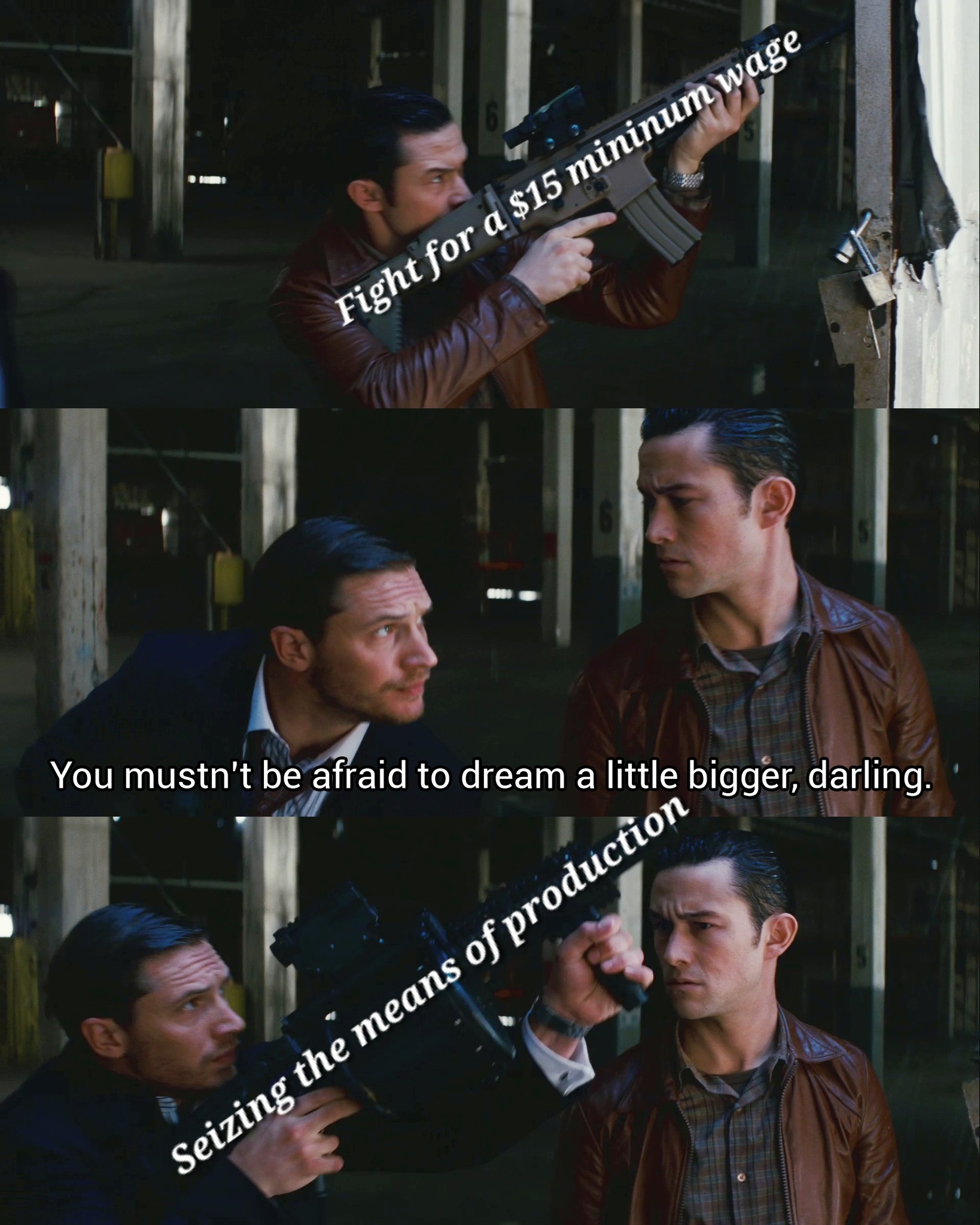
The meme utilizes a three-panel format, pulling stills from a scene in the film Baby Driver. The scene features a tense confrontation. In the first panel, Baby (Ansel Elgort) holds a gun pointed at Buddy (Jon Hamm) who is dressed in a suit. In the second panel Buddy, still in a suit, says "You mustn't be afraid to dream a little bigger, darling" to Baby. The third panel repeats the situation, but with text overlaid "Seizing the means of production."
The visual contrast is key: a seemingly "respectable" figure (Buddy, representing the capitalist class/management) speaks to someone in a more informal position (Baby, representing the working class) while a weapon is present. The setting itself—an industrial-looking space—hints at the site of labor.
Marxist Conflict Theory
This meme deeply resonates with Marxist Conflict Theory. The core tenet of this theory is that society is characterized by a fundamental conflict between classes – in this case, the bourgeoisie (owners of capital, like Buddy) and the proletariat (the working class, like Baby).
- Exploitation: The demand for a $15 minimum wage directly addresses the exploitation of labor. Marx argued that workers are not paid the full value of what they produce; the difference (surplus value) is appropriated by the capitalist. A higher minimum wage is an attempt to reclaim some of that surplus value.
- Class Consciousness: The "Fight for $15 minimum wage" text in the first panel invokes class consciousness—awareness of one's social class and its interests. The meme suggests a need to challenge the status quo and recognize shared struggles.
- Seizing the Means of Production: The final panel's phrase, "Seizing the means of production," is a core Marxist concept. Traditionally, this refers to the proletariat overthrowing the capitalist class and taking control of the factories, land, and other resources. Here, it's being ironically applied to the seemingly mundane goal of a higher minimum wage. This highlights how even seemingly modest demands for economic justice can be seen as a step toward challenging the fundamental power structures of capitalism.
- The "Darling" remark: The condescending tone of Buddy's remark ("You mustn't be afraid to dream a little bigger, darling") epitomizes the dismissive attitude often displayed by the capitalist class towards the needs and aspirations of workers. It's a paternalistic attempt to quell dissent and maintain control. The gun adds a sinister edge.
Foucauldian Genealogical Discourse Analysis
Michel Foucault’s work on power relations and discourse is also relevant.
- Power/Knowledge: Foucault argued that power is not simply a top-down force but is embedded in all social relations. The meme demonstrates how discourse (the way we talk about things) shapes our understanding of "fair" wages. The capitalist discourse frames minimum wage debates as benevolent concessions from employers, rather than a right of workers.
- Discipline and Punishment: The presence of the gun subtly suggests the potential for violence and repression used to maintain the existing power structure. It represents the disciplinary forces that keep workers in line. Even the implication of threat through the gun speaks to the discourse of control.
- Genealogy of "Dreaming Bigger": Foucault’s genealogical approach would examine the historical development of the idea of “dreaming bigger.” Originally, it might have been a genuinely empowering message, but within a capitalist framework, it's often used to encourage individuals to accept the blame for their economic circumstances, rather than challenging systemic inequality. The meme exposes that manipulative side.
Critical Theory
Critical Theory, particularly the Frankfurt School tradition, focuses on dismantling ideologies and exposing systems of domination.
- Ideology Critique: The meme critiques the ideology of meritocracy—the belief that success is solely determined by individual effort. The capitalist narrative often suggests that those earning minimum wage simply haven't "dreamed big enough" or worked hard enough. The meme rejects this narrative by presenting a forceful rejection of that system.
- Commodification of Labor: Critical Theory highlights how capitalism turns human labor into a commodity. The minimum wage debate is about the price of that commodity. The meme suggests that the price is currently too low and that workers deserve more than a mere "survival" wage.
- False Consciousness: The "dream a little bigger" line can be seen as an attempt to instill false consciousness—a distorted understanding of one's own interests that serves the ruling class. The meme attempts to break through that false consciousness by encouraging a radical rethinking of economic justice.
Postmodernism
While not the dominant lens, elements of postmodernism can be observed.
- Irony and Parody: The meme employs irony by juxtaposing the menacing visual of a gun with the seemingly polite phrase “dream a little bigger.” This parodies the capitalist discourse of opportunity and aspiration.
- Deconstruction of Meaning: Postmodernism questions fixed meanings. The meme deconstructs the conventional understanding of the phrase “dream a little bigger,” revealing its potential to be a tool of oppression.
In conclusion: This meme is a powerful visual statement about the need for economic justice. It leverages the imagery of a tense confrontation to highlight the inherent conflict between labor and capital, while simultaneously challenging the dominant narratives that justify economic inequality. It's a call to action, a rejection of complacency, and an ironic assertion that even demanding a living wage can be a revolutionary act.
simple-description (llama3.2-vision_11b)
The meme is a still image from the 2013 film "The Wolf of Wall Street" featuring a character (played by Jonah Hill) holding a gun and pointing it at someone. The image is captioned with a quote from the film's dialogue, "You mustn't be afraid to dream a little bigger, darling." However, the text is overlaid with the phrase "Fight for a $15 minimum wage" and the quote is replaced with "Seizing the means of production" and "You mustn't be afraid to dream a little bigger, darling." The meme is a commentary on the struggle for a living wage and the need for workers to take action to achieve it.
detailed-analysis (gemma3-27b-vision)
Okay, let's break down this meme featuring Mad Men characters Don Draper and Peggy Olson, overlaid with text about minimum wage and production, using the requested theoretical lenses.
Visual Description
The image is a four-panel screengrab from the television series Mad Men. It depicts a tense confrontation between Don Draper (a powerful advertising executive) and Peggy Olson (a copywriter). They are inside what appears to be a warehouse or industrial setting. The lighting is dramatic, with harsh shadows. Don, in a dark suit, appears dominant and somewhat menacing, pointing at Peggy with a finger. Peggy, dressed in a leather jacket, initially looks surprised and then increasingly determined. The layering of text across the panels is done in a way that links the visual narrative to the themes of wage struggles and production. The text is bright and overlaid on the image, creating a sense of interruption and recontextualization.
Foucauldian Genealogical Discourse Analysis
The meme brilliantly utilizes Foucauldian concepts. The dialogue ("You mustn't be afraid to dream a little bigger, darling") is itself a discourse of power. Don, representing the capitalist elite, frames a demand for a $15 minimum wage as a benevolent offering of encouragement to dream bigger. This is a key mechanism of power - normalizing inequality by presenting it as opportunity.
The image itself, juxtaposed with the wage demand, reveals the historical genealogy of labor relations. Mad Men depicts an era of rigid social hierarchies and the emergence of consumer culture. By connecting this imagery to a contemporary issue like minimum wage, the meme exposes how power dynamics from the past continue to shape the present. The warehouse setting symbolizes the sites of production where labor is extracted and controlled.
The meme suggests that these sites and power relations aren’t inherently 'natural', but are constructed through discourse and historical processes. They have a genealogy that is visible through the association of the old Mad Men setting with a modern fight for wage equality.
Critical Theory
The meme resonates with Critical Theory, particularly the Frankfurt School's emphasis on the "culture industry." Mad Men itself is part of the culture industry, often glorifying (or at least normalizing) the values of the capitalist elite. The meme critiques this by re-appropriating imagery from a show that often obscures power imbalances and using it to highlight the struggle for economic justice.
The "dream bigger" line becomes a cynical commentary on the ideology of meritocracy. It suggests that the system isn't about enabling individuals to achieve their dreams, but about controlling those dreams and extracting value from their aspirations. The meme exposes how dominant ideologies (like the American Dream) are used to legitimize exploitation. It deconstructs the surface narrative of the show, exposing the underlying power structures at play.
Marxist Conflict Theory
This meme is deeply rooted in Marxist conflict theory. It explicitly frames the relationship between Don Draper (representing the bourgeoisie/capitalist class) and Peggy Olson (representing the proletariat/working class) as inherently conflictual. Don's offer to "dream bigger" is not genuine encouragement but a veiled attempt to perpetuate the exploitation of labor. The minimum wage fight is presented as a direct challenge to the capitalist system, a struggle over the distribution of surplus value.
The warehouse setting represents the material conditions of production and the site of class struggle. The meme implies that the fight for a $15 minimum wage is a necessary step towards dismantling the exploitative relations that are inherent in capitalism. The power dynamic in the image is visually clear—the executive holds the power and dictates the terms, mirroring the power imbalance in capitalist labor relations.
Postmodernism
The meme displays postmodern characteristics through its playful recontextualization and mixing of cultural references. It takes an image from a nostalgic period drama and connects it to a contemporary political issue, creating a jarring and thought-provoking juxtaposition. This is a hallmark of postmodern art—the deconstruction of traditional boundaries and the mixing of high and low culture.
The meme also critiques the grand narratives of capitalism and the American Dream. It suggests that these narratives are not universal truths but are constructed ideologies that serve the interests of the powerful. By interrupting the original meaning of the image with the wage demand, the meme challenges the viewer to question the dominant narratives that shape their understanding of the world.
Queer Feminist Intersectional Analysis
While not overtly central, a queer feminist intersectional lens can still enrich the analysis. Peggy Olson, as a woman in a male-dominated advertising world, experiences power dynamics that are complicated by gender. Her striving for professional success is interwoven with the struggle against patriarchal structures and expectations.
A feminist reading highlights how economic inequality disproportionately affects women and marginalized genders. The fight for a $15 minimum wage is thus not just a labor issue but a feminist issue, as it seeks to address the economic vulnerabilities of women who are often concentrated in low-wage jobs.
While the image does not explicitly address issues of race or sexuality, the concept of intersectionality reminds us that the struggle for economic justice must be inclusive and address the multiple forms of oppression that affect marginalized communities. The meme can be seen as a symbolic representation of the broader fight for liberation from all forms of domination, including economic, gender, and racial.
Let me know if you'd like me to elaborate on any of these analyses or explore other theoretical perspectives!
simple-description (llama3.2-vision)
The meme is a series of images from the movie "Fight Club" with text overlaid on top. The first image shows a man holding a gun, with the text "Fight for a $15 minimum wage" written across it. The second image shows the same man, with the text "You mustn't be afraid to dream a little bigger, darling." The third image shows the same man again, with the text "Seizing the means of production." The text is meant to be humorous and ironic, as it takes a serious and dramatic scene from the movie and applies it to a more mundane and everyday topic. The meme is likely meant to be humorous and satirical, rather than serious or educational.