First Seen
2025-07-11T20:19:30+00:00
simple-description (qwen3.5_2b-q8_0)
This meme critiques Elon Musk by applying an economic principle where high productivity should command a higher pay rate than the actual capital or service provided. The caption "Weird looking Rivian" humorously suggests that while he has built an impressive vehicle (high capital), he is underpaying his team for their immense labor relative to its true value. Essentially, it argues that his massive investment in productivity isn't compensating him fairly compared to the revenue he generates.
detailed-analysis (gemma3_27b-it-q8_0)
Okay, let's break down this image as a meme within the context of Anti-Capitalism and Minimum Wage, using the requested theoretical lenses.
Visual Description
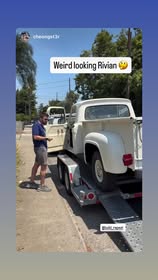
The image shows a white, classic pickup truck being transported on a flatbed trailer. The trailer appears to be towed by another vehicle (out of frame). A person stands beside the trailer, seemingly examining it. The caption reads “Weird looking Rivian 😂” – Rivian is a high-end, electric vehicle manufacturer, targeting a wealthy demographic. The overall scene suggests a degree of affluence and conspicuous consumption. The location seems to be a relatively affluent residential street.
Marxist Conflict Theory
This image is highly evocative when viewed through a Marxist lens, particularly in relation to minimum wage.
- Class Contrast: The Rivian (or perceived Rivian due to the caption being satirical) represents the ownership class and capital. It signifies wealth, the ability to afford luxury items and the means of transporting those items. The "weird looking" comment, coupled with the image of a classic truck being hauled, can be read as a sarcastic commentary on the conspicuous consumption of the wealthy. This contrasts sharply with the experiences of workers earning minimum wage, who struggle with basic needs like housing, food, and transportation.
- Means of Production: The truck itself is a means of production, symbolic of wealth generated through labor. The trailer and the act of transporting the truck underscores the reliance on labor and infrastructure (roadways, logistics) to facilitate the accumulation of capital. The person examining the trailer also highlights the laborers who facilitate the consumption of the wealthy.
- Alienation: The meme indirectly points to the alienation of labor. Those who produce the goods and services that allow for a lifestyle where one can afford to own and transport luxury items like a Rivian are often alienated from the fruits of their labor. They don’t benefit directly from the wealth being displayed.
- The "Weirdness" as Critique: The "weirdness" comment can be interpreted as a critique of the absurdity of vast wealth disparity. It’s “weird” that someone needs (or wants) to transport such a vehicle, and it’s “weird” that while some people can afford this, others are struggling to survive on minimum wage.
Critical Theory
Critical Theory (drawing from the Frankfurt School) focuses on exposing power structures and ideologies.
- Ideology & Commodification: The meme critiques the ideology that equates wealth with status and happiness. The Rivian is not just a vehicle; it's a commodity loaded with cultural significance. It signifies belonging to a certain social class. The meme’s mocking tone undermines that ideology. The emphasis on the "weirdness" is a way to challenge the norms that normalize such extreme displays of wealth.
- Instrumental Rationality: Critical Theory would argue that the pursuit of profit (and the accumulation of luxury goods) is driven by “instrumental rationality,” a focus on means to an end without regard for ethical or humanistic considerations. The meme subtly calls attention to the moral costs of a system that prioritizes capital accumulation over human wellbeing (especially the wellbeing of minimum wage workers).
Foucauldian Genealogical Discourse Analysis
Foucault’s approach examines how knowledge and power are intertwined.
- Discourse of Wealth: This image participates in a discourse of wealth, which is a system of beliefs, practices, and language that defines and reinforces the idea of wealth. The meme subtly disrupts this discourse by questioning the “normalcy” of luxury and the justification of such disparity.
- Power/Knowledge: The ability to own and display such wealth is tied to systems of power. The meme reveals how these systems function, subtly exposing the ways in which wealth and power are intertwined. The “weirdness” comment is a micro-act of resistance against the dominant discourse.
- Normalization of Inequality: The meme, in pointing out the “weirdness,” subtly deconstructs the normalization of vast income inequality. It suggests that what is often presented as “normal” or “desirable” is, in fact, abnormal and problematic.
Postmodernism
While not the primary lens, postmodernism offers some insights.
- Irony & Simulation: The sarcastic tone and the suggestion that a Rivian is “weird” point to a postmodern sensibility. It could be seen as a deconstruction of the authenticity of status symbols. The image doesn’t necessarily reject the Rivian; it ironically questions its value and significance.
- Fragmentation of Meaning: The meme’s brevity and reliance on cultural context (knowing what a Rivian is and its association with wealth) exemplifies postmodern fragmentation of meaning. Meaning isn't inherent in the image; it’s constructed by the viewer's interpretation.
Why it works as an anti-capitalist/minimum wage meme:
The meme's power lies in its subtlety. It doesn't directly preach about minimum wage or the evils of capitalism. Instead, it offers a visual juxtaposition that prompts viewers to question the status quo. The “weirdness” comment is a catalyst for reflection, inviting viewers to consider the absurdity of a system where such extreme wealth exists alongside widespread poverty.
Disclaimer: Meme interpretation is subjective. This analysis represents one possible reading within the given theoretical frameworks.
simple-description (llama3.2-vision_11b)
The meme is a photo of a person holding a sign that says "I'd rather be working" with a picture of a person working on a laptop. The meme is making a joke about the minimum wage and the struggle of working-class people. The image is likely a humorous take on the idea that even with a minimum wage, people are still struggling to make ends meet.
detailed-analysis (gemma3-27b-vision)
Okay, here's an analysis of the image, broken down into sections as requested. Please be aware that interpreting an image like this through dense theoretical lenses is often interpretive and requires stretching to apply the frameworks. I'll indicate when the connection is more tenuous.
Visual Description
The image appears to be a screenshot of a social media story (Instagram is likely, based on the interface elements). It depicts a man standing next to a car trailer, which is carrying what seems to be a vintage white pickup truck. The truck is significantly aged, with visible rust and a classic design. The overall lighting suggests a sunny day. The image is captioned "Weird looking Rivian 😂". It appears the truck is being transported on the trailer, and the angle suggests the vehicle may be partially blocking a driveway or road.
Foucauldian Genealogical Discourse Analysis
This is an interesting lens to apply. The "weirdness" identified in the caption suggests a discourse around the “proper” or expected form of a Rivian vehicle. Rivian, as a brand, is explicitly selling a future vision of electric vehicles, often sleek, modern, and environmentally conscious. This older pickup truck, especially one appearing in a state of disrepair, disrupts that discourse. A Foucauldian analysis would focus on the power dynamics embedded in how we define “normal” and “weird” in relation to vehicles.
- Genealogy: The history of trucks, from their functional origins to their current status as status symbols or lifestyle choices, would be relevant. This vintage truck represents an earlier moment in that history, one that Rivian is simultaneously referencing (by evoking the idea of a truck) and differentiating itself from (through its modern design).
- Discourse/Power: The caption "weird looking Rivian" subtly exerts power by categorizing this vehicle as "other." This sets up a binary – what counts as a Rivian (modern, electric) versus what doesn’t. It’s a power play within the branding and market positioning of the company.
- Archaeology: To dig into the underlying assumptions is the question of how "Rivian" has been defined and constructed.
Critical Theory
Critical Theory aims to deconstruct power structures and expose social inequalities. We can apply it here by examining the image through the lens of consumer culture and the automobile.
- Commodity Fetishism: The image indirectly highlights the cultural investment we place in automobiles. The truck isn't simply a means of transportation; it's imbued with meaning—nostalgia, status, identity. The commenter seems perplexed that a Rivian would be associated with something so not "new" or "cutting edge."
- Mass Culture: The juxtaposition of the vintage truck and the mention of "Rivian" connects past and present mass culture. It is the modern culture consuming the past, but also, in this case, commenting on it.
- The Automobile as a Symbol: The automobile, historically, has been tied to freedom, independence, and the American Dream. However, it is also associated with environmental damage, social inequality (car ownership is not universal), and even patriarchal structures. The image sparks questions about what the “future” of that symbolism will be, with brands like Rivian attempting to redefine it.
Marxist Conflict Theory
This is a stretch, but possible. From a Marxist perspective, the image can be seen as hinting at the contradictions within capitalism.
- Means of Production/Consumption: The truck represents an older mode of production and consumption, tied to a different economic era. Rivian represents a new mode of production and consumption, promising sustainability and technological innovation.
- Class & Status: Vintage vehicles are often associated with leisure and a certain level of economic privilege. The "weirdness" might stem from a dissonance between this association and the aspirational branding of Rivian, which is aiming for a broader, perhaps more progressive, demographic.
- Alienation: There's a hint of alienation in the comment. The commenter seems alienated from the idea of a "Rivian" being associated with something so old and "broken down" (even if aesthetically appealing).
Postmodernism
Postmodernism celebrates fragmentation, pastiche, and the breakdown of grand narratives. This image lends itself well to this analysis.
- Hyperreality & Simulation: The image blurs the lines between the "real" past (the vintage truck) and the manufactured future (Rivian’s branding). It’s a simulation – a juxtaposition of two eras that challenges our assumptions about authenticity.
- Pastiche & Intertextuality: The image is a playful mixing of styles and eras. The "weirdness" arises from the unexpected combination of the old and the new, creating a sense of ironic commentary.
- Deconstruction of Meaning: The comment “weird looking Rivian” deconstructs the assumed meaning of the brand. It suggests that meaning is not fixed but fluid and dependent on context.
Queer Feminist Intersectional Analysis
This is the most challenging application, but possible if we stretch the interpretation.
- Challenging Norms: The “weirdness” can be seen as a rejection of the heteronormative and patriarchal associations often linked to trucks and masculinity. Vintage trucks are historically marketed toward a specific demographic.
- Deconstructing the "Ideal" Vehicle: The comment subverts the “ideal” vehicle, dismantling traditional notions of what a “good” or “desirable” vehicle looks like. It opens up possibilities for alternative representations.
- Intersectionality: We could theorize that the discomfort with the image stems from an intersection of class (vintage vehicles as status symbols), gender (trucks and masculinity), and environmental consciousness (the contrast between older, gas-guzzling vehicles and electric vehicles). The “weirdness” could be a subtle way of challenging these intersecting power structures.
Important Note: These analyses are interpretations based on the visual information and the provided caption. There's room for debate and alternative readings. The deeper we delve into these theoretical frameworks, the more speculative the analysis becomes.
simple-description (llama3.2-vision)
This meme features a photo of a man standing next to a white pickup truck, which is being transported on a trailer. The image is accompanied by a text bubble that reads "Weird looking Rivian". The meme is likely making a humorous comment about the unusual appearance of the Rivian, a car brand that is known for its innovative and often experimental designs.