First Seen
2023-05-10T21:03:32+00:00
simple-description (llama3.2-vision_11b)
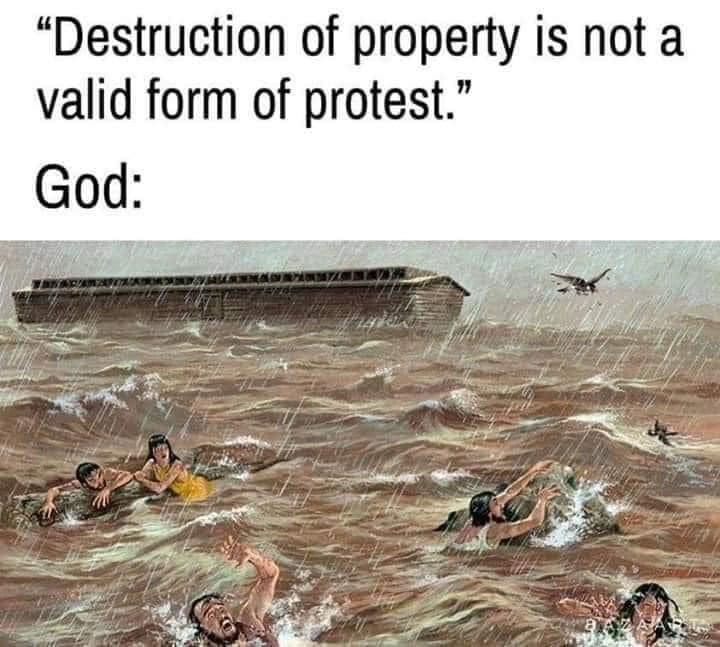
This meme is a satirical commentary on the idea that the destruction of property is not a valid form of protest, as stated in the image. The image depicts a chaotic scene of people being swept away by a flood, with a caption that reads "Destruction of property is not a valid form of protest." However, the image is actually a biblical reference to the story of Noah's flood, where God's destruction of the world through a flood was a form of protest against the wickedness of humanity. The meme is poking fun at the idea that the destruction of property is not a valid form of protest, by using a biblical reference to show that even God's destruction of the world through a flood was a form of protest.
detailed-analysis (gemma3-27b-vision)
Okay, let's break down this meme through the lenses you've provided. It's a rich image with potential for multiple interpretations.
Visual Description
The meme juxtaposes text with a dramatic illustration depicting the Great Flood. The illustration shows numerous people struggling and drowning in turbulent, muddy waters. A large wooden ark is visible in the background, seemingly remaining afloat while the rest of humanity perishes. The composition emphasizes the chaos and desperation of the drowning figures, contrasting with the static stability of the ark. The color palette is dark and somber, enhancing the sense of doom and tragedy. The overall feeling is one of immense power disparity, with a select few “saved” while the majority are destroyed.
Foucauldian Genealogical Discourse Analysis
This meme works strongly through a Foucauldian lens. The text "Destruction of property is not a valid form of protest" is presented as a statement of power, a discursive rule established by "God."
- Discourse & Power: The statement isn’t about the intrinsic validity of protest methods; it's a declaration defining what constitutes legitimate resistance. It's an exercise of power through establishing the boundaries of acceptable action. "God," in this context, functions as a sovereign power defining the terms of permissible dissent.
- Genealogy: We can trace a historical genealogy of this statement. Throughout history, those in power have consistently delegitimized forms of resistance that challenge their property or authority. This meme reveals that impulse as a foundational component in the construction of power itself. The Flood itself can be read as an act of 'property destruction'—the destruction of a world and its populace—justified through a moral and power-based framework.
- Normalization: The meme subtly normalizes the idea of accepting arbitrary limits to protest, highlighting the way power defines and controls what is considered "legitimate" action.
Critical Theory
The meme participates in the project of critical theory by exposing inherent power structures and challenging dominant narratives.
- Domination & Oppression: The image and text represent a clear power dynamic. “God” is the ultimate authority, and the drowning masses represent those subject to that authority. The meme implicitly questions the justification for such authority and the violence it can unleash. The text, presented alongside the image, functions as the articulation of an ideology that justifies that violence.
- Ideology Critique: The meme can be interpreted as an ideology critique, questioning the values and beliefs that uphold systemic injustice. The statement about property subtly suggests that the preservation of property is prioritized over the lives of people.
- Emancipation: While the meme itself isn't explicitly emancipatory, it creates a space for questioning and resisting dominant power structures. It highlights the ways in which those in power attempt to control dissent and maintain their position.
Marxist Conflict Theory
The meme resonates strongly with Marxist conflict theory.
- Class Struggle: The scene can be read as a metaphor for class struggle. “God” and those on the ark represent the ruling class, controlling the means of salvation (the ark). The drowning masses are the proletariat, suffering the consequences of a system designed to protect the privileged few.
- Means of Production/Preservation: The ark represents the 'means of preservation' - the control over resources needed to survive, hoarded by the elite while the majority are left to perish.
- Revolution & Resistance: The meme implicitly suggests that resistance (even if it involves disrupting the status quo, or "destroying property") may be a necessary response to systemic oppression. The image questions the legitimacy of a system that prioritizes the preservation of property (the ark) over the lives of people.
Postmodernism
The meme operates within a postmodern framework through its fragmentation and playful questioning of authority.
- Deconstruction of Authority: The meme deconstructs the traditional image of God as a benevolent savior. By juxtaposing the divine with a scene of mass destruction and a dismissive statement about protest, it challenges the very notion of divine legitimacy.
- Intertextuality: The meme relies on the viewer's prior knowledge of the biblical flood story, creating an intertextual connection that adds layers of meaning.
- Playful Irony: The meme employs irony, highlighting the absurdity of prioritizing property over life. The stark contrast between the text and the image generates a sense of dissonance that encourages critical reflection.
Queer Feminist Intersectional Analysis
This meme can be interpreted through a queer feminist intersectional lens, though it's a more nuanced reading.
- Power & Vulnerability: The drowning figures can be seen as representative of marginalized groups who are disproportionately vulnerable to systemic oppression. The ark becomes a symbol of privileged safety, accessible only to a select few.
- Rejection of Normative Structures: The meme challenges the traditional power structures that have historically marginalized queer and feminist voices. It implicitly questions the values that uphold those structures.
- Critique of Savior Complex: The image subverts the trope of the benevolent savior, highlighting the ways in which those in power often perpetuate harm even while claiming to offer salvation. "God" is a gatekeeper, deciding who is worthy of rescue.
Let me know if you'd like any of these sections expanded or explored in more detail!
simple-description (llama3.2-vision)
This meme is a humorous take on the biblical story of the Great Flood, where God destroys the world by flooding it with water. The image shows a chaotic scene of people being swept away by a massive flood, with the caption "God: I said to destroy the world, not flood the neighborhood" above it. The text at the top of the image reads, "God: I said to destroy the world, not flood the neighborhood".
tesseract-ocr
“Destruction of property is not a valid form of protest.” God: Eas ea gaa: ee BO Pea gh 0 al eens a,