First Seen
2023-05-10T21:03:32+00:00
simple-description (llama3.2-vision_11b)
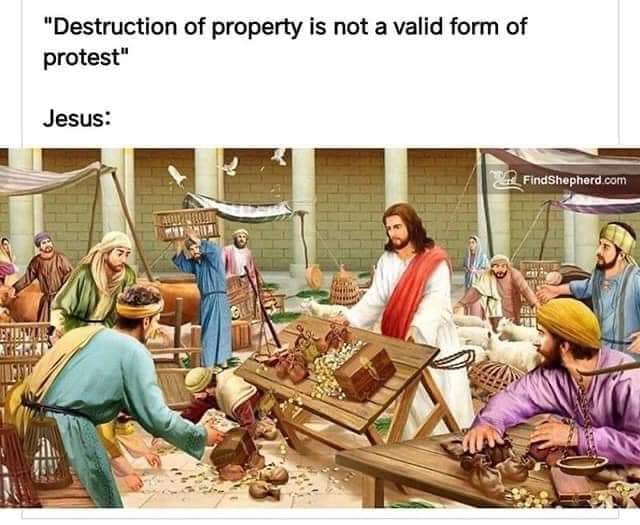
This meme uses the biblical story of Jesus clearing the temple, where he drives out merchants and money changers, to comment on the anti-capitalist sentiment of the "Jesus is a socialist" meme. The image depicts Jesus driving out the money changers, with a caption that says "Jesus is a socialist" and "the temple" in the background. The meme is saying that Jesus' actions in the temple are a form of anti-capitalist protest, and that he is a socialist.
detailed-analysis (gemma3-27b-vision)
Okay, let's break down this image and its implied meme format through the lenses of different theoretical frameworks. It's important to note that applying these frameworks is interpretive; there's no single "right" answer.
Please note: This is a complex analysis, and the depth of each section depends on the strength of the connection to the image.
1. Visual Description
The image is a painting depicting a scene commonly known as Jesus cleansing the Temple. The setting is a bustling marketplace within the Temple courtyard. Multiple figures populate the scene, including Jesus (prominently positioned in white robes), merchants, and onlookers.
- Key Elements: Tables laden with goods (likely livestock, produce, and potentially money changing tables) are overturned and in disarray. Merchants appear surprised or upset, while some onlookers watch with curiosity. Jesus is shown actively overturning the tables with a look of righteous indignation. The color palette is relatively muted, typical of traditional religious paintings. The composition is dynamic with lots of movement and implied action.
- Meme Format: The image is presented with the text: "Destruction of property is not a valid form of protest" followed by "Jesus:". This creates a deliberate irony. The meme juxtaposes a contemporary discourse (validity of protest methods) with a well-known biblical event that is an act of property destruction.
2. Foucauldian Genealogical Discourse Analysis
This framework is highly relevant. Michel Foucault's work examines how power operates through discourse – how language and practices shape what we consider "normal" or "acceptable."
- Power/Knowledge: The meme challenges the power/knowledge structures that define "valid" protest. Who gets to decide what constitutes legitimate resistance? The statement implies an established authority (police, government, media) defining the boundaries of acceptable dissent.
- Genealogy of "Valid Protest": A genealogical approach asks how the concept of "valid protest" came to be. What historical and social forces shaped it? Consider how legal systems, media representations, and political ideologies have historically favored certain forms of protest (peaceful marches, petitions) while demonizing others (riots, sabotage).
- Disciplinary Power: The implied message is that disruption is not allowed. The policing of protest relies on disciplinary power: normalizing particular behaviors while categorizing others as deviant. The meme's irony highlights how power has defined and maintained itself.
- Inversion: The meme inverts this expectation by bringing in an act that would be condemned today as vandalism, but which is often viewed as righteous in biblical accounts.
3. Critical Theory
Critical Theory, originating with the Frankfurt School, aims to understand how power structures are embedded in social institutions and cultural norms.
- Ideology: The statement "Destruction of property is not a valid form of protest" functions as an ideological assertion – a belief system that serves to maintain the status quo. It reinforces the sanctity of private property and discourages challenges to the existing order.
- Dominant Narrative: The meme challenges the dominant narrative surrounding protest. By juxtaposing it with the Temple cleansing, it raises questions about hypocrisy and the selective application of moral standards.
- Critique of Rationality: Critical theorists argue that rationality can be used to justify domination. The statement appears "rational" – property rights are generally accepted – but the meme questions whether this rationality serves the interests of those in power.
4. Marxist Conflict Theory
Marxism focuses on class struggle and the exploitation inherent in capitalist systems. This framework has a strong connection.
- Material Conditions: The Temple was a center of economic activity. Jesus’s actions can be interpreted as a direct challenge to the economic exploitation occurring within the Temple walls. He's not just protesting religious corruption, but a system that profited from the needs of the people.
- Class Struggle: The merchants represent a ruling class benefiting from the existing system, while the common people are potentially the exploited class. Jesus’s actions can be seen as aligning with the oppressed against the oppressors.
- Revolutionary Potential: Destroying the means of exploitation (the market stalls) can be seen as a symbolic act of rebellion – a rejection of the capitalist (even in ancient terms) system and a demand for change.
- The meme suggests a critique of a system that condemns resistance while enabling injustice.
5. Postmodernism
While less central than the previous frameworks, postmodernism is relevant.
- Deconstruction of Meaning: Postmodernism challenges fixed meanings and universal truths. The meme deconstructs the seemingly straightforward statement about "valid protest" by presenting a counter-example from religious history.
- Relativism: Postmodernism emphasizes the relativity of truth and values. What constitutes "valid" protest is not objective but socially constructed.
- Irony and Pastiche: The meme is inherently ironic, juxtaposing a contemporary statement with a historical event. This use of juxtaposition is a common postmodern technique.
- Fragmentation of Meaning: By presenting the statement and image together, it fragments the traditional meaning of protest, making the viewer consider the historical context.
6. Queer Feminist Intersectional Analysis
This is the least directly applicable framework, but can be stretched for analysis.
- Challenging Authority: Jesus’s actions could be interpreted as a challenge to patriarchal power structures within the Temple. The Temple hierarchy was likely male-dominated, and his disruption of their economic activities can be seen as a form of resistance.
- Marginalized Voices: The marginalized groups of the time (the poor, the sick, those excluded from Temple rituals) would have benefited from his actions. His protest can be seen as a form of solidarity with the oppressed.
- Intersectionality: While less obvious in the initial image, the concept of intersectionality can be applied by considering how the economic exploitation within the Temple intersected with other forms of oppression, such as social status, gender, or religious affiliation.
- The meme subtly challenges the notion that "respectable" protest is the only valid form, potentially empowering marginalized voices who may engage in more disruptive tactics.
In conclusion: The meme is a potent example of how a simple juxtaposition can raise complex questions about power, protest, and the social construction of meaning. Applying these theoretical frameworks reveals the multiple layers of interpretation and the potential for challenging dominant narratives.
simple-description (llama3.2-vision)
This meme is a humorous comparison between the biblical story of Jesus clearing the Temple in Jerusalem (Matthew 21:12-13) and a modern-day protest. The top text reads "Biblical quote: 'Destroy this temple and in three days I will build it'", which is actually a mistranslation or misquote. The image shows a scene from the Bible, with Jesus overturning tables and driving out merchants, but the caption below it says "Jesus: [smiling] I'm not here to make a scene, I'm just here for the free bread".
tesseract-ocr
“Destruction of property is not a valid form of protest" Jesus: a | | ! ss =a \ ed ee | oes Le pe BS 7) if “ eh ‘ ty EN i 3 y/ ate aa fy}, eye ee/, f ALD =x alle a PN ce / “cla | ae. '~ ae ay” / SS AY Ray: ye had Ade 27, © NV i ~~) AS Ne wk a SR Se n es ee > ce eA a