First Seen
2023-05-10T21:03:32+00:00
simple-description (llama3.2-vision_11b)
The meme is a reference to the TV show Star Trek: The Next Generation, where the character Data, an android, is trying to understand human emotions. In this meme, the image shows Data's face with a caption "I am not a machine, I am a human being" in a parody of a famous scene from the show. The text "I am not a machine, I am a human being" is a quote from the show, and the image is a play on this quote, with Data's face and a caption that is a play on words, saying "I am not a machine, I am a human being" but replacing "human" with "capitalist".
detailed-analysis (gemma3-27b-vision)
Okay, let's break down this image/meme, applying relevant theoretical lenses.
Visual Description
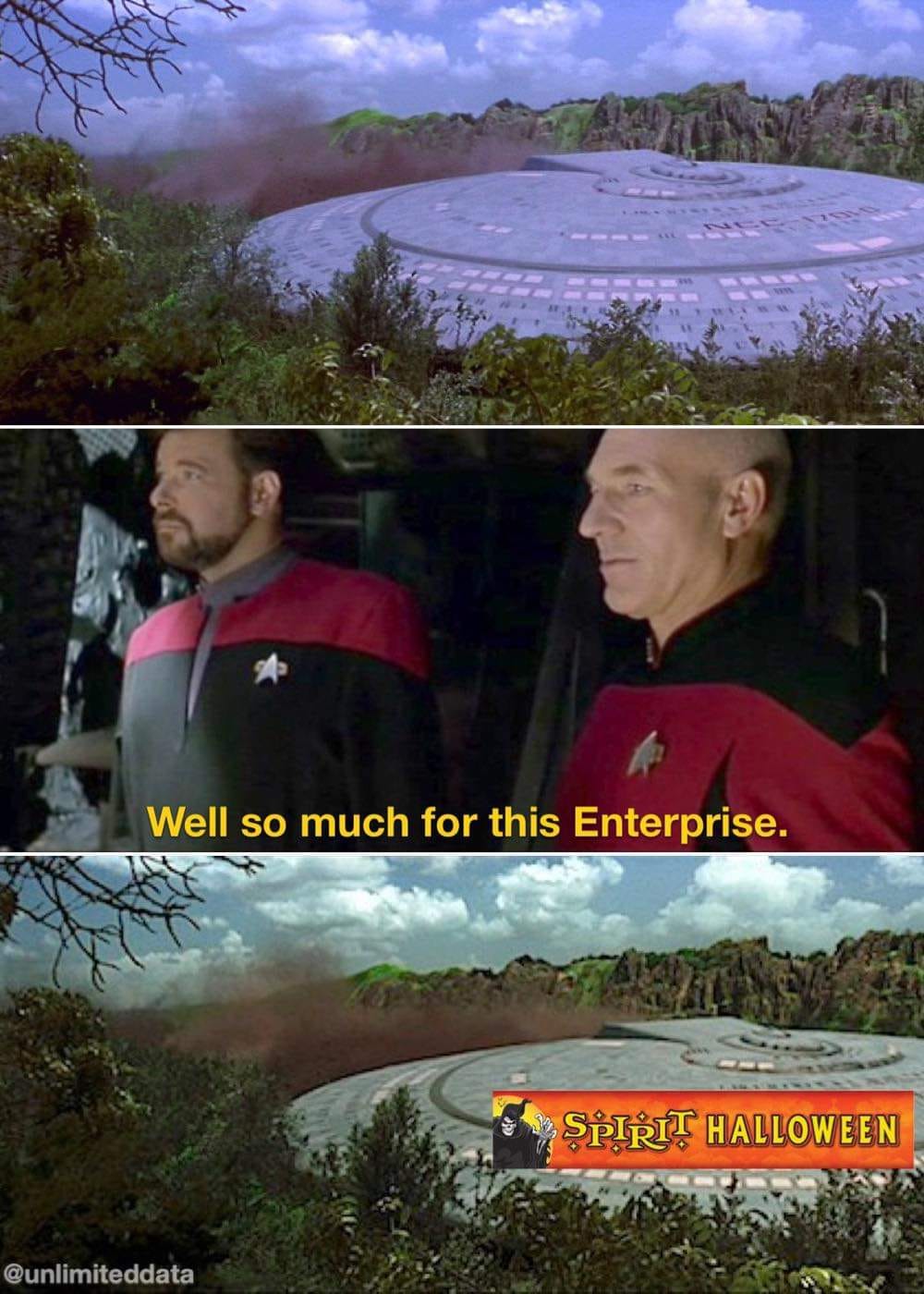
The image is a layered meme construction. It’s comprised of three horizontal bands.
- Top Band: A digitally manipulated landscape – a seemingly rural, pastoral scene with rolling hills and a sky that shifts between light and ominous. The landscape is digitally altered to suggest a flattened, otherworldly quality.
- Middle Band: A screencap from Star Trek: The Next Generation, depicting Captain Picard and Commander Riker, with Picard delivering a somewhat melancholic line: “Well so much for this Enterprise.” The text is rendered in a bright yellow, contrasting with the darker tones of the screencap.
- Bottom Band: Another digitally altered landscape mirroring the top, but with the text “Spirit Halloween” prominently displayed within a spooky logo.
The overall effect is jarring and humorous, juxtaposing the high-stakes, sci-fi aesthetic of Star Trek with the distinctly mundane, commercial, and seasonal context of the Spirit Halloween store. The digital manipulation of the landscapes reinforces a sense of unreality and the uncanny.
Foucauldian Genealogical Discourse Analysis
This meme operates through the deliberate mixing of discourses. Foucault's genealogy examines how power operates through knowledge and discourse. Here, we see a collision of discourses:
- The Discourse of Space Exploration/Sci-Fi: Star Trek represents a utopian vision of exploration, technological advancement, and collective human endeavor. The phrase "Enterprise" itself carries connotations of ambition, risk, and progress.
- The Discourse of Consumerism/Temporality: Spirit Halloween embodies a highly specific temporal and commercial practice: the seasonal demand for costumes and spooky decorations. It represents a fleeting, manufactured desire.
- The Discourse of Loss/Abandonment: Picard’s line signifies a failure or destruction of a cherished institution (the Enterprise).
The meme deconstructs these discourses by placing them in unexpected relation. The "Enterprise" has been "lost" to the banal reality of Spirit Halloween. This suggests a critique of how grand narratives (like space exploration) are subsumed and rendered meaningless by the relentless logic of consumerism and its ephemeral cycles. Power operates here by hijacking and trivializing the ambition inherent in the original sci-fi discourse.
Critical Theory
From a critical theory perspective (drawing from thinkers like Adorno and Horkheimer from the Frankfurt School), this meme can be read as an example of the “culture industry” at work. The culture industry doesn't necessarily create culture; it reproduces it, standardizing and commodifying experiences.
The meme highlights the flattening of experience. The monumental, philosophical stakes of the Star Trek universe – exploring the unknown, confronting existential challenges – are reduced to the level of buying a rubber mask and plastic decorations. It suggests a loss of depth and authenticity in contemporary culture, where even profound themes are subject to commercialization. It’s a cynical commentary on how everything, including our aspirations and values, are assimilated into the logic of the market.
Postmodernism
This meme is almost textbook postmodern. Several key postmodern tropes are at play:
- Pastiche/Intertextuality: The meme relies heavily on mixing elements from different cultural texts ( Star Trek and the ubiquitous Spirit Halloween). It doesn’t create something original, but rather reconfigures existing materials.
- Irony/Parody: The juxtaposition is deliberately ironic. The grandiosity of the Star Trek universe is undercut by the triviality of Spirit Halloween.
- The Death of the Meta-Narrative: Postmodernism argues that grand, unifying narratives (like the belief in progress through science or the inherent goodness of exploration) are no longer credible. This meme, in a playful way, mocks the idea of the grand, epic journey. It implies that everything ultimately collapses into the same level of superficiality.
- Simulacra and Simulation: (Baudrillard) The meme leans toward the idea of a "hyperreality," where the copy (the meme) has become more real than the original (the Star Trek episode). The Spirit Halloween landscape is a simulation of a spooky aesthetic, and the meme simulates the feeling of disappointment and loss.
No elements strongly apply for the remaining theories. The image doesn't necessarily lend itself to a clear analysis through Marxist Conflict Theory or Queer Feminist Intersectional Analysis. It lacks elements that directly address class struggle, power dynamics related to gender or sexuality, or intersectional oppression. While all cultural artifacts can be examined through these lenses, this particular meme does not foreground these themes in any significant way.
Let me know if you'd like me to expand on any of these analyses, or if you have another image you'd like me to interpret.
simple-description (llama3.2-vision)
The meme is a screenshot from the TV show Star Trek: The Next Generation, featuring Captain Jean-Luc Picard and Commander William Riker on the bridge of the USS Enterprise. The image shows the two characters looking at a mysterious alien planet, with the caption "Well, that's a lot of money for a planet that doesn't even have a decent gift shop." Below the image is a red banner with the text "Star Trek: The Next Generation" in white, followed by "Well, that's a lot of money for a planet that doesn't even have a decent gift shop."
tesseract-ocr
a * SAS € > Cr Nig ALE NE * < a P 4 ee c F : es ‘ ‘ Fd SN AE >. hab Sr, Se , fi ee : 3 ae 3 ee pee = (Sot a is y ; “ oa) & ay = oy i es " a y Mi 4 f OM tS S35 : ie tas 2 ot oes a. SE = = ET he NS it eee Sieeer, Ase ee OM ans (ste) Ase i ap