First Seen
2023-05-10T21:03:32+00:00
simple-description (llama3.2-vision_11b)
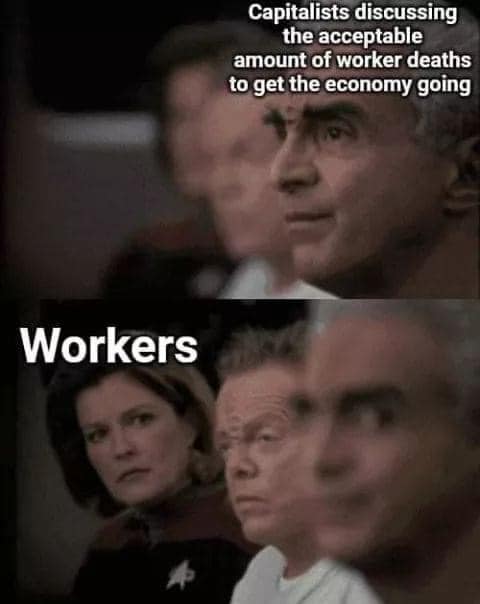
This meme is a satirical commentary on the relationship between capitalism and workers. The image shows a group of people looking at something with a mix of shock and horror, with the text "Capitalists discussing the acceptable amount of worker deaths to get the economy going" above them. The image is captioned "Workers". The meme pokes fun at the idea that capitalists are willing to sacrifice workers' lives to boost the economy, implying that workers are simply a means to an end in the eyes of capitalists.
detailed-analysis (gemma3-27b-vision)
Okay, let's break down this meme using the frameworks you've requested. It's a particularly potent meme, so we have a good amount to unpack.
Visual Description
The meme is a two-panel "drakeposting" format.
- Top Panel: Features a still of actor Bryan Cranston (from Breaking Bad), looking seriously, almost calculatingly, into the camera. The text overlay reads: “Capitalists discussing the acceptable amount of worker deaths to get the economy going.” The lighting is dim and shadowy.
- Bottom Panel: Features two actors (Kathy Bates and Morgan Freeman) looking concerned and despondent. The text overlay reads: “Workers.” The lighting in this panel is equally dim, highlighting the concerned expressions.
- The juxtaposition of the photos and text creates a stark contrast between the perceived cold calculation of the "capitalists" and the vulnerability/suffering of "the workers."
Marxist Conflict Theory
This meme is almost a direct illustration of core tenets of Marxist Conflict Theory.
- Class Struggle: The meme explicitly represents the inherent conflict between the bourgeoisie (capitalists, those who own the means of production) and the proletariat (workers). The text implies a callous disregard for worker safety and well-being in pursuit of profit—a central argument in Marxist thought.
- Exploitation: The "acceptable amount of worker deaths" phrase highlights the concept of exploitation. Workers are treated as a cost of doing business—a disposable resource to be used until no longer profitable. Their lives are implicitly devalued.
- Alienation: The workers' expressions (despondency, concern) reflect alienation. They are distanced from the fruits of their labor, and their worth is reduced to their productivity.
- False Consciousness: The meme subtly suggests that the capitalist framing of economic success (as measured by profit, even at the cost of life) is a form of ideological control. It obscures the exploitative reality.
Critical Theory
The meme also lends itself to analysis through the lens of Critical Theory (specifically, the Frankfurt School).
- Power Dynamics: The meme reveals the asymmetrical power relationship between capitalists and workers. The capitalists discuss the acceptable level of death, demonstrating their control over life and death. The workers are simply affected by that decision.
- Rationalization & Instrumental Reason: The very discussion of acceptable death rates exemplifies the "rationalization" and "instrumental reason" that Horkheimer and Adorno critique. Everything is reduced to a calculation; human life is quantified and becomes a variable in an equation.
- Domination: The meme illustrates a form of domination not simply through force, but through the structuring of reality itself. The capitalist framework allows for this kind of calculation and framing, normalizing the devaluation of worker lives.
Foucauldian Genealogical Discourse Analysis
Foucault's work provides a nuanced way to understand how this dynamic is produced rather than simply existing as an inherent conflict.
- Discourse & Power/Knowledge: The phrase "acceptable amount of worker deaths" isn’t just a statement of fact; it creates a discourse. It defines the terms of the conversation, normalizes the idea of quantifying human life, and constructs a reality where this is a valid topic of discussion. This discourse is deeply intertwined with power.
- Genealogy: A genealogical approach would trace the historical development of this discourse. When did the idea of acceptable risk/sacrifice for economic gain become normalized? What institutions, laws, and practices have contributed to this way of thinking?
- Biopower: Foucault's concept of biopower is also relevant. Biopower refers to the way modern states and institutions regulate life—managing populations, controlling bodies, and defining what constitutes a "healthy" or "productive" life. The meme suggests that workers are managed and disposed of within the logic of biopower.
Postmodernism
While less central than the above frameworks, postmodern thought can offer some insight.
- Deconstruction of "Truth": The meme challenges the notion of objective truth. The idea of an "acceptable amount of worker deaths" is presented as a subjective (and disturbing) calculation. This destabilizes the idea of a universal moral framework.
- Hyperreality & Simulation: One could argue that this meme reflects a hyperreal situation. The meme is an exaggeration of how capitalist systems treat its workers; it is not necessarily an accurate depiction but a simulation of an extreme.
- Meta-narratives: The meme challenges the meta-narrative of economic growth as inherently positive. It exposes the hidden costs and the power dynamics that underpin that narrative.
Queer Feminist Intersectional Analysis
While the meme doesn't explicitly address gender or sexuality, an intersectional lens can still add depth.
- Vulnerability & Precarity: Workers, especially those from marginalized groups (women, people of color, immigrants, disabled individuals), are often more vulnerable to unsafe working conditions and exploitation. Their lives are often devalued by capitalist systems. An intersectional analysis would reveal how those vulnerabilities are compounded.
- Gendered Labor: Certain types of dangerous labor are often disproportionately performed by women. The meme implicitly raises questions about who is bearing the brunt of these "acceptable" deaths.
- Commodification of Bodies: Feminist thought often addresses the commodification of bodies. In this meme, workers' bodies are reduced to their productive capacity, and their lives are valued only insofar as they contribute to profit.
In conclusion, this meme is powerfully evocative and lends itself to a rich and complex analysis through various critical frameworks. It's a sharp commentary on the inherent contradictions and exploitative tendencies of capitalist systems.
simple-description (llama3.2-vision)
The meme is a split-image of a scene from the movie "A Few Good Men" where a character is being questioned under intense scrutiny. The top image shows the character's face with a caption "Capitalists discussing the acceptable amount of worker deaths to get the economy going". The bottom image shows the character's face again with a caption "Workers". The image is meant to be humorous and satirical, implying that the character's intense scrutiny is actually a conversation about the value of human life in the context of economic growth.
tesseract-ocr
Capitalists discussing ad Workers ae _