First Seen
2023-05-10T21:03:32+00:00
simple-description (llama3.2-vision_11b)
This meme is a satirical critique of capitalism, using a quote from the rapper 2Pac to highlight the exploitation and inequality of the capitalist system. The image shows a photo of 2Pac, with a quote overlayed on top: "You know how the system is a joke? They ain't got nothing for you except an idea of a job, an idea of a house, an idea of a car, an idea of a family. You ain't got nothin'." The meme is a commentary on the capitalist system's failure to provide for the working class, and the quote highlights the inequality and lack of opportunities for the working class.
detailed-analysis (gemma3-27b-vision)
Okay, here's an analysis of the image you provided, broken down into sections based on the requested theoretical frameworks. It's important to note that some frameworks will be more applicable than others, and some might not fit at all. I will indicate when a section is not relevant.
Image Description
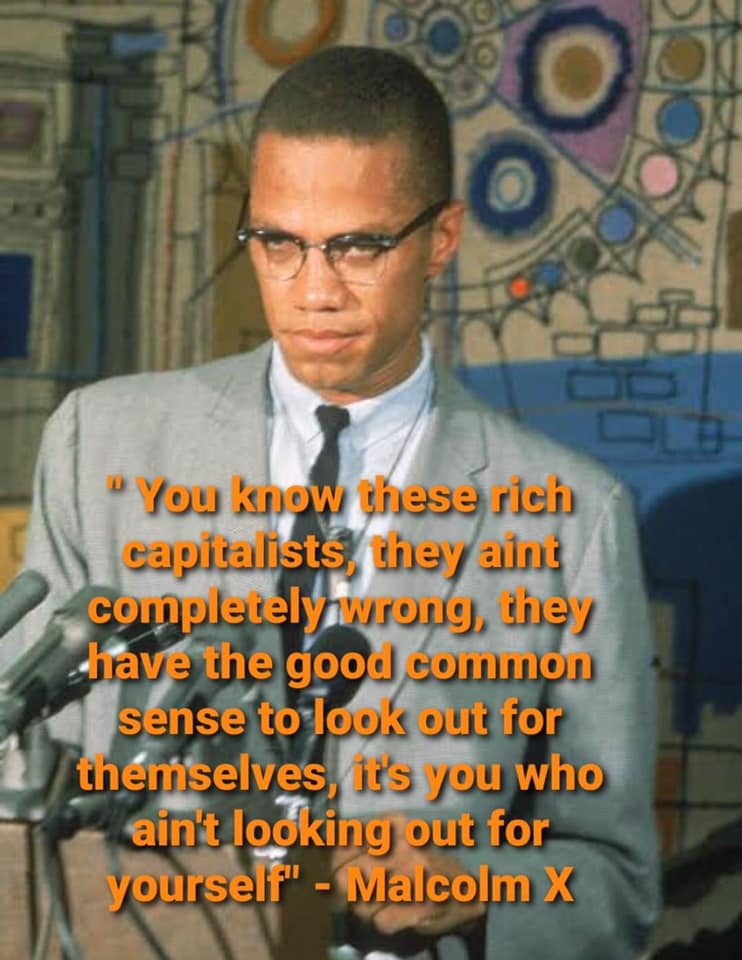
The image is a medium shot of Malcolm X speaking at a podium, likely during a public address. He is wearing a dark suit and tie and is in mid-speech, facing slightly to the right of the frame. His expression is serious and engaged. Behind him is a brightly colored, abstract patterned wall. The colors are primary and secondary, creating a slightly disorienting background. Overlaid on the image is a text quote attributed to Malcolm X: "You know these rich capitalists, they ain't got the good common sense to look out for themselves, it's you ain't looking out for yourself."
Marxist Conflict Theory
This image and the accompanying quote are highly relevant to Marxist conflict theory.
- Class Struggle: The quote directly addresses the relationship between the capitalist class ("rich capitalists") and "you" – which can be interpreted as the working class or marginalized communities. It positions these groups as being in direct opposition, with the capitalists failing to act in their own self-interest and the "you" being culpable for their own neglect.
- Critique of Capitalists: The quote implies a critique of capitalist motivations and prioritization. The claim that they “ain’t got the good common sense” suggests they are driven by greed and are unable to see the long-term consequences of their actions.
- Agency & Self-Interest: Malcolm X places the onus of self-preservation on the “you,” implying that they must actively fight for their interests. This echoes the Marxist idea that the proletariat must organize and develop class consciousness to overthrow the capitalist system.
- Power Dynamics: The photograph of Malcolm X speaking asserts a form of counter-discourse against the established power structures. His speech, as captured in this image, is an attempt to mobilize and empower those traditionally oppressed by the capitalist system.
Foucauldian Genealogical Discourse Analysis
This framework can be applied to understand how the concepts within the quote and image have evolved historically and how power operates through discourse.
- Discourse of Capitalism: The quote participates in a discourse surrounding capitalism. The phrasing (“rich capitalists”) is not neutral; it creates a specific framing of this group. Genealogically, we can trace how the term “capitalist” itself has been constructed and used historically, often carrying negative connotations.
- Power/Knowledge: Foucault’s concept of power/knowledge is crucial. The assertion that capitalists lack "good common sense" is not simply an observation; it’s a claim that positions Malcolm X (and his audience) as possessing a superior understanding of how the world works. This knowledge becomes a form of power.
- Subject Formation: The directive to “look out for yourself” contributes to a subject formation of self-reliance and responsibility. It’s a call for individuals to take agency, but it also implicitly acknowledges the lack of protection or care from the larger system.
- Historical Contingency: A genealogical analysis would investigate how these discourses surrounding capitalism, self-reliance, and social responsibility have changed over time and the specific historical conditions that shaped them.
Critical Theory
Critical Theory aims to critique and challenge existing social structures and power dynamics.
- Domination & Emancipation: Malcolm X’s statement directly addresses issues of social domination – how the capitalist class potentially exploits and oppresses others. His call to action ("look out for yourself") is an attempt to promote emancipation and empower marginalized communities.
- Ideology Critique: The quote subtly critiques the ideology of capitalism – the set of beliefs and values that justify and maintain the system. By questioning the "common sense" of the rich, Malcolm X exposes the potential irrationality and injustice of the system.
- Alienation: The implied message that the "you" must fend for themselves suggests a sense of alienation – a feeling of disconnection from society and a lack of support from existing institutions.
- Reflexivity: Critical theory encourages us to be reflexive – to examine our own assumptions and biases. Malcolm X's quote forces us to question the dominant narratives about capitalism and consider alternative perspectives.
Postmodernism
Postmodernism focuses on the deconstruction of grand narratives and the embrace of relativism.
- Deconstruction of "Common Sense": The quote challenges the notion of "common sense" as a universal or objective truth. It implies that what is considered "common sense" is often shaped by social and economic interests.
- Rejection of Universal Truths: Postmodernism would question the idea that there is a single, correct way to understand capitalism or social responsibility. It would emphasize the importance of multiple perspectives and interpretations.
- Fragmentation: The vibrant and somewhat chaotic patterned wall behind Malcolm X can be seen as a visual metaphor for the fragmentation and uncertainty characteristic of postmodernity.
Queer Feminist Intersectional Analysis
While not the primary lens for analyzing this image, an intersectional perspective can add nuance.
- Marginalized Identities: While the quote doesn't explicitly address gender or sexuality, it’s important to remember that the impacts of capitalism are not experienced equally. Women, LGBTQ+ individuals, and other marginalized groups often face additional layers of oppression and economic vulnerability.
- Double Consciousness: Intersectional theory highlights the concept of double consciousness – the awareness of being both an insider and an outsider. This could apply to the "you" in the quote – individuals who are simultaneously members of the working class and other marginalized groups.
- Power dynamics: The analysis could explore the ways in which power imbalances intersect along lines of race, class, gender, and sexuality, and how these intersections shape individual experiences of capitalism.
In conclusion:
The image and quote resonate strongly with Marxist conflict theory and Foucauldian discourse analysis. Critical theory provides a helpful framework for understanding the broader implications of Malcolm X’s message. Postmodernism can help deconstruct the underlying assumptions, while queer feminist intersectional analysis can add a crucial layer of nuance to the analysis.
Let me know if you’d like me to elaborate on any of these sections or explore a different theoretical framework!
simple-description (llama3.2-vision)
This meme features a photo of Malcolm X, a prominent African American leader, with a quote that appears to be a misquote or parody of his actual words. The quote reads: "You know these rich capitalists, they ain't completely wrong, they have the good common sense to look out for themselves, it's you who ain't looking out for yourself." The image is likely intended to be humorous or ironic, using Malcolm X's name in a way that is not accurate to his actual views or legacy.
tesseract-ocr
etil 2 diego -- > ‘ -? 2 po - yO) > ie. tA Ag OH ‘a my OA a Wet 2x Tim a, ae | 1 _-* ers sal if N 24 at > —= i » Yeyey lenye thasd rep \\ ie Bee they alni Pe oe TN ee i | 7 yy Ly ae i Vaeee VA RAB