First Seen
2023-05-10T21:03:32+00:00
simple-description (llama3.2-vision_11b)
The meme features a character from the Star Trek: The Next Generation series, but with a modified image of his face with a caption "I see no one is talking about the economy" with a "I can see your house is made of the finest [insert random material here]". The meme is poking fun at the idea that people are so focused on the economy and the stock market that they're ignoring the real issues. The image is a play on the idea that the economy is a joke and that people are so focused on it that they're ignoring the real issues.
detailed-analysis (gemma3-27b-vision)
Okay, let's break down this image through a variety of critical lenses. It's a rich image, rife with memetic and cultural references that lend themselves to a complex analysis.
Visual Description
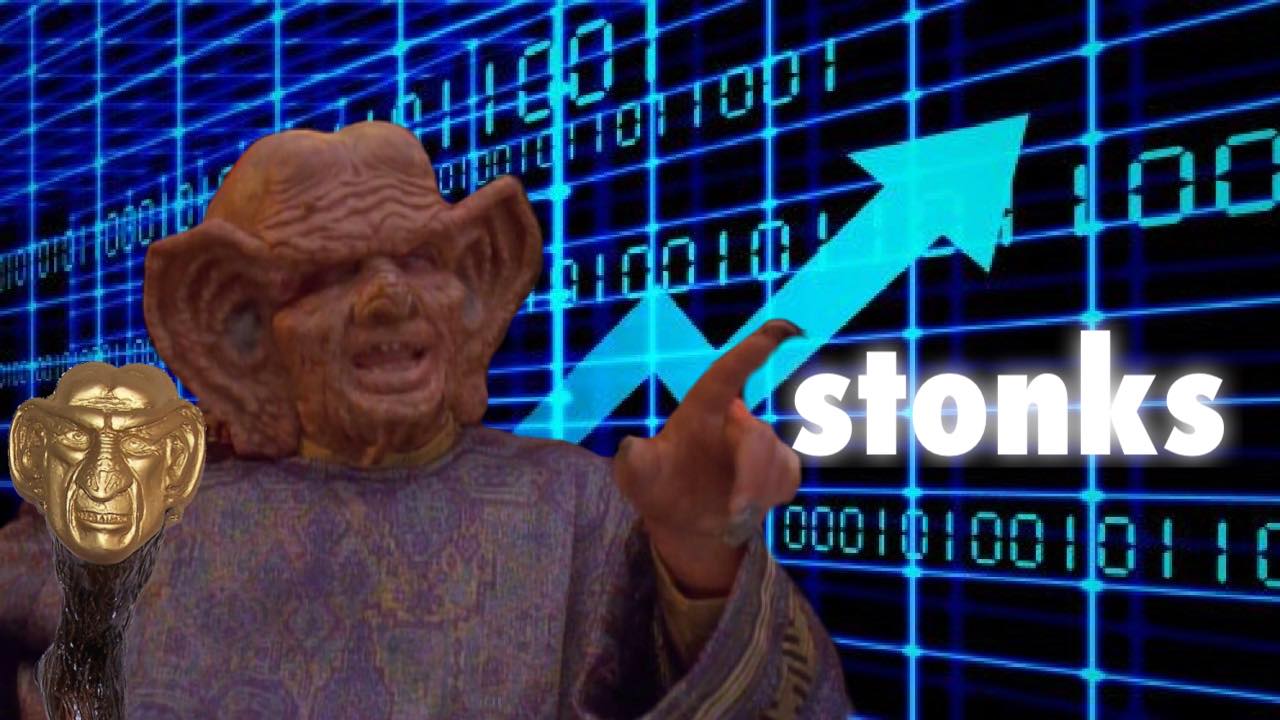
The image depicts a stylized rendering of Yoda from the Star Wars franchise, overlaid against a background dominated by digital code and upward-pointing arrow graphs. Yoda is draped in brown robes, and a golden head sculpture of him is visible in the lower left corner. The code appears to be binary, cascading down the background. Overlaid on the code is a prominent white text label reading "stonks" (a deliberate misspelling of "stocks") in a bold, almost playfully juvenile font. The overall color scheme is dominated by blues, browns, and golds, suggesting a blend of high-tech futurism and ancient wisdom. It's clearly created to evoke internet meme culture, and a sense of ironic commentary on the world of finance.
Foucauldian Genealogical Discourse Analysis
A Foucauldian analysis would focus on the discourse surrounding finance, memes, and authority figures like Yoda. The image represents a rupture in traditional financial discourse. Traditionally, finance has been framed by jargon, authority, and "expert" knowledge. This image subverts that by layering it with a pop-cultural figure known for wisdom and esoteric understanding, yet presented in a deliberately unserious way.
- Power/Knowledge: The "stonks" meme represents a decentralization of financial knowledge. The traditional power dynamic – where financial institutions and "experts" hold the knowledge – is challenged. Anyone can now participate in this discourse. The binary code background is an indicator of a system of data, and data is power.
- Genealogy: Tracing the history of “stonks” reveals it originated as a purposefully inaccurate depiction of stock market graphs, often mocking reckless investment strategies. The image traces the meme to it's roots, but uses a figure as old as Yoda as an indicator of something cyclical. The meme then evolves into a symbol of participation in the 'gamification' of investing (seen with platforms like Robinhood and GameStop), and the image's message is that this system is ancient, and will continue on.
- Discourse Practices: The image performs a new discourse – one of ironic detachment, collective action (often through online communities), and a rejection of traditional financial norms. It's a visual articulation of a shifting power dynamic.
Critical Theory (Frankfurt School)
The image lends itself to a reading through the lens of the Frankfurt School, particularly regarding the “culture industry” and the commodification of everything.
- Commodification of Culture: Yoda, a character imbued with philosophical weight, is reduced to a visual signifier used to promote the idea of “stonks.” This illustrates the culture industry's tendency to strip away meaning from authentic cultural products and repurpose them for commercial gain.
- False Consciousness: The "stonks" meme, despite its seeming rebelliousness, can be argued to contribute to a "false consciousness." By reducing complex financial systems to a humorous, easily digestible image, it obscures the underlying systemic problems. It allows people to feel like they’re “in the know” without actually engaging with critical analysis.
- Instrumental Reason: The binary code, as a representation of algorithmic trading and data-driven decision-making, embodies the idea of instrumental reason – where everything is reduced to a means to an end (profit). The image suggests that even wisdom (represented by Yoda) is ultimately subject to this logic.
Marxist Conflict Theory
A Marxist reading centers on class conflict and the exploitation inherent in capitalist systems.
- Capital and Labor: The image highlights the growing tension between institutional investors and retail investors. The “stonks” meme is often associated with movements like the GameStop short squeeze, which saw individual investors challenging the established financial power structure.
- Alienation: The image suggests a degree of alienation from traditional financial systems. The use of a meme figure and the ironic tone point to a lack of trust in institutions and experts. The people are using the markets and are no longer interested in the experts.
- Commodity Fetishism: The binary code and the stock charts can be seen as representing the "fetishized" nature of commodities in capitalism. The focus is on the abstract value of stocks (represented by the graphs) rather than the real labor and resources that underpin them.
Postmodernism
The image is fundamentally postmodern in its embrace of irony, pastiche, and the blurring of boundaries.
- Hyperreality: The image exists within a hyperreal space – a simulation of reality where representations are more real than the real. The “stonks” meme has become a self-referential signifier, divorced from its original context.
- Deconstruction: The image deconstructs traditional notions of expertise and authority. Yoda, a figure traditionally associated with wisdom, is presented in a context of financial speculation. The image challenges the idea that any single source holds definitive knowledge.
- Loss of Grand Narratives: The image implicitly acknowledges the loss of overarching narratives (like the belief in the inherent rationality of markets). Instead, it embraces a fragmented, ironic worldview.
Queer Feminist Intersectional Analysis
This lens is the most challenging to apply directly, but possibilities exist.
- Subversion of Norms: The image, by embracing irony and meme culture, can be seen as a subversion of the traditionally masculine, authoritative world of finance.
- Collective Action & Community: The "stonks" meme is often associated with online communities, where marginalized groups can find solidarity and engage in collective action.
- Accessibility & Inclusivity: The meme format and its accessibility can potentially democratize financial knowledge, offering a more inclusive entry point than traditional sources. (Though it is a simplistic entry, and may only broaden false consciousness.)
Let me know if you'd like me to expand on any of these analyses or explore other theoretical frameworks!
simple-description (llama3.2-vision)
The meme is a still image from the movie Star Trek: The Next Generation, featuring the character Data, a humanoid android, with a caption "I'm not going to sit in a room filled with Klingons when I can watch it from home". The text "I'm not going to sit in a room filled with Klingons when I can watch it from home" is overlaid on the image, and the image is accompanied by the text "STONKs" and "I can smell the stocks".
tesseract-ocr
ae aie ane sy asa tt oh sos ae aa eit es Ts g Pom = Ea He a SMA Usd a) Sed aie a oot Teh TT