First Seen
2023-05-10T21:03:33+00:00
simple-description (llama3.2-vision_11b)
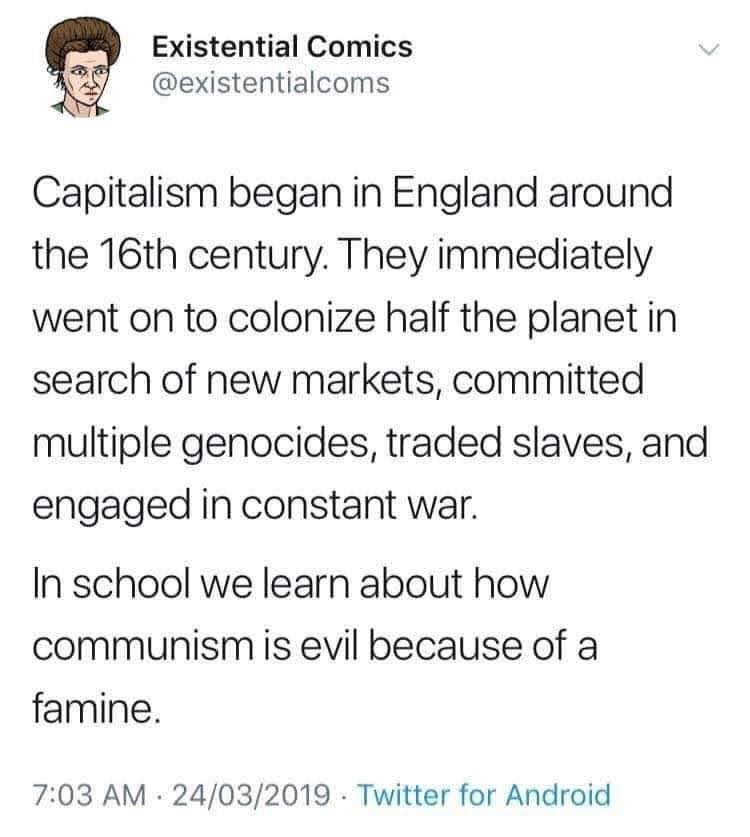
The meme is a humorous and satirical take on the concept of capitalism, specifically referencing the historical context of the 16th century and the concept of capitalism's roots in the UK. The text reads: "Capitalism began in England around the 16th century. They immediately went on to colonize half the planet in search of new markets, committed multiple genocides, traded slaves, and engaged in constant war." The meme is poking fun at the dark history of capitalism's origins and the exploitation of the working class, highlighting the brutal and oppressive nature of the system.
detailed-analysis (gemma3-27b-vision)
Okay, let's break down this Twitter post from "Existential Comics" through several critical lenses.
Visual Description
The image is a screenshot of a tweet. The tweet features a profile image – a cartoonish black-and-white illustration of a man with a mustache and a pensive expression. Below the profile image is the Twitter handle "@existentialcoms" and the name "Existential Comics." The bulk of the image is occupied by text which consists of two paragraphs. Below that are time and date stamps: "7:03 AM • 24/03/2019 • Twitter for Android"
Foucauldian Genealogical Discourse Analysis
This post lends itself strongly to Foucault's concept of genealogy. The tweet’s core argument isn’t about ‘truth’ or moral judgements, but about the construction of knowledge and how certain narratives come to dominate.
- Power/Knowledge: The tweet highlights how the dominant narrative regarding economic systems ignores the violence inherent in the very origins of capitalism, while focusing exclusively on the negative consequences of communism. This is a power/knowledge relationship: the selection of what is 'known' and remembered serves the interests of those who benefit from the current system.
- Discursive Formation: The construction of capitalism as a neutral or even positive force is a ‘discursive formation’ - a system of thought, language, and practice that shapes how we understand the world. The tweet challenges this by revealing the brutal beginnings of capitalism.
- Archaeology & Genealogy: Foucault's archaeological method seeks to uncover the historical rules of formation for a discourse, while genealogy explores the discontinuous, contingent, and often messy emergence of a concept. The tweet functions as a brief genealogical intervention, pointing out the violence at the ‘birth’ of capitalism, challenging the idea of a natural, inevitable, or benevolent system.
Critical Theory
This post aligns strongly with the aims of Critical Theory, particularly the Frankfurt School tradition.
- Critique of Ideology: The tweet is a direct critique of ideological domination. It argues that dominant narratives about economic systems obscure the realities of exploitation, violence, and oppression. The post suggests that the selective focus on the failures of communism while ignoring the historical violence of capitalism is a way of legitimizing the status quo.
- Reason as Domination: Horkheimer and Adorno’s concept of ‘instrumental reason’ applies here. The focus on abstract economic ‘progress’ and market efficiency obscures the human cost of capitalism's expansion – the genocides, slavery, and wars.
- Emancipation: By challenging the accepted narrative, the tweet implicitly aims to expose the structures of domination and open up possibilities for a more just and equitable future.
Marxist Conflict Theory
This is perhaps the most obvious lens through which to analyze this post.
- Historical Materialism: The post is rooted in a historical materialist understanding of society. It argues that economic structures (capitalism) shape social relations, political systems, and even ideas.
- Class Struggle: The mention of colonization, slavery, and war are all manifestations of class struggle – the inherent conflict between the ruling class (those who benefit from capitalism) and the oppressed classes (those who are exploited).
- Exploitation & Alienation: The post implies that the pursuit of profit under capitalism leads to the exploitation of people and resources, as well as the alienation of individuals from their labor and their fellow humans.
- False Consciousness: The focus on the failures of communism while ignoring the history of violence within capitalism, can be interpreted as a manifestation of false consciousness. The "we" in "we learn" suggests that people are indoctrinated into believing this view.
Postmodernism
While not the strongest fit, some postmodern elements can be identified.
- Deconstruction of Grand Narratives: The tweet challenges the “grand narrative” of economic progress. It destabilizes the notion that capitalism is inherently positive or inevitable.
- Relativism and Subjectivity: The post implicitly suggests that there are multiple ways to understand history and economic systems. It challenges the notion of a single, objective truth.
- Critique of Universalism: The tweet hints at the dangers of applying universal categories or concepts to diverse historical contexts. The selective emphasis on communist failures while ignoring the history of capitalism reflects this.
Queer Feminist Intersectional Analysis
While not directly focused on gender or sexuality, an intersectional analysis can be applied.
- Interlocking Systems of Oppression: The violence inherent in capitalism (colonization, slavery, war) disproportionately affects marginalized groups – people of color, Indigenous populations, women, and other vulnerable communities.
- Commodification of Bodies: Capitalism often relies on the commodification and exploitation of bodies – particularly the bodies of women and people of color. This aligns with queer and feminist critiques of power and control.
- The "Universal" as Masculine: The historical narrative of economic progress has often been framed in masculine terms – emphasizing competition, conquest, and domination. This has marginalized alternative ways of organizing society that prioritize care, cooperation, and sustainability.
In summary, this seemingly simple Twitter post is a rich text that invites analysis from multiple critical perspectives. It is a powerful commentary on the ways in which historical narratives are constructed to serve the interests of those in power, and a call for a more honest and critical understanding of economic systems.
simple-description (llama3.2-vision)
This meme is a humorous commentary on the concept of capitalism and its origins. The text reads: "Capitalism began in England around the 16th century. They immediately went on to colonize half the planet in search of new markets, committed multiple genocides, traded slaves, and engaged in constant war." The meme pokes fun at the dark history of capitalism and its brutal beginnings.
tesseract-ocr
Existential Comics @existentialcoms Capitalism began in England around the 16th century. They immediately went on to colonize half the planet in search of new markets, committed multiple genocides, traded slaves, and engaged in constant war. In school we learn about how communism is evil because of a famine. 7:03 AM - 24/03/2019 - Twitter for Android