First Seen
2023-05-10T21:03:33+00:00
simple-description (llama3.2-vision_11b)
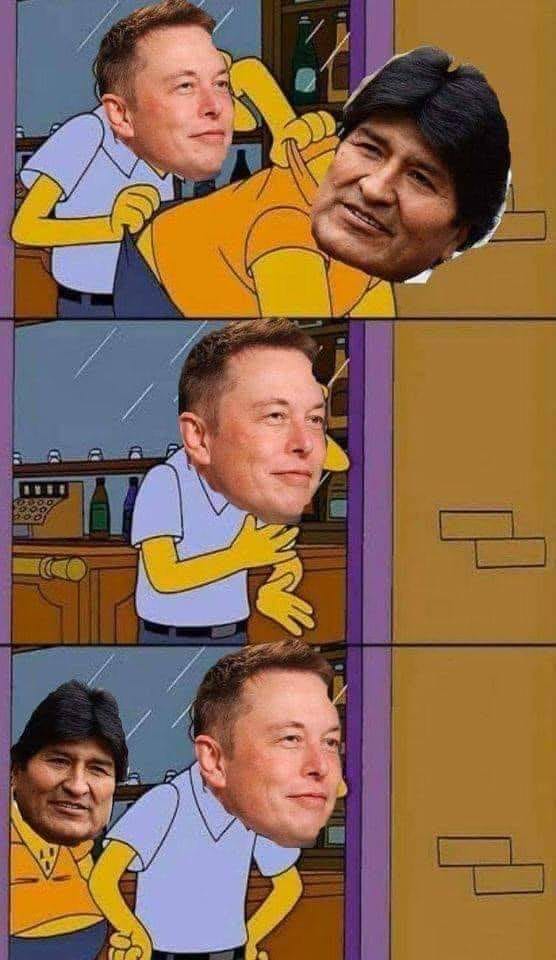
The meme is a play on the popular TV show "The Simpsons" character Ned Flanders' "Okily-Dokily" catchphrase, but in this version, it's replaced with "Elon's" and "Tesla's" logos. The image shows a person looking at a Tesla car with a surprised expression, implying that they've just realized that their "sustainable" electric car is actually a product of a capitalist corporation. The text "Okily-Dokily" is replaced with "Elon's" and "Tesla's" logos, implying that the person is now aware of the "okily-dokily" of the corporate system.
detailed-analysis (gemma3-27b-vision)
Okay, here's an analysis of the image, broken down into the requested theoretical frameworks. Since not all frameworks will apply equally or at all, I will omit sections that are not relevant.
Visual Description
The image is a digitally altered version of a four-panel meme originating from The Simpsons. The original meme depicts two characters standing shoulder-to-shoulder, with the top character looking down on the second character, and both looking slightly askance. The meme is commonly used to represent an indifferent or dismissive attitude towards a subordinate or someone perceived as less significant.
In this particular alteration, the face of Elon Musk has been superimposed onto the top character's body, while the face of Hugo Chávez (former President of Venezuela) has been superimposed onto the second character's body. Both figures appear to be inside Moe's Tavern, a recurring location in The Simpsons. The digital alteration is fairly basic, though noticeably present. The visual effect intends to create a juxtaposition that’s likely intended to be satirical or to communicate a specific power dynamic.
Foucauldian Genealogical Discourse Analysis
This meme can be analyzed through a Foucauldian lens focusing on power/knowledge relationships and the formation of discourse.
- Power Dynamics: The positioning of Musk 'looking down' on Chavez immediately establishes a power dynamic. The meme doesn’t merely depict power, but enacts it visually. The alteration reinforces a narrative of Western tech billionaires (Musk) as superior, or at least more visible and influential, to leaders from Global South nations like Chavez.
- Discursive Formation: The alteration draws upon pre-existing discourses about both Musk and Chavez. Musk is often framed in media as a disruptive innovator, a libertarian figure, and a symbol of entrepreneurial capitalism. Chavez, conversely, is often portrayed (especially in Western media) as an anti-imperialist, socialist, and polarizing figure. The meme mobilizes these pre-existing discourses, layering them onto the visual form.
- Genealogical Examination: A genealogical approach would examine how these discourses around Musk and Chavez were formed, the historical conditions that produced them, and the power struggles inherent in their construction. It would ask: what specific social, economic, and political forces shaped the narratives surrounding both figures? The meme operates within that history of power/knowledge relations, and serves to further construct/disseminate a particular interpretation.
- The “Game of Truth”: The meme is a performative act, an attempt to “speak the truth” about the perceived relationship between these figures. However, according to Foucault, truth is not objective but is constructed through discourse. This meme asserts a certain “truth” about the relationship between Musk and Chavez, but it does so through a highly subjective and biased lens.
Marxist Conflict Theory
This image clearly illustrates core concepts of Marxist conflict theory.
- Class Struggle: The meme implicitly represents a conflict between different social classes or systems. Musk embodies the interests of the capitalist class – wealth, innovation, and market domination. Chávez represented a socialist/anti-imperialist ideology that challenged capitalist structures, particularly within the context of Latin America.
- Ideology: The image reinforces a specific ideology. By positioning Musk as dominant, it tacitly validates the ideology of neoliberal capitalism and suggests its superiority over alternative political-economic systems. It can be seen as promoting the idea that entrepreneurial capitalism is the most effective means of development, and downplaying the critiques leveled against it by figures like Chávez.
- Power and Domination: The physical positioning of Musk “looking down” on Chávez symbolizes the power imbalance between capitalist powers and nations challenging that power. It visually encodes the notion that Western capitalism is dominant and that nations like Venezuela are subordinate.
- False Consciousness: One could argue that the meme promotes “false consciousness” among viewers by obscuring the historical and material conditions that led to the different trajectories of these two figures, and instead presenting a simplified, symbolic representation of their relationship.
Postmodernism
The meme embodies several characteristics of postmodern thought:
- Pastiche and Intertextuality: It utilizes a pre-existing visual form (the Simpsons meme) and combines it with recognizable figures (Musk and Chávez) to create a new, layered meaning. This is a characteristic of postmodern pastiche, where fragments of culture are recombined in unexpected ways.
- Deconstruction of Authority: By juxtaposing these two figures in a comedic and potentially critical way, the meme subtly undermines any notion of inherent authority or legitimacy. It challenges the narratives surrounding both figures and invites viewers to question their established roles.
- Simulacra and Simulation: The meme itself is a simulation of a power dynamic, rather than a genuine representation of the actual relationship between Musk and Chávez. The image becomes a “hyperreality,” where the signifier (the meme) becomes detached from the signified (the actual individuals and their political ideologies).
- Irony and Parody: The meme often relies on irony and parody to convey its message. The comedic framing may serve to conceal a more serious critique of power, capitalism, or political ideology.
Note: The interpretations above are not exhaustive and are open to debate. The meaning of a meme is always context-dependent and can vary depending on the viewer’s background and perspective.
Let me know if you’d like me to elaborate on any of these points or explore a different theoretical framework!
simple-description (llama3.2-vision)
This meme is a parody of the TV show "The Simpsons" scene where Homer Simpson is caught by his wife Marge in a compromising position. The image shows a split-screen of Homer's face with a shocked expression, followed by a shot of his wife's face with a "gotcha" expression. The text "Gotcha!" is written above the split-screen.
tesseract-ocr
ee wile ar | GC ne - i : ae bs a (ee. SY ry SN We Pe y Ee es pL SF i @ \ . | L i r sc a 24 PY : ~ ee | = Ce a = <a | >. : —~ Kaa 7 Wy a rit pa