First Seen
2023-05-10T21:03:33+00:00
simple-description (llama3.2-vision_11b)
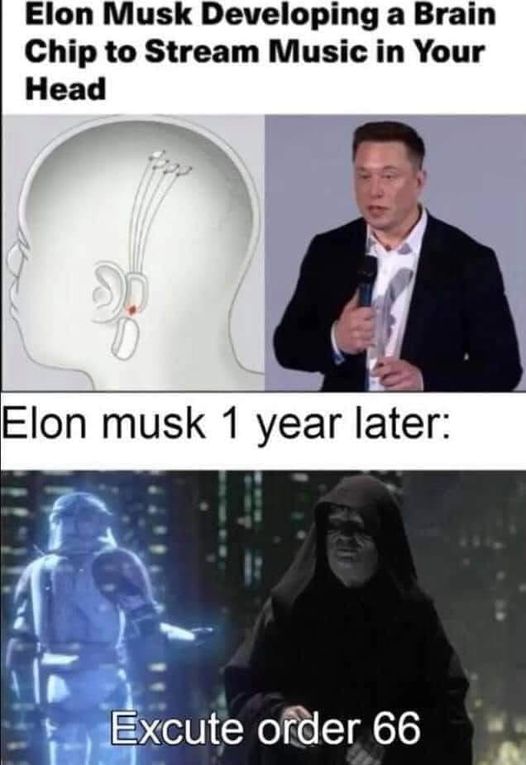
This meme is a commentary on the dangers of technological advancements, particularly those that prioritize profit over human well-being. The image shows a brain chip implanting a microchip into a person's brain, with the caption "Elon Musk developing a brain chip to stream music in your head" implying that the tech mogul is prioritizing profit over human well-being. The second image shows a person with a brain chip implanting a microchip into a person's brain, with the caption "Elon Musk 1 year later" implying that the tech mogul's brain chip has turned into a mind control device that forces people to obey his commands, with the text "Excuse order 66".
detailed-analysis (gemma3-27b-vision)
Okay, here’s an analysis of the meme, broken down into sections as requested. Given the nature of the meme, some sections will be more robust than others.
Visual Description
The meme is a two-panel comparison.
- Top Panel: The left side shows a simplified line drawing of a human brain with a tech-like implant. The right side shows a photo of Elon Musk speaking at an event, looking confident. The text above states “Elon Musk Developing a Chip to Stream Music in Your Head.”
- Bottom Panel: This features a still from Star Wars: Revenge of the Sith depicting a Jedi Master (Kit Fisto) being attacked by Darth Sidious, with the caption “Execute Order 66” overlaid. This scene is iconic, representing a betrayal and mass killing of the Jedi.
The overall effect is meant to be humorous, implying a dark, dramatic turn of events following the development of Neuralink.
Foucauldian Genealogical Discourse Analysis
This meme taps into a discourse surrounding technology, control, and the body. A Foucauldian analysis could explore the historical development of these discourses:
- Discipline & Surveillance: The meme evokes themes of discipline and surveillance. The brain implant isn't just about music; it's about access to the brain. This access immediately raises questions of control. Foucault would be interested in how power operates through technologies that penetrate and monitor the body. The implant represents a new level of control—not simply behavior, but thought itself.
- The Medical Gaze: The development of technology into the human body creates a “medical gaze” wherein the body is observed, analyzed, and subjected to intervention by experts. Neuralink embodies this.
- Genealogy of Control: Tracking the history of technologies designed to influence behavior (from religious practices to advertising to pharmaceuticals) would reveal a lineage of attempts to control the human subject. Neuralink would be the latest, and arguably most direct, iteration of this impulse.
- Discursive Formation: The meme relies on pre-existing discourses around the potential dangers of technological overreach, the hubris of tech billionaires, and the dystopian fears of surveillance.
Critical Theory
The meme can be analyzed through a critical theory lens, especially focusing on the concept of "instrumental reason" (Horkheimer and Adorno).
- Instrumental Reason: The meme suggests that the initial benevolent-sounding goal (streaming music directly into the brain) conceals a darker, more controlling impulse. The "Order 66" reference indicates a shift from providing a service to enacting a form of domination. This exemplifies how technological rationality, when divorced from ethical considerations, can lead to dehumanizing outcomes.
- The Culture Industry: The initial promise of easily accessible music feeds into the culture industry’s promise of pre-packaged and readily consumed entertainment. However, the "Order 66" twist suggests that this entertainment is not merely consumed, but a means of control and manipulation.
- Alienation: The brain implant, even with the promise of seamless entertainment, could be seen as furthering alienation from the self. If thoughts and experiences are mediated through technology, there's a loss of authentic experience.
Marxist Conflict Theory
This meme touches upon themes relevant to Marxist thought, though more subtly.
- Class Control: The technology developed by someone like Elon Musk is not accessible to everyone. This creates a power imbalance, where those who can afford or access the technology potentially have an advantage (or are subjected to more intense control).
- Commodification of Consciousness: The meme hints at the potential for the commodification of consciousness. If thoughts and experiences can be accessed and manipulated through a brain implant, they become another resource to be exploited for profit.
- The Role of the Capitalist: Elon Musk, as a symbol of capitalist innovation, is positioned as the agent of this potentially oppressive technology. The “Order 66” reference positions him as a figure wielding immense power over the masses.
- False Consciousness: The meme could be interpreted as a commentary on how technology is presented as liberating, while actually reinforcing existing power structures. The initial promise of streaming music hides a darker reality.
Postmodernism
The meme utilizes several postmodern characteristics:
- Intertextuality: The reliance on a reference to Star Wars is a prime example of intertextuality—mixing different cultural texts to create new meaning. The reference isn't just about the Star Wars universe; it's a shorthand for betrayal, power, and control.
- Parody & Irony: The juxtaposition of a seemingly benevolent technological innovation with a scene of galactic genocide is deeply ironic. The meme subverts the expected narrative of technological progress.
- Simulation & Hyperreality: The meme implies a blurring between reality and simulation. The brain implant creates a mediated experience, making it difficult to distinguish between authentic experience and technologically generated input.
- Deconstruction of Meta-Narratives: The meme challenges the dominant meta-narrative of technological progress as inherently positive. It suggests that technology can be used for oppressive purposes.
Queer Feminist Intersectional Analysis
While not the primary focus of the meme, some intersectional analysis is possible:
- Surveillance & Control of Bodies: The meme’s themes of surveillance and control over the body are particularly relevant to feminist and queer concerns. Historically, women's bodies and queer bodies have been subject to heightened surveillance and control. The brain implant represents a new level of intrusion into the most private space – the mind.
- Technological Bias: The development of technologies like Neuralink often occurs within a predominantly white, male, and privileged context. This can lead to biases in the technology's design and implementation, potentially marginalizing or harming other groups.
- Data Privacy & Vulnerability: The data collected from brain implants could be used to discriminate against certain groups or to reinforce existing power structures. Vulnerable populations could be particularly at risk.
- Representation: The creator of Neuralink, Elon Musk, is a prominent figure known for problematic behavior and rhetoric that intersects with patriarchal and anti-feminist views.
Let me know if you'd like me to elaborate on any of these sections, or if you'd like me to analyze the meme through a different theoretical lens.
simple-description (llama3.2-vision)
This meme is a humorous commentary on the rapid progress of artificial intelligence. It features a split-screen image with a top section that reads "Elon Musk Developing a Brain Chip to Stream Music in Your Head" and a bottom section that says "Elon Musk 1 year later". The top section shows a simple illustration of a brain with a small chip implanted in it, while the bottom section features a dark and ominous image of Elon Musk with a sinister tone, saying "I'll just use it to control the world".
tesseract-ocr
Elon Musk Developing a Brain Chip to Stream Music in Your Head ; oN o f | 4 =) Elon musk 1 year later: ts ; : Ea eines v cute ofder 66