First Seen
2023-05-10T21:03:33+00:00
simple-description (llama3.2-vision_11b)
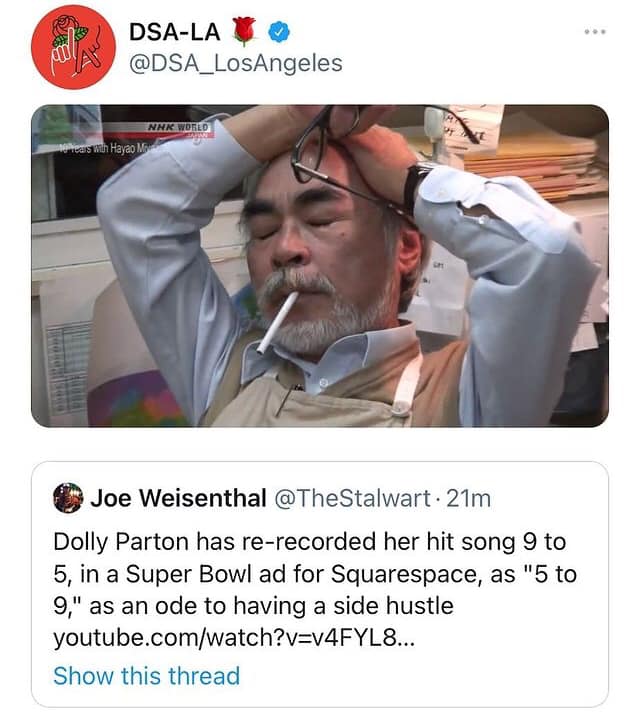
The meme features a photo of a person with a look of exhaustion, accompanied by a quote from a 1980s song by the band "The 1980s" that reads: "You're not going to get a job, you're not going to get a job, you're not going to get a job, you're not going to get a job". The meme is a commentary on the struggles of the working class, highlighting the difficulties of finding employment and the lack of job opportunities.
detailed-analysis (gemma3-27b-vision)
Okay, let's break down this Twitter post through the lenses you've requested. It's a complex image and situation, so the depth of analysis will vary depending on how applicable each theory is.
Visual Description
The image shows an older man intensely pouring a dark liquid (likely coffee) into a mug. He is seated at a desk, wearing a patterned shirt, and appears to be in a domestic or office setting, with a screen showing Japanese characters in the background. He’s using a gooseneck kettle and focusing intently on the task, almost with a meditative quality. The lighting is bright and the overall aesthetic is slightly quirky and amateur, resembling a candid shot rather than a professionally staged photo. The image is paired with a Twitter post regarding Dolly Parton's re-recording of "9 to 5" for a Squarespace ad. The post notes the song is now "5 to 9" as an ode to having a side hustle.
Marxist Conflict Theory
This image, when paired with the tweet, is rich for a Marxist analysis. The core of the issue is the commodification of labor and the current cultural push toward "side hustles."
- Exploitation of Labor: Traditionally, "9 to 5" represented the standardized working day, a constraint on labor. Now, it's being flipped to "5 to 9", celebrating additional work. This is a shift that can be interpreted as normalizing increased exploitation. Capitalism demands constant growth and expansion, meaning workers are encouraged to fill every moment with productive (and profitable) activity.
- False Consciousness: The ad and the framing of the "5 to 9" side hustle tap into the ideology of individualism and entrepreneurialism. It implies that success is achievable through hard work and initiative, masking the systemic inequalities that make upward mobility difficult for many. The image of the man intently making his coffee could symbolize the need for increased productivity and preparation for a demanding workload.
- Alienation: The embrace of the "side hustle" culture can lead to further alienation from one's work. The constant pressure to generate income outside of primary employment can erode boundaries between work and personal life, diminishing one’s ability to find fulfillment or meaning in labor.
- Class Issues: The side hustle often becomes a necessity for those in lower economic brackets to make ends meet, but is presented as an option to increase income, disguising the structural inequalities which force this dependence.
Critical Theory
Critical Theory is closely related to Marxism but has a broader scope. This image and situation invite analysis concerning the role of culture industry and its influence on our perceptions of work and success.
- Commodification of Culture: Dolly Parton's song, originally a critique of workplace alienation, is now repurposed for a commercial, contributing to the blurring of lines between art, commerce, and ideology. This re-appropriation is a classic example of how the culture industry co-opts dissent and transforms it into a commodity.
- Ideological Reproduction: The "5 to 9" framing normalizes a particular worldview about work: one where perpetual productivity is valorized. This ideology is reproduced through media (like the ad) and social media (like this Twitter post), shaping our beliefs and expectations.
- Normalization of precarity: By encouraging and celebrating constant work, the system can avoid acknowledging and dealing with the structural reasons people need to pursue multiple income streams. It individualizes a systemic problem.
Postmodernism
Elements of Postmodernism are present in the image and situation.
- Pastiche & Recontextualization: The reworking of "9 to 5" into "5 to 9" is a clear example of pastiche – taking an existing cultural artifact and recontextualizing it. This act diminishes the original song's critical message and transforms it into a marketing tool.
- Hyperreality: The ad might be said to contribute to a hyperreal landscape, where representations of work and success become more important than the actual experiences. The meticulously crafted image (even if candid-looking) and the emphasis on a lifestyle of constant productivity create a sense of artificiality.
- Deconstruction: The reversal of “9 to 5” can be seen as a deconstruction of the traditional work day. While this is primarily a marketing tactic, it taps into the postmodern tendency to challenge established norms and conventions.
Foucauldian Genealogical Discourse Analysis
Applying a Foucauldian lens, we can examine how the discourse around work has shifted and how power operates through this shift.
- Shifting Disciplinary Practices: The historical discourse around work has evolved from one of necessity and hardship to one of self-improvement and entrepreneurialism. This shift reflects a change in disciplinary practices – how individuals are regulated and controlled through social norms and expectations.
- Power/Knowledge: The advertisement operates as a form of power/knowledge. It presents a particular understanding of work as inherently desirable and empowering, thereby influencing how we think about and experience labor.
- Panopticism: The image of the man intensely focused on his coffee can be read as a metaphor for the self-disciplining individual. The constant pressure to be productive creates a sense of internal surveillance, where we monitor and regulate our own behavior in accordance with societal expectations.
Queer Feminist Intersectional Analysis
This is the least direct application of these theories, but still relevant.
- Unpaid Labor and Gender: While the ad promotes the concept of a side hustle, it does not address the uneven distribution of unpaid labor, which disproportionately falls on women. Women often bear the brunt of housework, childcare, and emotional labor, leaving them with fewer resources to pursue additional income streams.
- Precarity and Marginalization: Intersectional identities (race, class, gender, sexuality) all interact to shape access to economic opportunities. Marginalized groups may face additional barriers to pursuing side hustles, such as lack of access to capital, education, or networks.
- Deconstruction of the "Ideal Worker": Traditional notions of the "ideal worker" often prioritize male characteristics and exclude those who do not fit this mold. Queer and feminist critiques challenge this notion and advocate for a more inclusive and equitable understanding of labor.
Let me know if you'd like me to elaborate on any of these points, or explore another theoretical angle!
simple-description (llama3.2-vision)
The meme is a screenshot of a video of an elderly Japanese man, known as "Hikikomori" or "Kokoro", who is a YouTube personality known for his eccentric and often disturbing behavior. The image shows him looking disheveled and stressed, with a cigarette in his mouth and a look of exhaustion on his face. The text in the image reads: "I'm not a doctor, but I'm a doctor."
tesseract-ocr
i DSA-LA B @ Gee / @DSA_LosAngeles ee Se — . - en - — 1 7 < : = Lil / gr, A @ Joe Weisenthal @TheStalwart- 21m Dolly Parton has re-recorded her hit song 9 to 5, in a Super Bowl ad for Squarespace, as "5 to 9," as an ode to having a side hustle youtube.com/watch?v=v4FYL8... Show this thread