First Seen
2023-05-10T21:03:33+00:00
simple-description (llama3.2-vision_11b)
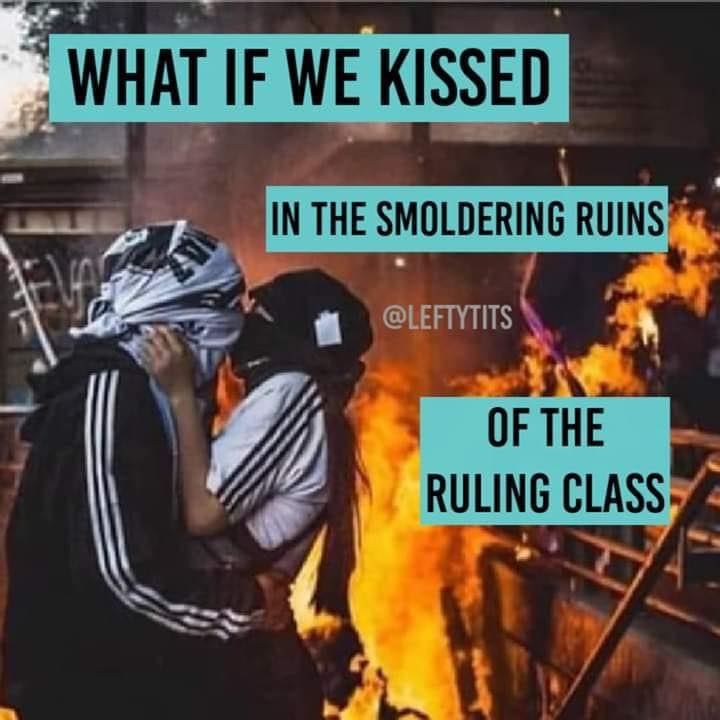
The meme is a humorous take on the idea of a romantic kiss in a post-apocalyptic or dystopian setting. The text "What if we kissed in the smoldering ruins of the ruling class" implies a scenario where two people are embracing in the midst of a catastrophic event, with the implication that the "ruling class" has been destroyed. The tone is playful and ironic, poking fun at the idea of romance in the face of disaster.
detailed-analysis (gemma3-27b-vision)
Okay, here's an analysis of the image, broken down into sections as you requested, focusing on areas where the image lends itself to the suggested theoretical frameworks. I will note if a section isn't particularly strong based on the image.
Please note: This is an interpretation based solely on the image and the text on it. A fuller understanding would require the context of where this image was posted/shared.
1. Visual Description
The image depicts two figures, viewed from the back, standing in front of a dramatic and intense blaze. The figures are wearing some kind of head coverings (possibly bandanas or scarves), and what appears to be tactical gear or a harness. One figure has a dark backpack. The fire is the dominant visual element, consuming what appears to be a structure of some sort. It’s bright orange and engulfs a significant portion of the frame, suggesting a large-scale destruction event. Text overlays the image reading "WHAT IF WE KISSED IN THE SMOLDERING RUINS OF THE RULING CLASS" and a social media handle, @leftytits. The color scheme is dominated by dark tones contrasted with the bright, hot colors of the fire. There is graffiti on the wall behind the figures.
2. Marxist Conflict Theory
This is the most readily applicable theoretical framework. The core message of the image is explicitly aligned with Marxist ideas.
- Class Struggle: The phrase "THE RULING CLASS" immediately identifies a central tenet of Marxism: the existence of antagonistic social classes. The image implies a desire for the overthrow or destruction of this dominant class.
- Revolution & Destruction: The fire represents a cataclysmic event—a potential revolution—designed to dismantle the existing power structure. The "smoldering ruins" symbolize the aftermath of this struggle.
- The Role of the Proletariat: While the figures aren't explicitly identified, their appearance suggests individuals participating in (or celebrating) the upheaval. They can be interpreted as representing the oppressed class actively challenging the status quo.
- Romanticization of Rebellion: The phrase “What if we kissed…” takes a decidedly romantic tone and frames revolutionary action not as brutal conflict but as a passionate, intimate act. This can be seen as a tactic to glamorize and encourage revolutionary action.
3. Foucauldian Genealogical Discourse Analysis
While subtle, a Foucauldian lens can shed light on how power operates within the image.
- Power/Knowledge: The phrase "Ruling Class" itself reveals the construction of power. It’s not inherent but established through discourse and social constructions of what constitutes “ruling.” The image implicitly challenges this constructed order.
- Disrupting Norms: The juxtaposition of a potentially violent scenario (a revolution) with the intimate act of kissing is a disruption of conventional norms. Foucault would be interested in how this challenges accepted ways of thinking about power, intimacy, and resistance.
- Genealogy of Power: The image invites us to consider the historical lineage of the “ruling class” and how their power has been established and maintained. The ruins suggest a rejection of that history.
4. Queer Feminist Intersectional Analysis
The image has potential for intersectional analysis, particularly if understood within a specific socio-political context.
- Subversion of Traditional Romance: The romantic framing of revolution challenges the traditional association of romance with stability and the existing social order. It posits a radical alternative where intimacy is intertwined with upheaval.
- Reclaiming Spaces: The "smoldering ruins" could be seen as a space reclaimed from oppressive structures, offering a potential for creating new, more equitable social arrangements.
- Solidarity & Collective Action: The presence of two figures implies a collective act of resistance, hinting at the power of solidarity and coalition-building.
- The Social Media Handle: The account name @leftytits, suggests a radical and feminist-aligned perspective.
5. Postmodernism
The image exhibits some elements of postmodern thought.
- Deconstruction of Grand Narratives: The image implicitly rejects the “grand narrative” of the established order and its claims to legitimacy. It presents an alternative vision, even if only as a provocative question.
- Fragmentation & Juxtaposition: The jarring combination of a violent backdrop with a romantic sentiment creates a sense of fragmentation and challenges conventional modes of representation.
- Irony & Playfulness: The phrasing "What if we kissed..." can be seen as ironic and playful, undermining the seriousness of the revolutionary context. This is a common postmodern tactic.
6. Critical Theory
Critical Theory, broadly, is present in most of the above analyses. It provides the overarching framework for challenging power structures and examining the social and historical contexts that produce them.
Important Considerations:
- Context is Crucial: The meaning of this image is heavily dependent on the context in which it's shared. Knowing where it originated, the intent of the creator, and the audience it's directed toward would provide further insight.
- Ambiguity: The image is intentionally provocative and open to interpretation. It doesn't offer a clear-cut message but rather invites viewers to contemplate the possibilities of radical change.
I hope this analysis is helpful. Let me know if you'd like me to elaborate on any particular aspect.
simple-description (llama3.2-vision)
The meme is a humorous take on a hypothetical situation where a couple would react if they were in a classroom and kissed in the middle of a lesson. The text "WHAT IF WE KISSED IN THE SMOLDERING RUINS OF THE SCHOOL" is overlaid on an image of a couple embracing in front of a burning building.
tesseract-ocr
: *., See p — A 2 ; 7 RUINS way As te SOLE uINs”* a \ g (Glens \ an I], ~ OFTKE j Vi RULING CLASS ua o , rh } at ay fi a t ~~. ¥ a f ;