First Seen
2023-05-10T21:03:33+00:00
simple-description (llama3.2-vision_11b)
In the context of anti-capitalism, this meme is a humorous critique of the capitalist system's emphasis on profit over people. The image of a giant, grotesque, and absurdly expensive sandwich being served to a poor, starving individual, with the caption "I'm not a sandwich, I'm a human being!" is a satirical commentary on the exploitation of the working class and the prioritization of corporate profits over human well-being.
detailed-analysis (gemma3-27b-vision)
Okay, here's a multi-faceted analysis of the image, broken down into the requested sections. It's quite a provocative image, and lends itself well to these critical lenses.
Please note: This analysis will necessarily be interpretative and will draw connections based on the image and the cultural context.
Visual Description
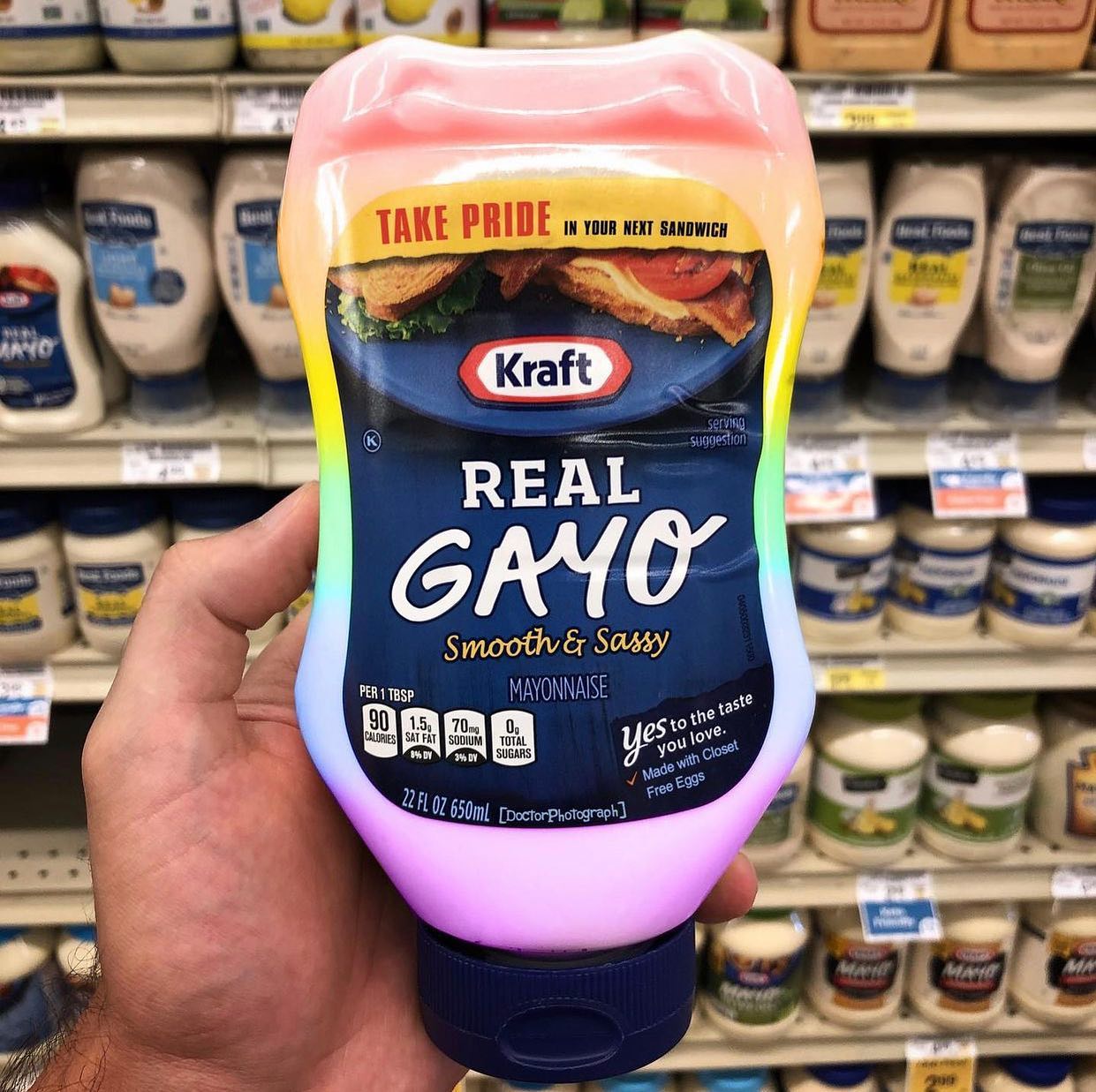
The image showcases a brightly colored, pink squeeze bottle of mayonnaise. The branding has been modified: The word "Real" is present, but the rest of the product name has been altered to read "GAYO," using a playful and intentionally handwritten-looking font. The bottle is surrounded on a supermarket shelf with a multitude of conventional mayonnaise bottles, which are a standard white color. A banner across the top of the bottle reads "Take Pride in Your Next Sandwich." The nutrition facts are visible. A cartoon sandwich image is also present. The overall impression is one of deliberate subversion and a playful hijacking of a mainstream product.
Foucauldian Genealogical Discourse Analysis
Michel Foucault’s work focuses on how power operates through discourse, shaping our understandings and categorizing things. This image can be examined through that lens.
- Discourse of Normalcy: The standard white mayonnaise bottles represent the established “norm” of both the product and of heteronormative expectations. White is frequently coded as pure, neutral, and conventional.
- Disrupting Categorization: By altering the label to "GAYO," the image disrupts this established categorization. It forces a re-evaluation of what mayonnaise is and how it relates to identity. It introduces the concept of queerness (represented by the altered name) into a seemingly neutral, mundane object.
- Power/Knowledge: The act of rebranding isn't simply an aesthetic change. It’s a claim. It signals that the LGBTQ+ community is not an “other” to be separate from everyday life but is a part of everyday life. The “power” lies in the ability to redefine meaning and insert queerness into this space.
- Genealogy of “Pride”: The "Take Pride" banner is significant. Historically, "Pride" is a political statement rooted in LGBTQ+ resistance and visibility. By associating it with a mundane food item, the image highlights how LGBTQ+ identity has become increasingly integrated into consumer culture (and, arguably, diluted/commodifed).
Critical Theory
This image can be seen as an example of how capitalist systems appropriate and neutralize radical ideas.
- Commodification of Identity: The rebranding transforms a political identity ("gay," "LGBTQ+") into a marketable product. This is a common critique of “rainbow capitalism” – where corporations profit from LGBTQ+ visibility without necessarily addressing systemic issues.
- False Consciousness: The image could be interpreted as potentially fostering a "false consciousness." It presents a superficially inclusive message (supporting LGBTQ+ rights) without addressing the underlying economic and social inequalities faced by the community. The image gives a feeling of support, but may do little to help the actual issues.
- Cultural Hegemony: The image illustrates how dominant ideologies (capitalism and heteronormativity) can be reinforced even while seemingly challenging them. By incorporating queer imagery into consumer goods, capitalism absorbs and neutralizes potential resistance.
Marxist Conflict Theory
From a Marxist perspective, the image exemplifies the struggle between those who have power and those who do not.
- Class Struggle: While on the surface, this image seems to promote inclusivity, the act of rebranding a product is ultimately driven by profit motive. It's about capturing a specific market segment (the LGBTQ+ community and allies) to increase sales. This can be seen as a form of exploitation, as the image capitalizes on a historically marginalized group’s identity.
- Commodity Fetishism: The image contributes to the "commodity fetishism" described by Marx. It obscures the exploitative labor practices and power dynamics involved in the production and distribution of the mayonnaise itself. We focus on the branding and the message, not on the underlying conditions.
- Capitalism and Identity: This image exemplifies how capitalism increasingly commodifies identity and uses it as a marketing tool. The LGBTQ+ community is transformed into a "target demographic," reducing complex identities to purchasing power.
Postmodernism
The image embodies many characteristics of postmodern thought.
- Deconstruction of Meaning: The alteration of the mayonnaise label "deconstructs" the assumed meaning of the product and its branding. It challenges the idea that a product can have a fixed, stable identity.
- Intertextuality: The image relies on intertextuality – the relationship between different texts and cultural references. It draws on the history of LGBTQ+ activism, the iconography of "Pride," and the conventions of advertising.
- Simulation and Hyperreality: The image could be seen as a "simulation" of inclusivity. It creates the appearance of support for the LGBTQ+ community without necessarily enacting genuine change. This contributes to a "hyperreality" where the line between representation and reality becomes blurred.
- Playfulness and Irony: There's a playful, ironic quality to the image. The juxtaposition of a mundane product with a politically charged label creates a sense of absurdity and challenges conventional expectations.
Queer Feminist Intersectional Analysis
This image lends itself to a Queer Feminist Intersectional analysis, which focuses on how various forms of oppression intersect.
- Visibility and Erasure: The altered label creates visibility for the LGBTQ+ community. However, this visibility is achieved within a capitalist framework, which can also lead to erasure and tokenism.
- Commodification of Queer Identity: The image raises questions about the commodification of queer identity. Does marketing "queer-friendly" products genuinely support the community or simply profit from it?
- Intersectional Marginalization: It is important to consider how this image might interact with other forms of oppression. For example, how might the image be viewed by LGBTQ+ people of color, who experience both queerphobia and racism? The image does not explore this, and the "Pride" message could come across as centered on the experiences of white LGBTQ+ individuals.
- Challenging Norms: The image disrupts the heteronormative assumption that products should be marketed to a "universal" audience. It recognizes and caters to a specific community, challenging dominant norms.
I hope this detailed analysis is helpful! Let me know if you'd like me to elaborate on any specific aspect.
simple-description (llama3.2-vision)
This meme is a play on the "Is it a bird? Is it a plane?" phrase from Superman, but with a twist. The image shows a person holding a bottle of "Mayo" (a type of condiment) and the text "Is it a condiment? Is it a sauce?" is written above it. The joke is that the person is trying to determine the identity of the "Mayo" bottle, but it's actually a bottle of "Mayoclinic" (a medical clinic) and the person is saying "Is it a clinic? Is it a hospital?"
tesseract-ocr
1) ii ten ae . — . : iniheoes hee { IN YOUR NEXT SANDWICH ey or Kd i « rao Y ne \ . ® 3 aS | fi 4 Perey ; Ts a ‘4 : . a Wa Kraft x ~R — = ee \ oO = —_— ce ——— - re Ties Cede es BA Sree eR = . ~ - / cay MAYONNAISE af lke = ) 99 . te ae od Coos fF e Es oer “dl — x os D 2FL 07 maces oe se ~ a a ” Se aa — oe e i s i . Abt oy ) pa - vnc it a ee oe Whe L = a, ————— —_