First Seen
2023-05-10T21:03:33+00:00
simple-description (llama3.2-vision_11b)
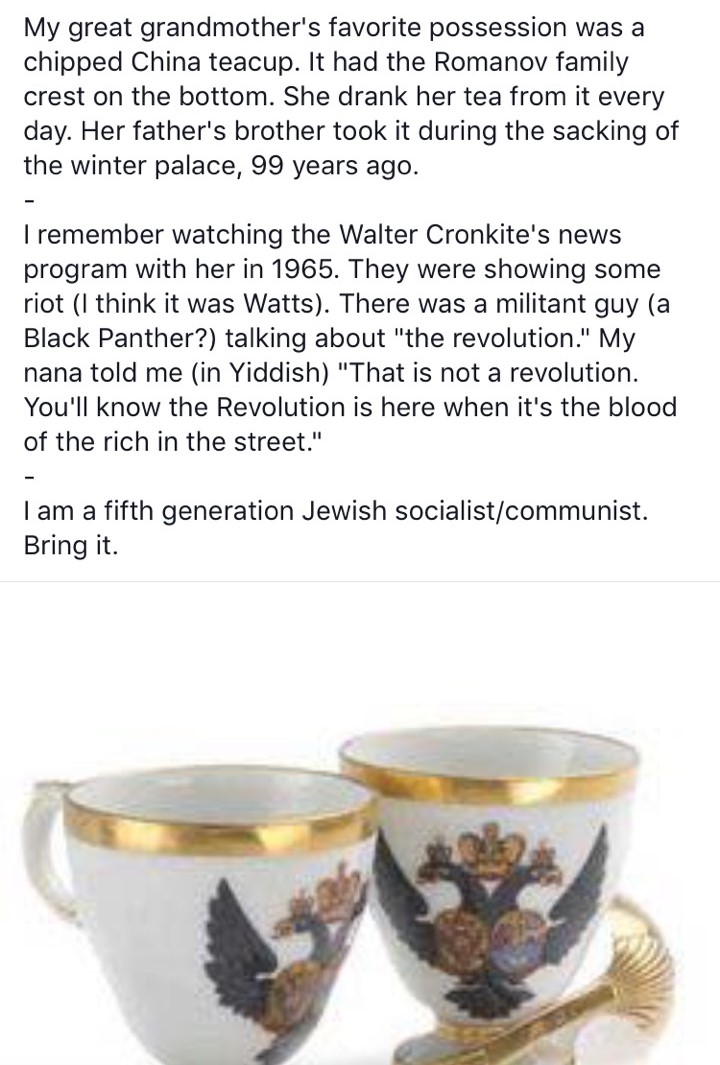
The meme is a satirical take on the Russian Revolution and the Romanov family's history. The image shows a tea cup with a Russian imperial eagle design, and the text is a fictionalized account of a family's history and a commentary on the Russian Revolution. The text is presented as a family history, but it's actually a commentary on the Russian Revolution and the Romanov family's history, using the tone of a family history to make a commentary on the Russian Revolution.
detailed-analysis (gemma3-27b-vision)
Okay, let's break down this evocative short text and image, applying relevant theoretical lenses where applicable. It's important to note that the text is rich in potential interpretation, and these aren't exhaustive analyses but starting points.
Visual Description
The image depicts a delicately painted porcelain teacup and saucer. The porcelain appears chipped, particularly around the rim of the cup, suggesting age and a history of use. The decoration is intricate, featuring floral motifs in gold and a coat of arms (likely the Romanov family crest as stated in the text) painted on the underside. The color palette is muted, with cream, gold, and touches of green and pink dominating. The object is clearly a luxury item, displaying craftsmanship and a visual indication of aristocratic origins. Its current state—chipped, but still in use—suggests resilience and a layered history.
Marxist Conflict Theory
This text is heavily infused with Marxist conflict theory. The core of the passage hinges on the grandmother's lived experience of class and revolution, and the statement, "You'll know the Revolution is here when it’s the blood of the rich in the street.” This is a classic Marxist proposition: revolution isn’t a polite request for change, but a violent overturning of the existing power structure.
- Historical Materialism: The teacup is a material object, imbued with historical significance. It represents the material culture of the Romanov dynasty, a symbol of aristocratic privilege. Its acquisition during the sacking of the Winter Palace represents a shift in ownership and a dismantling of the old order.
- Class Struggle: The grandmother's pronouncement directly identifies class as the central conflict. The "blood of the rich" signifies the overthrow of the ruling class. It suggests that real social change requires radical action, not incremental reform.
- Alienation: The grandmother's perspective, as a descendant of someone who took the cup, hints at a complex relationship to ownership and dispossession. She isn't simply admiring a beautiful object; she’s aware of its origin in exploitation.
- Fifth Generation Socialist/Communist: The author’s self-identification adds another layer to the discussion, demonstrating the sustained importance of these class struggles for her family.
Foucauldian Genealogical Discourse Analysis
A Foucauldian reading would focus on the discourses surrounding revolution, ownership, and power.
- Power/Knowledge: The teacup is not simply an object; it embodies power. It signifies the power of the Romanov dynasty, but also the power of those who seized it. The grandmother's knowledge, passed down through generations, is a form of power itself. The statement about the "blood of the rich" is a powerful articulation of revolutionary discourse.
- Genealogy: The grandmother’s statement, as remembered and passed down, represents a genealogy of revolutionary thought. It’s a tracing of the historical evolution of ideas about power, class, and change.
- Discursive Formation: The concept of "revolution" itself is a discursive formation— a historically contingent set of meanings, practices, and institutions. The grandmother challenges a conventional understanding of revolution as something abstract or peaceful, instead framing it as a brutal and visceral event.
Critical Theory
This passage lends itself well to a broadly Critical Theory approach, which questions societal power structures and their effects.
- Ideology: The teacup, as a symbol of aristocratic privilege, can be seen as an embodiment of ideology. The grandmother’s statement, however, disrupts this ideology by exposing the violence and exploitation underlying it.
- Emancipation: The grandmother’s advocacy for radical change, while stark, suggests a desire for emancipation from oppressive social structures.
- The Role of Memory: The author’s recalling the scene and repeating her grandmother's words demonstrates the importance of memory in resisting dominant narratives and preserving alternative visions of the future.
Postmodernism
While not the central lens, certain aspects align with postmodern thought:
- Deconstruction: The grandmother’s definition of revolution "deconstructs" traditional understandings of the term. She rejects the idea of a neat, peaceful transition and insists on its violent reality.
- Meta-Narratives: The passage implicitly questions grand narratives of progress and historical inevitability. The grandmother’s perspective suggests that history is not a linear progression towards a better future, but a messy, contested struggle for power.
- Subjectivity/Relativism: The personal nature of the passage — a memory passed down through generations — emphasizes the subjective and relative nature of knowledge and truth.
Important Note: It’s crucial to recognize that these are just interpretations. The richness of the text lies in its ambiguity and openness to multiple readings.
Let me know if you'd like me to expand on any of these points or explore other theoretical frameworks!
simple-description (llama3.2-vision)
This meme is a humorous comparison between two different types of tea cups. The text on the image reads: "My great-grandmother's favorite tea cup was a Russian Imperial Eagle cup. My great-grandmother's favorite tea cup was a Russian Imperial Eagle cup. I remember watching the Walter Cronkite's news program in 1965. They were showing some riot (I think it was Watts). There was a militant guy (a Black Panther?) talking about 'the revolution.' My grandmother told me (in Yiddish) 'That is not a revolution. You'll know the revolution is here when it's the blood of the rich in the streets.' I am a fifth-generation Jewish socialist/communist. Bring it."
tesseract-ocr
My great grandmother's favorite possession was a chipped China teacup. It had the Romanov family crest on the bottom. She drank her tea from it every day. Her father's brother took it during the sacking of the winter palace, 99 years ago. | remember watching the Walter Cronkite's news program with her in 1965. They were showing some riot (| think it was Watts). There was a militant guy (a Black Panther?) talking about "the revolution." My nana told me (in Yiddish) "That is not a revolution. You'll know the Revolution is here when it's the blood of the rich in the street." lam a fifth generation Jewish socialist/communist. Bring it. — — we = a ~. am