First Seen
2023-05-10T21:03:33+00:00
simple-description (llama3.2-vision_11b)
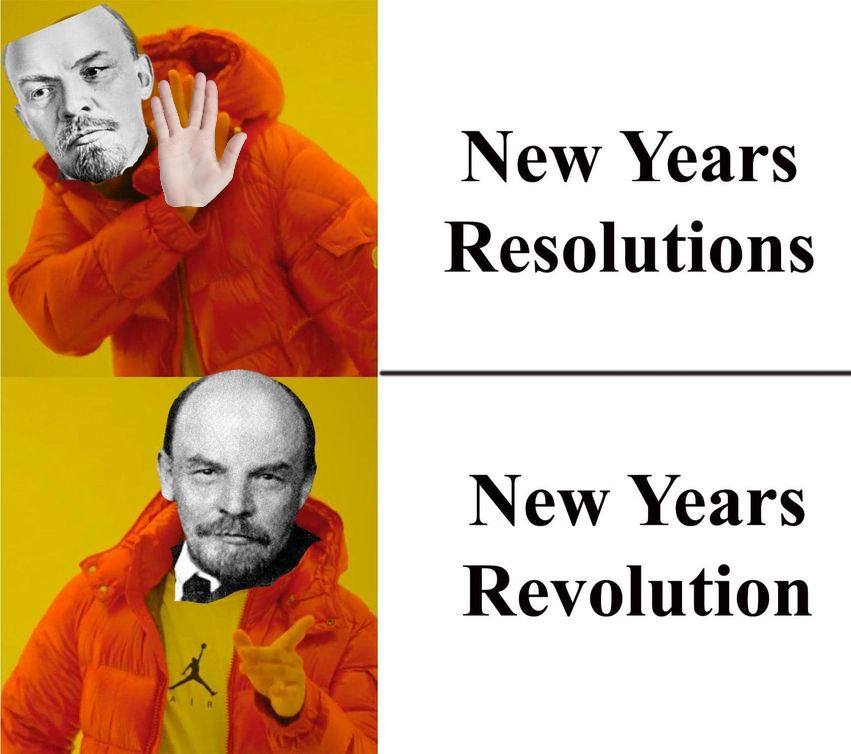
The meme is a play on the "Distracted Boyfriend" meme, but with a twist. It features a split image of a man looking at two different "New Year's Resolutions" on a white background. The left side shows a traditional "New Year's Resolutions" text, while the right side shows a "New Year's Revolution" text, implying a shift from traditional goals to a more radical, anti-capitalist approach.
detailed-analysis (gemma3-27b-vision)
Okay, let's break down this meme using the requested theoretical frameworks. It’s a fascinating piece to analyze because of its ironic juxtaposition.
Visual Description
The image is a "drakeposting" meme format, featuring two panels. Each panel depicts a portrait of Vladimir Lenin, overlaid onto a stock photo of a man wearing a bright orange puffer jacket.
- Top Panel: Lenin is presented with a slightly bemused expression, with a hand raised as if in a halting gesture. The text "New Years Resolutions" is to the right.
- Bottom Panel: Lenin appears more intensely focused, even scowling slightly. He’s wearing a t-shirt with the Jumpman logo from Air Jordans visible under the puffer jacket. The text "New Years Revolution" is to the right.
The meme heavily relies on the ironic juxtaposition of Lenin’s historical figure and revolutionary ideology with a trendy, contemporary aesthetic.
Marxist Conflict Theory
This meme is deeply rooted in Marxist Conflict Theory, but does so in an ironically playful manner.
- Class Struggle & Symbolic Reversal: The core of Marxism is the struggle between classes. Here, the meme ironically associates a historical figure leading a proletarian revolution with consumer culture (the puffer jacket, the Air Jordans). This can be seen as a symbolic "flipping" of the expected relationship – the revolutionary is now implicated in the very system he supposedly opposed.
- Ideology & False Consciousness: The meme highlights how ideology can be co-opted and commodified. Lenin, a symbol of radical change, is repackaged as part of consumer culture, potentially reinforcing the status quo by disarming his revolutionary message. The meme asks whether revolutionary desires are easily subsumed by the capitalist marketplace.
- The Spectacle: (borrowing from Guy Debord, a Marxist theorist): The puffer jacket and Jordan shoes are visual manifestations of ‘the spectacle’, representing a society where images and superficiality have replaced genuine social relationships and authentic experience. By dressing Lenin in this attire, the meme suggests that even revolutionary figures can be consumed by the spectacle.
Foucauldian Genealogical Discourse Analysis
Applying a Foucauldian lens to this meme reveals how power operates through discourse and the creation of knowledge.
- Discursive Formation of Lenin: How has the image and "meaning" of Lenin been constructed and changed over time? The meme intervenes in this formation by presenting a radically different "Lenin" – one who is fashionable, trendy, and potentially domesticated. This is a disruption of traditional discourse around him.
- Power/Knowledge: The image demonstrates how power and knowledge are interconnected. The meme takes a historical figure with significant political power (Lenin) and "re-codes" him through the discourse of contemporary consumer culture, effectively shifting his perceived power. The image suggests that even revolutionaries can be absorbed and "managed" by dominant cultural forces.
- Genealogy & Discontinuity: A genealogical analysis would explore the historical shifts in how Lenin has been represented, from revolutionary icon to a fashion statement. The meme isn't interested in establishing a coherent "truth" about Lenin, but rather in exposing the contingency and discontinuity of his image.
Postmodernism
The meme embodies many core tenets of Postmodernism:
- Pastiche & Irony: The juxtaposition of Lenin and the contemporary fashion is a clear example of pastiche – a playful imitation of different styles and eras. The humor and meaning come from the irony of the unexpected combination.
- Deconstruction of Grand Narratives: Postmodernism questions grand narratives (like the inevitable progress of history, or the triumph of revolution). This meme subtly undermines the seriousness of revolutionary ideals by placing them in the context of consumer culture, suggesting that even radical change can become trivialized.
- Simulation & Hyperreality: The meme creates a "hyperreal" image of Lenin – one that’s more of a simulation of a revolutionary than an authentic representation. The image becomes detached from its historical roots, becoming a surface-level signifier divorced from its original meaning.
Critical Theory
More broadly, this meme engages with central tenets of Critical Theory:
- Critique of Culture Industry: (Adorno & Horkheimer): The puffer jacket and shoes are products of the culture industry, designed to create conformity and mass consumption. The image points to how even radical ideas can be absorbed and neutralized by the forces of mass culture.
- Domination and Resistance: The meme presents a complex relationship between domination and resistance. On one hand, it acknowledges the power of consumer culture to co-opt even revolutionary symbols. On the other hand, the meme itself can be seen as a subversive act – a critical intervention that challenges dominant ideologies.
Please note: I've intentionally avoided applying Queer Feminist Intersectional Analysis, as it doesn't feel particularly relevant or fitting for the core message of the meme. While any image can be subjected to that kind of analysis, it would feel forced and dilute the insights gained from the more directly applicable frameworks.
I hope this provides a comprehensive analysis of the meme! Let me know if you'd like me to elaborate on any specific point.
simple-description (llama3.2-vision)
This meme is a humorous comparison between two images. The top image features a person with a "don't care" expression, while the bottom image shows the same person with a "I care" expression. The text "New Year's Resolutions" and "New Year's Revolutions" is written on the left and right sides of the image, respectively.
tesseract-ocr
— ie < WV % wed ‘A New Years SP ede . Jee =RResolutions _ on ‘SS - =e f 2 4 | New Years —2 Revolution je ah