First Seen
2023-05-10T21:03:33+00:00
simple-description (llama3.2-vision_11b)
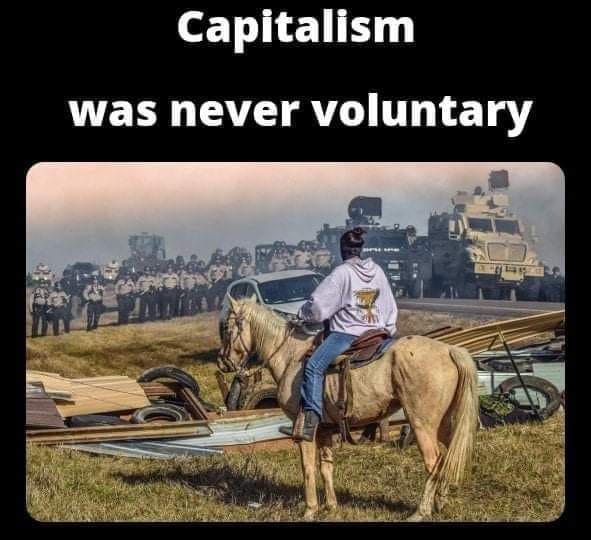
This meme is a satirical commentary on the notion that capitalism is not inherently voluntary, but rather a system that exploits and manipulates individuals to maintain its own power. The image depicts a person on horseback, but the horse is not moving, implying that the person is being forced to ride the horse, symbolizing the way people are forced to work in a capitalist system. The text "capitalism was never voluntary" drives home the idea that the system is not a choice, but a force that is imposed on people.
detailed-analysis (gemma3-27b-vision)
Okay, let's break down this image and its accompanying text ("Capitalism was never voluntary") through the lenses you've provided.
Visual Description
The image depicts a scene seemingly at a protest or occupation. A person in casual clothing (jeans, jacket, hat worn backwards) is riding a light-colored horse. The horse is standing amongst scattered debris, which appears to be wood and sections of a dismantled structure. Behind the rider and horse is a line of armed law enforcement or military personnel, visible as figures in uniform and the bulk of military vehicles. The setting appears to be an open field, and the sky is overcast. The overall composition feels stark and emphasizes the power dynamic between the individual on horseback and the forces behind them.
Foucauldian Genealogical Discourse Analysis
The image and text pair strongly lend themselves to a Foucauldian analysis. The statement "Capitalism was never voluntary" implies that the system wasn't entered into through free consent, but imposed through mechanisms of power. A genealogical approach, as Foucault advocates, would look at the historical emergence of capitalist relations, not as a natural progression but as a series of contingent events shaped by specific power/knowledge relations.
- Power/Knowledge: The image illustrates the relationship. The "knowledge" supporting capitalism – the belief in its legitimacy, its efficiency, its naturalness – is enforced by the power of the state (the armed forces in the background). The debris suggests the destruction of pre-capitalist ways of life or attempts at resistance.
- Discipline & Control: The armed forces represent the disciplinary mechanisms of the state – how bodies are regulated, controlled, and made useful for the capitalist system. The horse and rider could be seen as symbolic of a defiant force, but even their act of protest takes place within the disciplinary framework established by the state.
- Archaeology of Knowledge: A Foucauldian "archaeology" of capitalism would uncover how the discourses surrounding property, labor, and value were constructed over time, creating the conditions for the system to take hold.
Critical Theory
The image resonates with core themes of Critical Theory, especially those stemming from the Frankfurt School.
- Domination & Ideology: The image visually represents the domination inherent in capitalist systems. The statement "Capitalism was never voluntary" suggests that the system is sustained through ideology – the acceptance of certain beliefs and values that legitimize its power structures. The armed forces in the background are the ultimate manifestation of how this ideology is enforced.
- Instrumental Reason: The image can be interpreted as a critique of “instrumental reason,” the focus on efficiency and control that characterizes modern capitalist society. The state’s deployment of force suggests that maintaining the system is prioritized over individual freedom or the well-being of those who resist it.
- Emancipation: The rider on the horse can be read as a symbol of resistance and the potential for emancipation from oppressive systems. The image implies that achieving true freedom requires challenging the power structures that sustain capitalism.
Marxist Conflict Theory
This is a particularly apt framework for understanding the image.
- Class Struggle: The image visually represents the inherent conflict between the ruling class (represented by the state/military) and those who are subject to capitalist exploitation (potentially represented by the rider on the horse and the remnants of a disrupted community).
- Means of Production: The debris suggests a disruption of the means of production – the resources and infrastructure used to create wealth. This could represent a challenge to the existing economic order.
- False Consciousness: The statement "Capitalism was never voluntary" challenges the notion that individuals freely participate in the capitalist system. It implies that many are unaware of the underlying power structures and are thus subject to "false consciousness."
- Revolution: The image can be interpreted as a call for revolution – a fundamental change in the economic and political order. The rider on the horse represents a defiant force seeking to dismantle the existing system.
Postmodernism
While not the most central framework, postmodern lenses can also be applied.
- Deconstruction: The image and text challenge the grand narrative of capitalism as a natural and benevolent force. The statement "Capitalism was never voluntary" destabilizes the idea that participation in the system is based on free choice.
- Power/Discourse: Similar to the Foucauldian analysis, postmodernism emphasizes the role of language and discourse in shaping our understanding of reality. The statement challenges the dominant discourses surrounding capitalism and calls for a critical examination of its underlying power structures.
- Fragmented Reality: The debris and the ambiguous setting could be seen as symbolic of the fragmented and unstable nature of postmodern experience.
Queer Feminist Intersectional Analysis
This lens is more nuanced in its applicability but still relevant.
- Interlocking Systems of Oppression: The image can be read as a metaphor for how capitalism intersects with other systems of oppression (such as patriarchy, racism, and colonialism). The rider on the horse could represent a marginalized group who are disproportionately affected by capitalist exploitation.
- Rejection of Normative Structures: The image could be interpreted as a rejection of the normative structures of capitalism, which often prioritize profit over human needs and well-being.
- Resistance & Solidarity: The image could be seen as a call for resistance and solidarity among marginalized groups who are fighting against capitalist oppression.
Let me know if you'd like me to elaborate on any of these interpretations.
simple-description (llama3.2-vision)
This meme is a humorous commentary on the concept of capitalism. The image shows a person on horseback, but the horse is actually a tank, indicating that the person is riding a war machine, not a traditional horse. The text above the image reads "Capitalism: because owning nothing means you can afford anything".
tesseract-ocr
Capitalism was never voluntary iiceine |) SS apt. get 7 Wen aie —<— a Se bk Ge se wi meee a ree by “SOG. Law Pa eee a | fee | eS - Sa Wa AU) 3) eS SN See fe i sine Resets y) joc Pa ania. |) i SAG nae USTED Oiadie ct NE Ls peace (tee e: ba Sea te cea tee 1 Wins | Ma