First Seen
2023-05-10T21:03:33+00:00
simple-description (llama3.2-vision_11b)
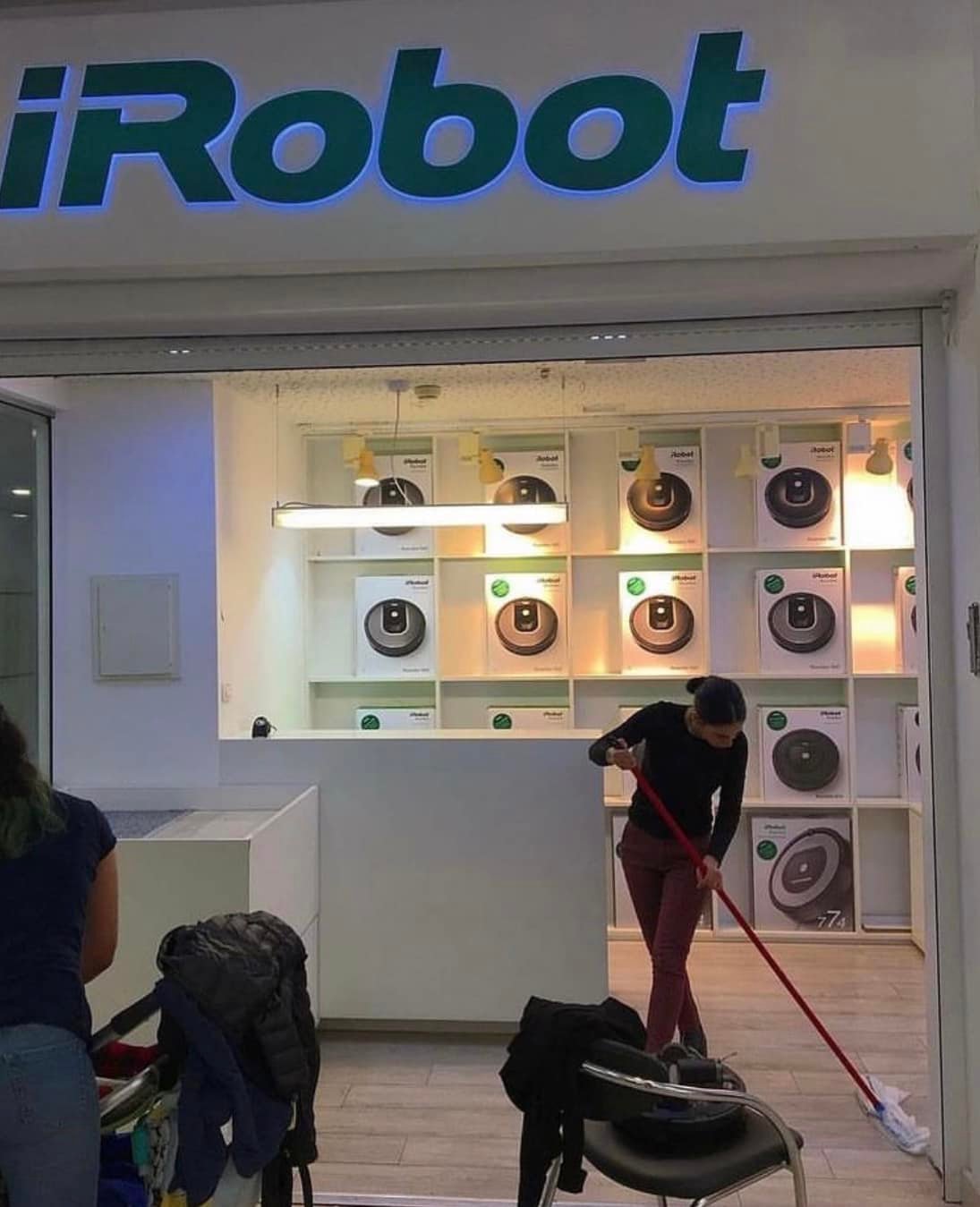
The meme features a screenshot of the popular robot vacuum cleaner brand iRobot's website, with a customer review that reads: "iRobot: where the robots do the work, and the humans get to enjoy the benefits of a clean home, without the burden of a job". This meme is poking fun at the idea of capitalism, where the owners of iRobot, a company that profits from the labor of robots, are able to enjoy the benefits of a clean home without having to do the work themselves.
detailed-analysis (gemma3-27b-vision)
Okay, here's an analysis of the image, broken down into sections as requested. I'll only include sections that apply to the imagery and seem relevant. Given the nature of the image, some sections will be more developed than others.
1. Visual Description
The image shows a storefront display for iRobot Roomba robotic vacuum cleaners. The display consists of a large glass window with multiple Roomba vacuum cleaners lined up on white shelving. The vacuums appear to be predominantly white with orange/brown accents. The iRobot logo is prominently displayed in large, bright green letters above the display.
A person, dressed in athletic wear (black top, reddish/brown leggings), is partially visible inside the store, seemingly restocking or adjusting the display. Behind her, a child in a stroller is partially visible, with an adult (their back is turned) handling the stroller. A black bag or backpack sits in front of the stroller, potentially belonging to the adult. The flooring appears to be beige tile. The space appears to be a retail environment, likely a department store or dedicated electronics shop. The overall lighting is bright and commercial.
2. Foucauldian Genealogical Discourse Analysis
This image is ripe for Foucauldian analysis because it visualizes the normalization and "discipline" inherent in modern home management.
-
Discipline and Control: The systematic arrangement of these vacuum cleaners isn’t just about selling a product. It represents a discourse of cleanliness, order, and efficiency. The Roomba isn’t simply a machine, but an instrument for enacting and reinforcing these norms. It embodies a specific technique of governing the domestic space.
-
Genealogy of Cleanliness: Tracing the historical “genealogy” of cleanliness reveals it's not a natural human desire, but a constructed one. Historically, levels of cleanliness changed. The Roomba represents a particularly advanced stage in the disciplinary technology of domestic labor. It externalizes and automates the labor, making it "invisible" and seeming "effortless," which reinforces the expectation of constant cleanliness.
-
Power/Knowledge: The proliferation of devices like Roombas is linked to a power/knowledge regime. Companies like iRobot produce not just the devices but also the knowledge about what a "clean home" should look like, and this knowledge justifies the purchase of their products. The image itself is a form of advertising—a "statement" contributing to this power/knowledge system.
3. Critical Theory
The image readily lends itself to a Critical Theory reading by demonstrating how consumer culture obscures the deeper social issues related to labor and domesticity.
-
Commodification of Labor: The Roomba represents the commodification of domestic labor. Traditionally, cleaning was a task performed by people, often women, with their time and energy. Now, that labor is “outsourced” to a machine, purchased with money. This obscures the value of that labor and perpetuates the idea that it should be minimized or avoided.
-
False Consciousness: The image suggests a solution to a "problem" (messy homes) that isn’t necessarily a real problem, or if it is, is framed in a way that benefits the company selling the solution. This can be seen as contributing to "false consciousness"—a state where individuals accept the prevailing system as natural or inevitable without questioning it. The image offers "ease" and "convenience", masking the exploitative nature of consumerism.
-
Culture Industry: The meticulously arranged display, and the promise of automated cleaning, align with concepts from the Frankfurt School (Adorno, Horkheimer). The image is part of the “culture industry,” designed to create standardized, commodified experiences and desires.
4. Marxist Conflict Theory
The image implicitly suggests a class dynamic.
-
Access to Automation: The ability to purchase a Roomba implies a level of economic privilege. Automation is not equally accessible. This reinforces the gap between those who can afford to outsource labor and those who cannot.
-
Labor Displacement: While not directly depicted, the automation of cleaning represents a potential displacement of labor. If robotic cleaning becomes widespread, it could reduce the need for human cleaning services, impacting employment opportunities for those performing that work.
-
Capital Accumulation: The production and sale of Roombas contribute to capital accumulation for iRobot and its shareholders, at the potential expense of workers involved in its manufacturing and those potentially displaced by its use.
5. Queer Feminist Intersectional Analysis
While not immediately obvious, there’s potential for a Queer Feminist Intersectional reading.
-
Gendered Labor: Historically, domestic labor, including cleaning, has been disproportionately assigned to women. The automation of this labor doesn't necessarily liberate women from these expectations; it may simply shift the burden of purchasing and maintaining the automation onto them.
-
The Ideal of the "Perfect" Home: The imagery implicitly reinforces the ideal of the spotless, perfect home, a standard historically imposed on women. This can contribute to anxiety and pressure around maintaining appearances.
- Intersectionality: The ability to purchase this product can be viewed through an intersectional lens of class, gender, and race. Access to this technology and the time to enjoy the benefits it offers are not equally distributed across all demographics.
Let me know if you’d like me to delve deeper into any of these areas or explore a different theoretical framework!
simple-description (llama3.2-vision)
This meme is an image of a storefront with a sign reading "iRobot" (a company that makes robots for cleaning homes) with a sign in the window that says "Help Wanted". The implication is that the company that makes robots to clean homes is now looking for human help, suggesting that their robots are not living up to expectations.
tesseract-ocr
Er s Y ( © A Gs ee (likes ie seg, SSS yt 3 i as i -_ mr g © ¢_- [ic ie |i i eo o @ i 2 o_o ——. 4 @ | ~ - ) a q ) ; \. es h i - y S|