First Seen
2023-05-10T21:03:33+00:00
simple-description (llama3.2-vision_11b)
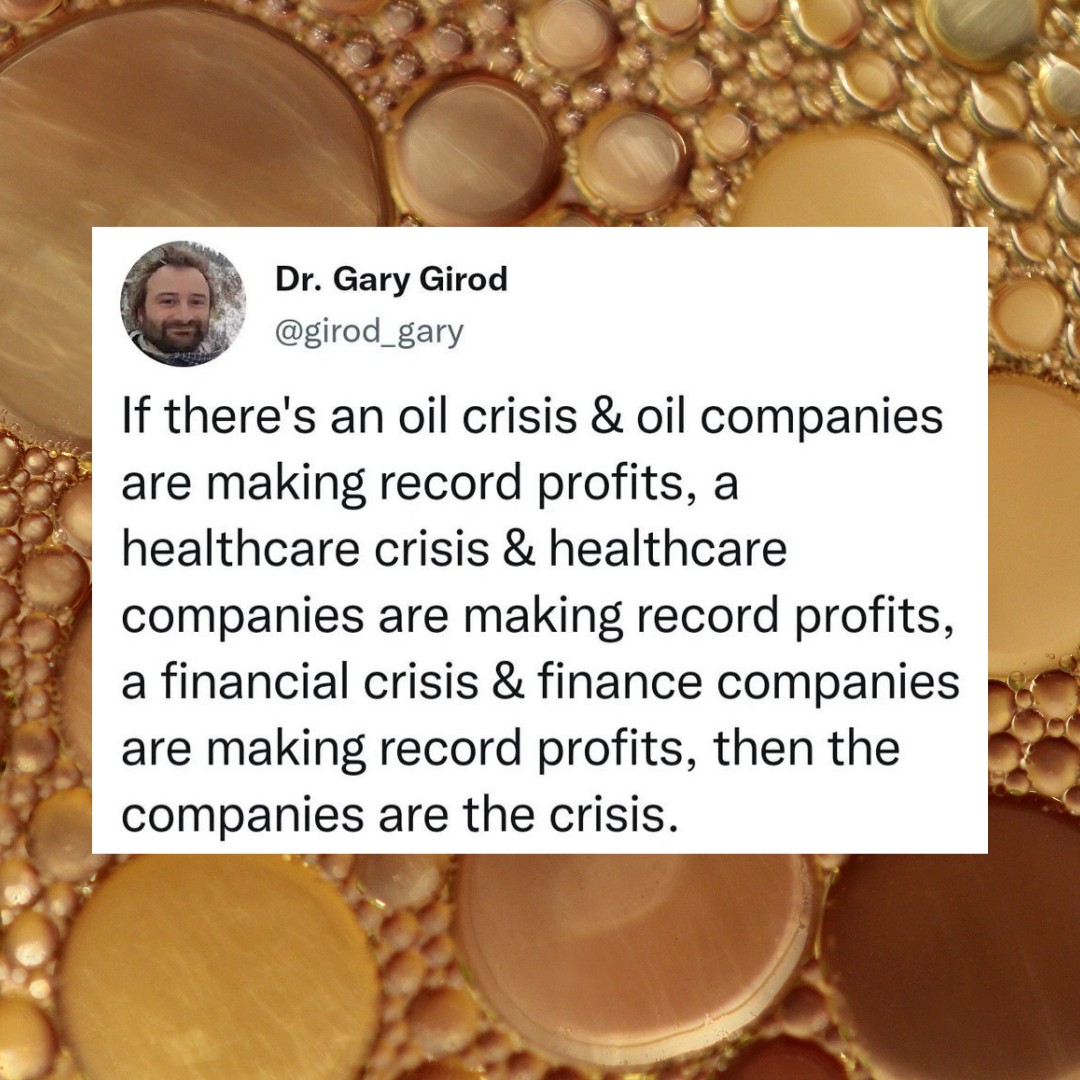
This meme is a satirical commentary on the economic crisis of 2008. The image shows a text box with a quote from a fictional "Dr. Gary Girod" (likely a play on the name of economist and financial expert, Gary Girod) that reads: "If there's an oil crisis & oil companies are making record profits, a healthcare crisis & healthcare companies are making record profits, a financial crisis & financial companies are making record profits, then the companies are the crisis." The quote is a tongue-in-cheek commentary on the tendency of corporations to profit from crises, implying that the crisis itself is the problem, not the solution.
detailed-analysis (gemma3-27b-vision)
Okay, let's break down the image and its text through the lenses you've requested.
1. Visual Description
The image features a screenshot of a Twitter (now X) post. A small circular portrait photo of a man with dark hair and a beard is visible, labeled "Dr. Gary Girod @girod_gary". The majority of the frame is dominated by a patterned gold background, resembling ornate jewelry or a textured surface. The text of the tweet, written in a simple black font, occupies a rectangular white box overlaid on the golden background. The composition draws attention to the text, while the elaborate background provides a sense of visual opulence and contrasts with the starkness of the message.
2. Marxist Conflict Theory
This post lends itself strongly to a Marxist analysis. The core argument – that crises in essential sectors (oil, healthcare, finance) coincide with record profits for the companies operating within them – directly echoes a central tenet of Marxist thought: the inherent contradictions within capitalism.
- Exploitation: The text implies that these profits aren't the result of increased production or service, but are accumulated during times of crisis. This suggests a form of exploitation – profits gained from leveraging societal need and precarity.
- Class Struggle: The "crisis" (oil, healthcare, financial) isn't simply a bad thing happening to everyone, but a condition created by the pursuit of profit. The companies are not victims of the crisis, but beneficiaries, actively profiting from the suffering of others. This highlights the underlying class struggle – the interests of capital (the companies) are fundamentally opposed to the needs of the population.
- Contradictions of Capitalism: The post exposes the core contradiction: a system that prioritizes profit accumulation even when that leads to widespread hardship. This, from a Marxist perspective, is a systemic flaw that will inevitably lead to instability and ultimately, the potential for transformative change.
- Capital as the Problem: The statement “then the companies are the crisis” isn't just about individual corporate greed. It’s a claim that the structure of capitalism, with its relentless drive for profit, is the source of the crisis, not an external factor.
3. Foucauldian Genealogical Discourse Analysis
While not as immediately obvious as the Marxist reading, a Foucauldian approach can reveal interesting dimensions:
- Power/Knowledge: The post challenges the discourse around crises. Mainstream narratives often frame crises as natural disasters, unforeseen circumstances, or the result of bad policy. This post argues that the crisis is not something happening to us, but something produced by specific power dynamics – the accumulation of wealth and power by corporations.
- Genealogy of Crisis: A genealogical approach could trace how the concept of “crisis” itself has been historically constructed. How has the way we understand crises changed over time, and how have these changes served the interests of those in power? For example, how has the language of “supply and demand” been used to justify price gouging during times of scarcity?
- Disciplinary Power: The post implicitly critiques the "discipline" of economics, which often presents corporate profit maximization as a natural and beneficial process. It challenges the assumptions and power relations embedded within this discipline.
- Truth Regimes: The message disrupts a truth regime where corporations are seen as “job creators” or “innovators.” It points towards a different truth – that corporations can be the source of systemic problems.
4. Critical Theory
The text aligns strongly with critical theory, particularly its focus on:
- Ideology Critique: The post dismantles the ideology that equates corporate profits with societal wellbeing. It exposes the ways in which dominant narratives obscure the exploitative nature of capitalism.
- Domination: It highlights the relationship of domination inherent in the system. Corporations, with their immense wealth and power, exert control over essential sectors, leaving individuals vulnerable.
- Emancipation: Implicitly, the post suggests the need for a more just and equitable system, one where human needs are prioritized over corporate profits. It’s a call to challenge the existing power structures and to imagine alternative ways of organizing society.
5. Postmodernism
A postmodern reading isn’t as central, but can add nuance:
- Deconstruction of Grand Narratives: The text implicitly rejects the “grand narrative” of capitalist progress. It exposes the contradictions and failures of the system, questioning the idea that capitalism inevitably leads to prosperity.
- Focus on Discourse: The argument hinges on how we frame the “crisis.” It’s a question of language and representation, challenging the dominant ways of understanding reality.
- Relativism (with a caveat): While not strictly relativistic, the post suggests that there isn’t a single, objective “truth” about the crisis. The “truth” depends on who you are, what your interests are, and how you interpret the evidence.
6. Queer Feminist Intersectional Analysis
This lens is less direct, but relevant.
- Interlocking Systems of Oppression: The crisis – particularly in healthcare – impacts marginalized communities disproportionately. The pursuit of profit exacerbates existing inequalities based on race, gender, sexuality, and class.
- Care Work & Exploitation: The exploitation of care workers (often women and people of color) is a key component of the healthcare system. The drive for profit leads to understaffing, low wages, and burnout, further exacerbating inequalities.
- Challenging Power Structures: A queer feminist perspective would emphasize the need to dismantle the patriarchal and capitalist power structures that perpetuate these injustices.
Let me know if you'd like me to elaborate on any of these perspectives!
simple-description (llama3.2-vision)
This meme is a humorous commentary on the 2020-2021 global economic downturn. The image features a quote from a Twitter post by Dr. Gary Girod, which reads: "If there's a crisis involving oil, it's a crisis. If there's a crisis involving banks, it's a recession. If there's a crisis involving hospitals, it's a healthcare crisis. If there's a crisis involving anything else, it's a crisis. If there's a crisis involving both oil and banks, it's a depression. If there's a crisis involving both oil and hospitals, it's a pandemic. If there's a crisis involving both oil and banks and hospitals, it's a global catastrophe. If there's a crisis involving both oil, banks, and hospitals, then the companies are making record profits, then the companies are the crisis."
tesseract-ocr
‘ walle \ * i ‘ : S \ e : may Aa © Dr. Gary Girod Ne i @girod_gary 4 ; If there's an oil crisis & oil companies f= are making record profits, a = healthcare crisis & healthcare companies are making record profits, a financial crisis & finance companies mE are making record profits, then the hon companies are the crisis. Ld , ~ am .