First Seen
2023-05-10T21:03:33+00:00
simple-description (llama3.2-vision_11b)
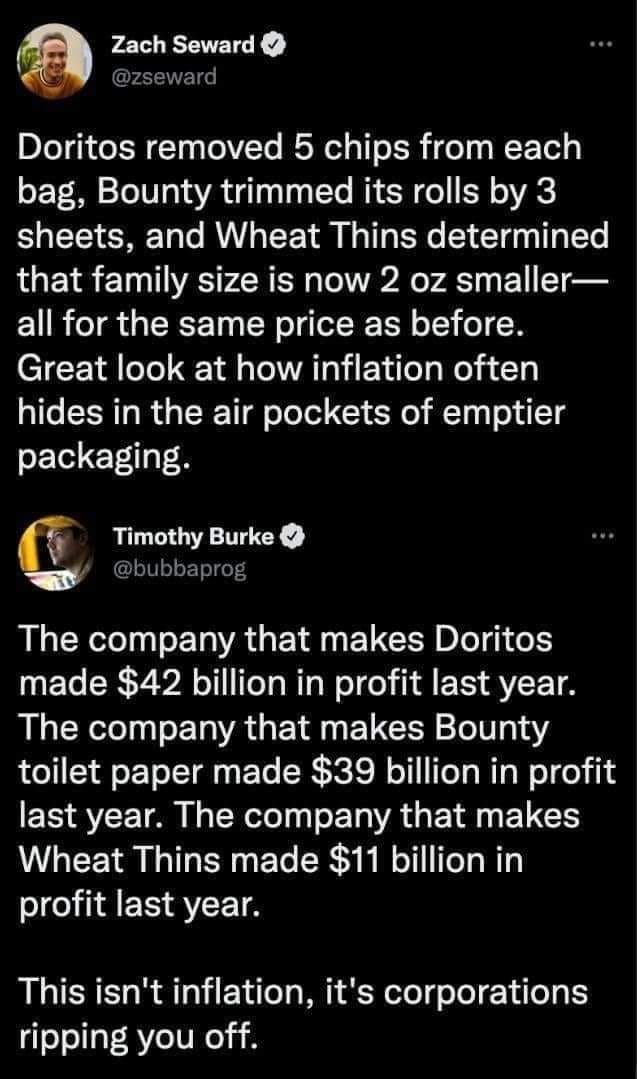
This meme is a commentary on the absurdity of corporate profits and the lack of accountability in the business world. It presents a humorous and satirical take on the financial success of major corporations, highlighting the contrast between their profits and the struggles of ordinary people. The meme uses a fictional scenario where a company's profits are so high that they can afford to pay for a specific quantity of a food item, in this case, a 2-ounce bag of chips.
detailed-analysis (gemma3-27b-vision)
Okay, let's break down this social media post through a variety of theoretical lenses, as requested.
Visual Description
The image is a screenshot of a post from social media (likely X/Twitter). It features two users—Zach Seward and Timothy Burke—and their statements. The post details examples of "shrinkflation"—reduced product sizes without a corresponding price decrease—for Doritos, Bounty paper towels, and Wheat Thins. The background is the standard blue and white interface of the social media platform. The overall impression is one of frustrated exposure of corporate practices.
Marxist Conflict Theory
This post is highly amenable to a Marxist interpretation. At its core, this post demonstrates a classic example of capital accumulation and the drive for profit maximization.
- Exploitation: The companies in question (Doritos, Bounty, Wheat Thins) are seen as exploiting consumers by reducing the quantity of goods while maintaining prices. This is a clear case of extracting surplus value. They are essentially taking a larger portion of the value created by labor and resources for themselves.
- Class Struggle: The post implicitly positions consumers as a collective 'class' being disadvantaged by powerful corporate entities. The message is a call to recognize this imbalance and potentially resist it through awareness and possibly collective action.
- False Consciousness: The claim that this isn't inflation but corporate greed suggests a critique of the dominant narrative that frames rising prices as a natural economic phenomenon. It’s an attempt to expose the true mechanisms driving cost increases.
- Commodity Fetishism: It could also be argued that the focus on the brands themselves (Doritos, Bounty, Wheat Thins) obscures the actual labor and resources that go into their production.
Critical Theory
The post aligns with critical theory's emphasis on exposing power structures and challenging dominant ideologies.
- Rationalization & Instrumental Reason: The reduction in product size can be seen as a manifestation of rationalized production aimed solely at maximizing efficiency and profit, even at the expense of consumer satisfaction or fairness.
- The Culture Industry: This example could be extended to suggest a broader critique of how the “culture industry” (consumer goods, advertising) perpetuates a system of control and manipulation.
- Ideology Critique: The central claim—"This isn't inflation, it's corporations ripping you off"—is a direct attempt to deconstruct the hegemonic ideology that justifies rising prices as inevitable. It invites a questioning of the 'naturalness' of current economic arrangements.
Foucauldian Genealogical Discourse Analysis
A Foucauldian analysis would look at how the practice of “shrinkflation” emerged as a discourse and a practice of power.
- Power/Knowledge: The post highlights how corporations wield power through their control over production and pricing, and how this is masked by 'expert' explanations like inflation. The corporations’ knowledge of market dynamics and consumer behavior enables them to manipulate the system in their favor.
- Genealogy: Investigating the history of this practice (when did it begin, how did it evolve?) would reveal the shifting strategies corporations have used to maintain profitability.
- Discipline and Control: "Shrinkflation" is a subtle but effective form of control. It doesn’t prohibit consumption, but it slowly erodes the value consumers receive, normalizing a reduction in quality/quantity without explicit price increases.
- Subjectification: This practice affects how we understand value. We’re conditioned to accept smaller portions for the same price, subtly shaping our expectations and behaviors.
Postmodernism
A postmodern take might focus on the breakdown of grand narratives and the fluidity of meaning.
- Simulacra and Simulation: The image of a full-sized Doritos bag (or Bounty roll) has become a simulation—an empty signifier. The actual contents are less important than the perception of fullness.
- Deconstruction: The post deconstructs the traditional understanding of “value” and “inflation,” revealing the constructed nature of these concepts.
- Fragmented Reality: Postmodernism often emphasizes fragmented and shifting realities. “Shrinkflation” is a manifestation of this—a constant manipulation of quantity and price that makes it difficult to grasp a stable sense of economic reality.
Queer Feminist Intersectional Analysis
This is the least obvious lens, but it could be applied.
- Precarity & Vulnerability: Shrinkflation disproportionately affects those with limited economic resources. This intersects with existing vulnerabilities (gender, race, class) that create greater financial insecurity.
- Care Work & Gendered Labor: Consider the context of items like Bounty paper towels. They are often associated with domestic labor, traditionally performed by women. Reducing the quantity of these goods can place an additional burden on those responsible for household tasks.
- Devaluation of Labor & Resources: Shrinkflation can be seen as a broader devaluation of labor and resources, reflecting a system that prioritizes profit over human needs and environmental sustainability. The system, by seeking to extract more from the same amount of work/resources, contributes to exploitative practices.
I hope this detailed breakdown is helpful! Let me know if you'd like me to elaborate on any of these points or explore other theoretical frameworks.
simple-description (llama3.2-vision)
This meme is a humorous comparison of the financial performance of several large corporations, using a humorous and exaggerated analogy to illustrate their financial struggles. The text reads: "Doritos removed 5 chips, Bounty trimmed its rolls by 3 sheets, and Wheat Thins are now 2 oz smaller - all for the same price. The company that makes Doritos made $42 billion in profit last year, the company that makes Bounty paper made $39 billion in profit last year, and the company that makes Wheat Thins made $11 billion in profit last year."
tesseract-ocr
re Zach Seward @ a Doritos removed 5 chips from each bag, Bounty trimmed its rolls by 3 sheets, and Wheat Thins determined that family size is now 2 oz smaller— all for the same price as before. Great look at how inflation often hides in the air pockets of emptier exe Ten.c-\ 101m @ Timothy Burke @ oo é @bubbaprog The company that makes Doritos made $42 billion in profit last year. The company that makes Bounty toilet paper made $39 billion in profit last year. The company that makes Wheat Thins made $11 billion in profit last year. This isn't inflation, it's corporations ripping you off.