First Seen
2023-05-10T21:03:33+00:00
simple-description (llama3.2-vision_11b)
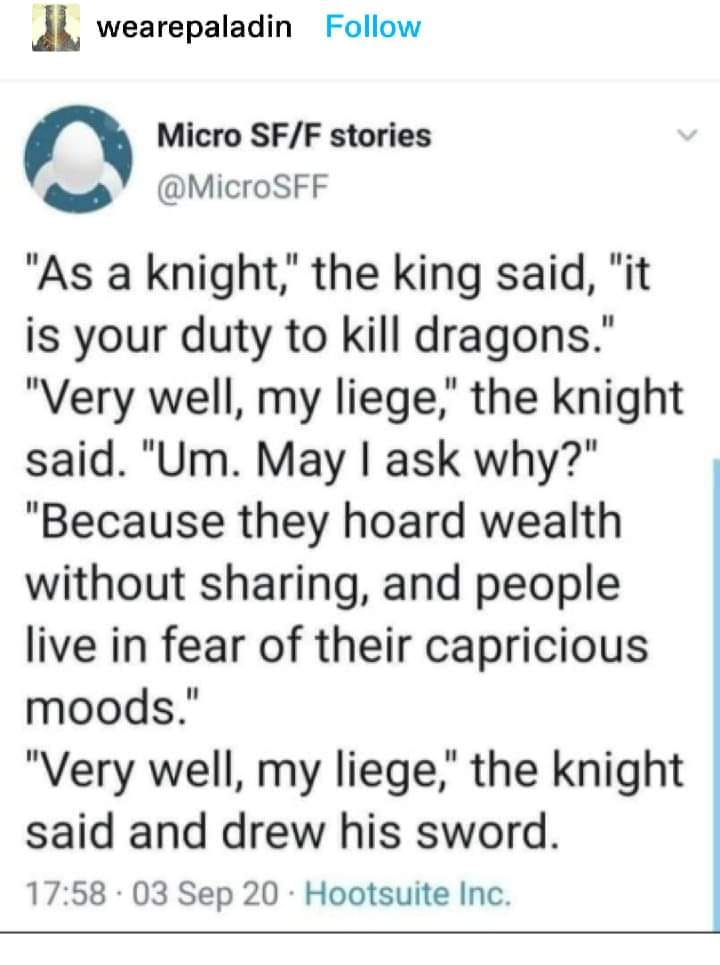
The meme is a quote from a fantasy story where a king is told that as a knight, his duty is to kill dragons. The knight responds with a series of absurd and humorous reasons for not killing dragons, including that they hoard wealth without sharing and that people live in fear of their capricious moods. The quote is often used to mock or satirize the idea of a knight's duty to kill dragons, and is often used to express the idea that people live in fear of their capricious moods, and that they hoard wealth without sharing.
detailed-analysis (gemma3-27b-vision)
Okay, here's an analysis of the Twitter post, broken down into sections addressing the requested theoretical frameworks. I'll indicate where a section isn't applicable. I will also offer a "general assessment" at the end as a synthesis.
Visual Description
The image is a screenshot of a Twitter post from the account "@MicroSFF." It features a blue background with white text. The account name and handle are visible at the top, and the timestamp ("17:58 - 03 Sep 20 - Hootsuite Inc.") is at the bottom. The core of the image is the dialogue between a king and a knight, presented as a very short fantasy/sci-fi "micro-story." The visual is simple and utilitarian; it serves primarily to deliver the textual content.
Foucauldian Genealogical Discourse Analysis
This text presents a compelling example for a Foucauldian approach. The act of "dragon-slaying" is not presented as a natural, inherent duty, but as a discourse constructed by the king.
- Power/Knowledge: The king's statement establishes a power dynamic, and the justification for dragon-slaying isn't based on any intrinsic danger of the dragons, but on their wealth hoarding and the resulting fear. This connects knowledge (the perceived threat of the dragons' wealth) to power (the king's command). The king's pronouncements constitute the dragons as "problems," making action against them seem necessary.
- Genealogy: A genealogical approach might examine how the concept of dragons as hoarders and sources of fear evolved historically. What earlier narratives or beliefs contributed to this specific framing? The post subtly suggests that this isn't an eternal truth, but a constructed one.
- Disciplinary Power: The knight, by accepting the command ("Very well, my liege"), seemingly internalizes the discourse. The act of drawing the sword is an embodiment of the disciplinary power exerted by the king, turning the knight into an instrument of that power.
Critical Theory
This post lends itself well to critical theoretical analysis, particularly in its unmasking of power structures.
- Ideology: The King’s statement can be read as an expression of prevailing ideology. The justification for violence against the dragons is framed in terms of economic equality and public safety. This disguises the underlying power dynamics; the king is reinforcing his authority by positioning himself as the protector of his people from “dangerous” wealth accumulation.
- Hegemony: The Knight’s acceptance suggests a form of hegemonic control. The King doesn't need to overtly threaten the knight; the knight’s obedience seems to stem from an ingrained acceptance of the King’s authority and the social norms that support it.
- Deconstruction: One could deconstruct the concept of “duty” itself. What does “duty” mean in this context? Is it a natural obligation, or a socially constructed role? The knight's single question ("Why?") disrupts the seemingly natural order and forces a moment of questioning.
Marxist Conflict Theory
This post is strongly aligned with Marxist analysis.
- Class Struggle: The dragons, by hoarding wealth, represent a dominant, exploiting "class" and the people are the oppressed. The conflict is explicitly framed as a struggle over resources and power.
- Materialism: The justification for the violence is entirely material: wealth, fear, and the social consequences of inequality. There’s no appeal to morality or justice, only to economic stability and the preservation of the social order.
- Ideology as False Consciousness: The king’s justification can be seen as a form of “false consciousness,” designed to obscure the true nature of the conflict. The knight’s acceptance initially reinforces this, but his question provides a crack in the ideological facade.
- Base & Superstructure: The hoarding of wealth (the "base") directly influences the superstructure (the need for knights and violence). This is a clear demonstration of the relationship between material conditions and social structures.
Postmodernism
While not overtly postmodern, the text can be read through a postmodern lens.
- Deconstruction of Grand Narratives: The post subtly questions the traditional “heroic quest” narrative. The knight isn’t driven by noble ideals, but by a directive tied to economic concerns. This challenges the notion of a universally meaningful purpose.
- Relativism: The post doesn’t present a clear-cut “right” or “wrong.” The dragons are simply portrayed as hoarders, and the knight’s acceptance doesn’t necessarily imply moral approval.
- Meta-Narrative: The brevity and self-contained nature of the post can be seen as a commentary on storytelling itself. It’s a miniature narrative that encapsulates larger themes.
Queer Feminist Intersectional Analysis
This is less directly applicable than other frameworks, but some elements can be explored:
- Power Dynamics: The power dynamic between the king and the knight echoes broader patriarchal structures where authority is concentrated in the hands of a few.
- Exploitation: The framing of the dragons as hoarders could be read as a metaphor for systems of exploitation that disproportionately affect marginalized groups. (Though this requires a more significant stretch).
- Disruption of Norms: The Knight’s question (“Why?”) represents a subtle disruption of traditional norms of obedience and unquestioning acceptance of authority, which can be seen as a feminist act. However, the framework is not central to the content.
General Assessment
This short text is remarkably potent. It functions as a microcosm of many larger social and political issues. Its strength lies in its simplicity and its ability to raise complex questions without providing easy answers. The text’s Marxist leanings are the most immediately apparent, but it also lends itself effectively to Foucauldian analysis, critical theory, and, to a lesser extent, postmodern and queer feminist frameworks. The post's power lies in its ability to subvert the tropes of traditional fantasy to reveal underlying power dynamics and ideological structures. It successfully prompts a deeper engagement with the ethics of violence, the construction of enemies, and the role of power in shaping our narratives.
simple-description (llama3.2-vision)
This meme is a humorous take on the classic "I see dead people" phrase from the movie "The Sixth Sense." It's a quote from the movie, but with a medieval twist, featuring King Arthur saying "I see dead people" in a medieval way. The meme is a quote from the movie, but with a medieval twist, featuring King Arthur saying "I see dead people" in a medieval way.
tesseract-ocr
Zz wearepaladin Follow 0% Micro SF/F stories a @MicroSFF "As a knight," the king said, "it is your duty to kill dragons." "Very well, my liege," the knight said. "Um. May | ask why?" "Because they hoard wealth without sharing, and people live in fear of their capricious moods." "Very well, my liege," the knight said and drew his sword. 17:58 - 03 Sep 20 - Hootsuite Inc.