First Seen
2023-05-10T21:03:33+00:00
simple-description (llama3.2-vision_11b)
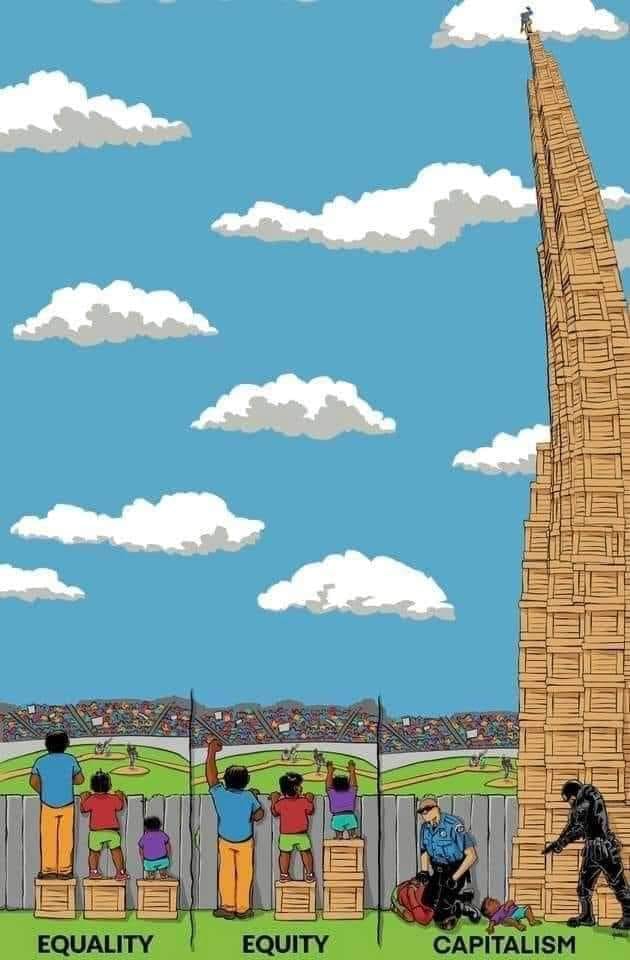
This meme depicts a scenario where a giant, oppressive capitalist structure (represented by a skyscraper) is being dismantled by a group of people working together, with each person contributing their unique skills and abilities to bring down the structure. The text "We can't build a wall, but we can dismantle a skyscraper" is a commentary on the ability of people to work together to dismantle oppressive systems, such as capitalism, and build a more equitable society.
detailed-analysis (gemma3-27b-vision)
Okay, here's an analysis of the image, broken down into sections using the frameworks you requested. Note that some frameworks won't be as applicable as others, and I'll explain why if that's the case.
Visual Description
The image is cartoon-style, rendered in bright colors. The backdrop is a clear blue sky with fluffy white clouds. In the foreground, a wooden fence separates a group of people from a very tall tower constructed entirely of boxes (possibly cardboard). The people are of varying heights, with some standing on top of boxes placed beneath their feet. There are three figures on the far right side of the image: One kneeling, appearing to add boxes to the tower and one person completely obscured by shadow, carrying boxes. The people standing in front of the fence are visible over the boxes. At the bottom of the image, labels read "EQUALITY", "EQUITY", and "CAPITALISM".
Critical Theory
The image directly engages with core concepts from Critical Theory, particularly the distinction between equality and equity.
- Equality is visually represented by the initial, flat line of boxes. It suggests that everyone receives the same resources, regardless of their starting point. However, those of shorter stature cannot see over the fence.
- Equity is illustrated by the stacked boxes giving some individuals the height they need to see over the fence. This is the core message of the image—equity recognizes that people have different circumstances and require different levels of support to achieve the same outcome. The addition of boxes to the tower by the kneeling person suggests a deliberate process of addressing those disparities.
- The image is a direct critique of a purely equal system where resources are distributed without acknowledging existing disadvantages. It posits equity as a more just and effective approach.
Marxist Conflict Theory
The image strongly lends itself to a Marxist interpretation.
- Class Stratification: The fence represents a barrier of class and access. Those on one side (the audience of the tower) have access, while those behind the fence are potentially excluded from whatever the tower represents (knowledge, opportunity, power).
- Labor and Production: The tower itself is built through labor – evidenced by the person adding boxes. The obscured, shadowy figure carrying boxes further emphasizes this. This highlights the value of work but also the often-invisible labor that supports larger structures.
- Exploitation: The shadowy figure suggests a potentially exploitative relationship. They are doing the work (carrying and building) but are not visible or benefiting from whatever is visible over the fence.
- False Consciousness: The image implies that those looking at the tower may not be aware of the effort and inequities that went into its construction, or the disparities between those who can and cannot see over the fence.
Foucauldian Genealogical Discourse Analysis
This framework can be applied, but requires some nuance.
- Power/Knowledge: The tower is a symbolic representation of power and knowledge. The image demonstrates how access to this power is not simply a matter of equal opportunity. It requires a deliberate "stacking" of resources to overcome existing disadvantages.
- Discourse of Equality/Equity: The labels "EQUALITY" and "EQUITY" themselves are part of a discourse. The image is a direct intervention within that discourse, challenging the simplistic understanding of equality and advocating for equity as a more nuanced and effective framework.
- Genealogy of the Concepts: Examining the historical development of "equality" and "equity" would reveal how they've been constructed and used to justify certain power structures. This image, in a sense, attempts to reconstruct the discourse around equity.
Postmodernism
The image has some elements that align with postmodern ideas, but it's not a central framework for analysis.
- Deconstruction of Binary Oppositions: The image deconstructs the simple binary opposition of "equality" versus "inequality." It proposes that "equity" is a more complex and accurate way of understanding social justice.
- Rejection of Universal Truths: The image implies there’s no single, universal solution to social problems. Rather, it calls for individualized responses that address specific needs.
- Questioning Grand Narratives: It subtly challenges the idea that simply offering everyone the same opportunities will lead to a just society.
Queer Feminist Intersectional Analysis
This analysis can be applicable, but requires some careful consideration.
- Interlocking Systems of Oppression: The image can be read as representing multiple forms of disadvantage. The height differences could symbolize differences in social position due to race, gender, class, or other factors.
- Visibility and Invisibility: The shadowy figure carrying boxes is particularly relevant. This figure's lack of visibility can represent the ways in which marginalized groups are often made invisible in society, their contributions overlooked.
- Equity as a Feminist Principle: Equity, as depicted in the image, aligns with feminist principles of recognizing and addressing the specific needs of women and other marginalized groups.
Let me know if you'd like me to expand on any of these analyses or explore a different angle.
simple-description (llama3.2-vision)
The meme is a visual representation of the concept of "income inequality" using a pyramid of blocks. The image shows a tall, narrow pyramid of blocks with a small number of people at the top and a large number of people at the base. The text at the bottom reads "Equality", "Equality", "Equality", and then "Capitalism", with the last one being a small figure at the top of the pyramid.
tesseract-ocr
ee Hed We ee ie s ges ey Eee Ee ESE seg BSE! ee S| le) ae Dik 7] aa ee, JV Ube) agi Sat EQUALITY EQUITY CAPITALISM ~