First Seen
2023-05-10T21:03:33+00:00
simple-description (llama3.2-vision_11b)
The meme is a screenshot from the video game "Fallout: New Vegas" where a character named "Mr. Handy" says "Either capitalism is a good thing or it's a bad thing. It's never both." This quote is juxtaposed with a post-apocalyptic landscape, implying that the collapse of society is a direct result of unchecked capitalism.
detailed-analysis (gemma3-27b-vision)
Okay, let's break down this image using the theoretical frameworks you've requested.
Visual Description
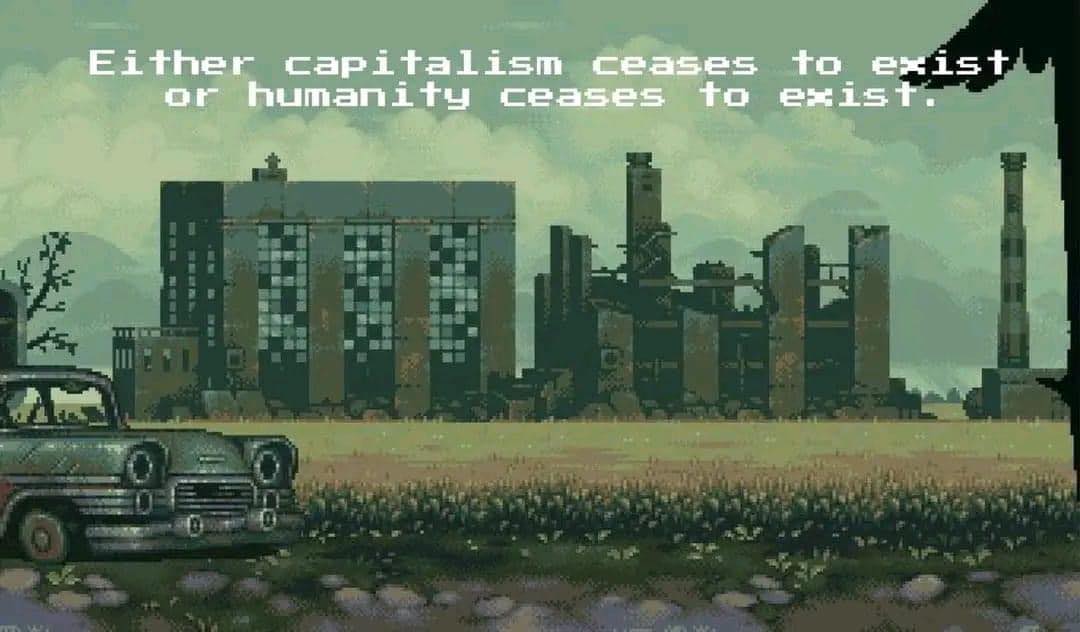
The image presents a bleak, post-industrial landscape rendered in a pixelated, somewhat retro aesthetic reminiscent of early computer graphics. In the foreground is a rusted, dilapidated vehicle, likely a car, partially overgrown with foliage, indicating abandonment and decay. The middle ground is dominated by a field of yellow wildflowers, a fragile beauty juxtaposed with the background. Behind the field rises a skyline of decaying industrial structures: brick buildings, smokestacks, and possibly factory walls. The sky is a murky, overcast green, contributing to a feeling of environmental distress and a sense of a world irrevocably changed. The use of pixelation lends a sense of distance and artificiality, and could be interpreted as symbolizing the breakdown of reality, or the deconstruction of traditional aesthetic norms. The statement "Either capitalism ceases to exist or humanity ceases to exist." is text at the top of the image.
Marxist Conflict Theory
The image is strongly suggestive of a Marxist interpretation. The decaying industrial landscape is a direct visual representation of the potential consequences of unchecked capitalist production. The smokestacks and factories symbolize the means of production, now fallen into ruin. This can be seen as a depiction of the inherent contradictions within capitalism – the drive for profit leading to environmental destruction, overproduction, and eventual collapse. The abandoned vehicle and overgrown nature suggest a societal breakdown and loss of human control, stemming from the failures of the system. The text statement provides the stark choice between the system and humanity's survival, positioning these as mutually exclusive outcomes. The image essentially visualizes the Marxist argument that capitalism is inherently unsustainable and will ultimately lead to its own destruction, potentially taking humanity with it. The abandoned cars, the decay, all are a symbolic representation of the worker's alienation and the inherent issues within the system.
Critical Theory
The image invites a Critical Theory analysis by highlighting the relationship between power, knowledge, and the environment. The decaying industrial landscape is not merely a visual accident; it's a manifestation of the power dynamics that prioritize economic growth over ecological sustainability. The image suggests that the dominant structures of knowledge (driven by capitalist ideologies) have created a system where short-term profit is valued over long-term survival. The text statement is a direct challenge to this logic, questioning the very foundations of a system that seemingly requires either its own perpetuation or the destruction of humanity. The image is a critique of the instrumental reason that underpins capitalist logic—the tendency to view everything, including nature and human life, as a means to an end.
Postmodernism
The image exhibits a degree of postmodern sensibility in its aesthetic choices and potential for deconstruction. The pixelated style and artificiality subvert traditional notions of realism and representation. This fragmentation and rejection of grand narratives resonate with postmodern ideas. The image’s ambiguity is a core postmodern tenant. It doesn't offer a clear solution or a definitive path forward, instead, it presents a stark juxtaposition of elements—decay and beauty, industrialization and nature—and leaves the interpretation open-ended. The lack of clear narrative and reliance on symbolism are characteristics of postmodern art. The text statement can be interpreted as a deconstruction of the traditional binary opposition between capitalism and humanity, revealing the inherent contradictions and instability within both concepts.
Foucauldian Genealogical Discourse Analysis
A Foucauldian analysis would focus on the discourses that have legitimized and normalized the destructive practices leading to this dystopian landscape. The image can be seen as a product of historical power relations, where discourses around economic progress and technological advancement have overshadowed concerns about environmental sustainability and social justice. The smokestacks and factory ruins represent the material manifestations of these discourses. Genealogically, one could trace the development of these discourses from early industrialization to contemporary neoliberalism, examining how they have shaped our understanding of nature, work, and human value. The text statement is a direct challenge to the dominant discourse, suggesting that it is unsustainable and ultimately self-destructive. It’s a moment of "rupture" that breaks from the established narrative.
Note: A Queer Feminist Intersectional Analysis doesn’t seem to apply strongly to this image. While environmental destruction disproportionately impacts marginalized communities (which intersects with feminist and anti-oppression concerns), the image itself doesn’t explicitly address issues of gender, sexuality, or intersectionality. It's more focused on the broader systemic critique of capitalism and its environmental consequences.
Let me know if you'd like any of these analyses expanded or elaborated on!
simple-description (llama3.2-vision)
This meme is a still image from the video game "Fallout 3", featuring a post-apocalyptic wasteland with a destroyed cityscape. The image shows a desolate landscape with a broken-down car and a sign in the distance that reads "In a world out of ideas, in a world out of time...". The text "Either capitalism has destroyed humanity or humanity has destroyed capitalism" appears at the top of the image.
tesseract-ocr
peop | ai . ie = J =e Tia VT eT aa cn = had i a it » rd is 4 \ iat stat. me a i Li L. au eae en san wks c i 7 ee i ee oe * B a eae Lid heel [ \. Or er . ed a} cy s | Mile . a ge wt : Te, i F ‘ r ae - =a as EPS ot a aca Cea gic See : a "li, a. I alm a Nm ce 1 = fa Mae iS eS UA eo ALS MAU Eh ak al eo ie eT Oh st Bide tial. J eal i os si “ah We Gs eo. allie — —— ss ae 2 ag i ae Bi.