First Seen
2023-05-10T21:03:33+00:00
simple-description (llama3.2-vision_11b)
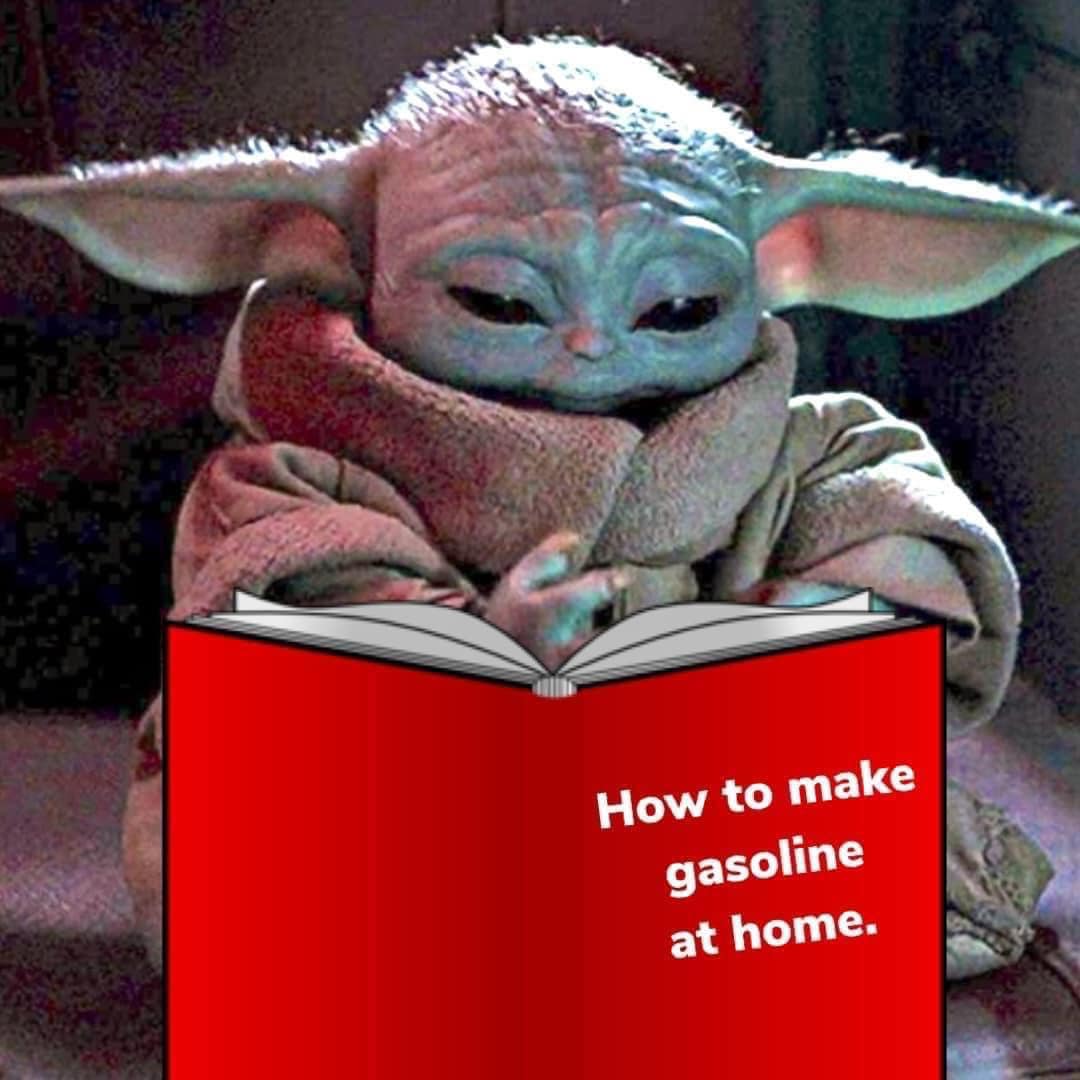
This meme features a character from the Star Wars franchise, Baby Yoda, holding a book with the title "How to make gasoline at home". The meme is likely referencing the idea that Baby Yoda is reading a book on how to make gasoline, a topic that is often associated with anti-capitalist or anarchist ideologies, as it is often seen as a way to break free from the capitalist system.
detailed-analysis (gemma3-27b-vision)
Okay, let's break down this image, "Baby Yoda reading a book titled 'How to make gasoline at home,'" using the lenses you’ve requested. I'll omit sections that don't readily apply.
1. Visual Description
The image features Grogu, often referred to as "Baby Yoda," a character from the Disney+ series The Mandalorian. He’s depicted in a close-up, seated and appearing to be reading a book. The book is bright red, and the white text on the cover reads “How to make gasoline at home.” Grogu has a somewhat pensive expression on his face. The background is blurred, suggesting a darker, indoor setting. The overall effect is humorous due to the incongruity of a small, innocent-looking character reading instructions for a complex and potentially dangerous process like making gasoline. The warm tone and soft lighting evoke a sense of cuteness.
2. Foucauldian Genealogical Discourse Analysis
This image provides a fascinating entry point for a Foucauldian analysis concerning knowledge, power, and discourse. The book's title, "How to make gasoline at home," implies a desire to decentralize and democratize access to a resource traditionally controlled by large corporations and nation-states.
- Historical Genealogy: Historically, gasoline production and distribution have been heavily regulated, tied to concerns about safety, environmental impact, and economic control. The manual suggests a desire to circumvent these structures—a return to a potentially "pre-modern" method of energy production, albeit with modern implications. Tracing the genealogy of knowledge surrounding gasoline would reveal how specific "truths" about its production and control have been constructed over time – and how this knowledge becomes intertwined with power.
- Discourse & Power: The discourse surrounding "DIY" or "maker" culture is crucial here. The book implies a challenge to the authoritative discourse of experts and institutions. It suggests that individuals can understand and control processes previously considered the domain of specialists. However, this empowerment is also fraught with danger, raising questions about who is responsible for safety and environmental consequences.
- Panoptic Disruption: The image can be interpreted as a subversion of surveillance. Typically, gasoline production is a process heavily monitored by government agencies. This book aims to disrupt that, making it "home-based" and therefore harder to monitor.
3. Critical Theory
This image lends itself well to a Critical Theory reading, specifically around the ideas of alienation, commodity fetishism, and the critique of technological rationality.
- Technological Rationality and Control: The desire to "make gasoline at home" can be seen as a reaction against the opaque and often impersonal systems of energy production. It’s a move toward reclaiming control over a vital resource. However, this individual attempt at control might be a false solution. The complex technology required for safe gasoline production is beyond the reach of most individuals.
- Alienation: The reliance on large corporations for essential resources like gasoline can be seen as a form of alienation, separating individuals from the means of production and making them dependent on external forces. The book represents a desire to overcome this alienation.
- Critique of Modernity: The image is essentially a deconstruction of modern industrial processes, suggesting that the current system is unsustainable and requires re-evaluation.
4. Marxist Conflict Theory
The image can be understood through a Marxist lens as a symbolic representation of class struggle and the desire for self-sufficiency.
- Challenge to Capitalist Control: The production and distribution of gasoline are controlled by large multinational corporations, accumulating wealth and power. The book challenges this control by suggesting that individuals can produce gasoline themselves, bypassing the capitalist system.
- Means of Production: The book represents a potential attempt to regain control of the “means of production” (in this case, energy production) from the capitalist class.
- Class Consciousness: The image can be seen as fostering “class consciousness” by encouraging individuals to question the existing power structures and seek alternatives.
5. Postmodernism
This image possesses several elements that align with postmodern thought.
- Irony & Parody: The juxtaposition of the innocent, almost childlike Baby Yoda with the potentially dangerous and complex subject matter creates a sense of irony and absurdity.
- Deconstruction of Grand Narratives: The image challenges the “grand narrative” of centralized, industrial energy production. It suggests that there is no single, authoritative way to produce and distribute energy.
- Simulacra and Simulation: The image, and the book itself, are simulations of an activity – DIY gasoline production. It is a representation of a process, potentially disconnected from any concrete reality. The “authenticity” of the image, as a meme, is secondary to its symbolic meaning.
Let me know if you'd like me to elaborate on any of these interpretations, or to explore other theoretical frameworks!
simple-description (llama3.2-vision)
This meme is a play on the popular "I can read" meme format, but with a humorous twist. The image features a character from the Star Wars franchise, Baby Yoda, sitting in a chair and holding a book with the title "How to make gasoline at home" on the cover. The joke is that Baby Yoda is not actually reading the book, but rather using it as a prop to look intelligent.
tesseract-ocr
4 - + : > ty ‘ . : i : 2 ~ : %, he: es “cae - vie eX | S ™~ ¥ 4 ie a pA ay Re: rie fi [ La is “t | val ee a Sg pits Be Pao NS a =