First Seen
2023-05-10T21:03:33+00:00
simple-description (llama3.2-vision_11b)
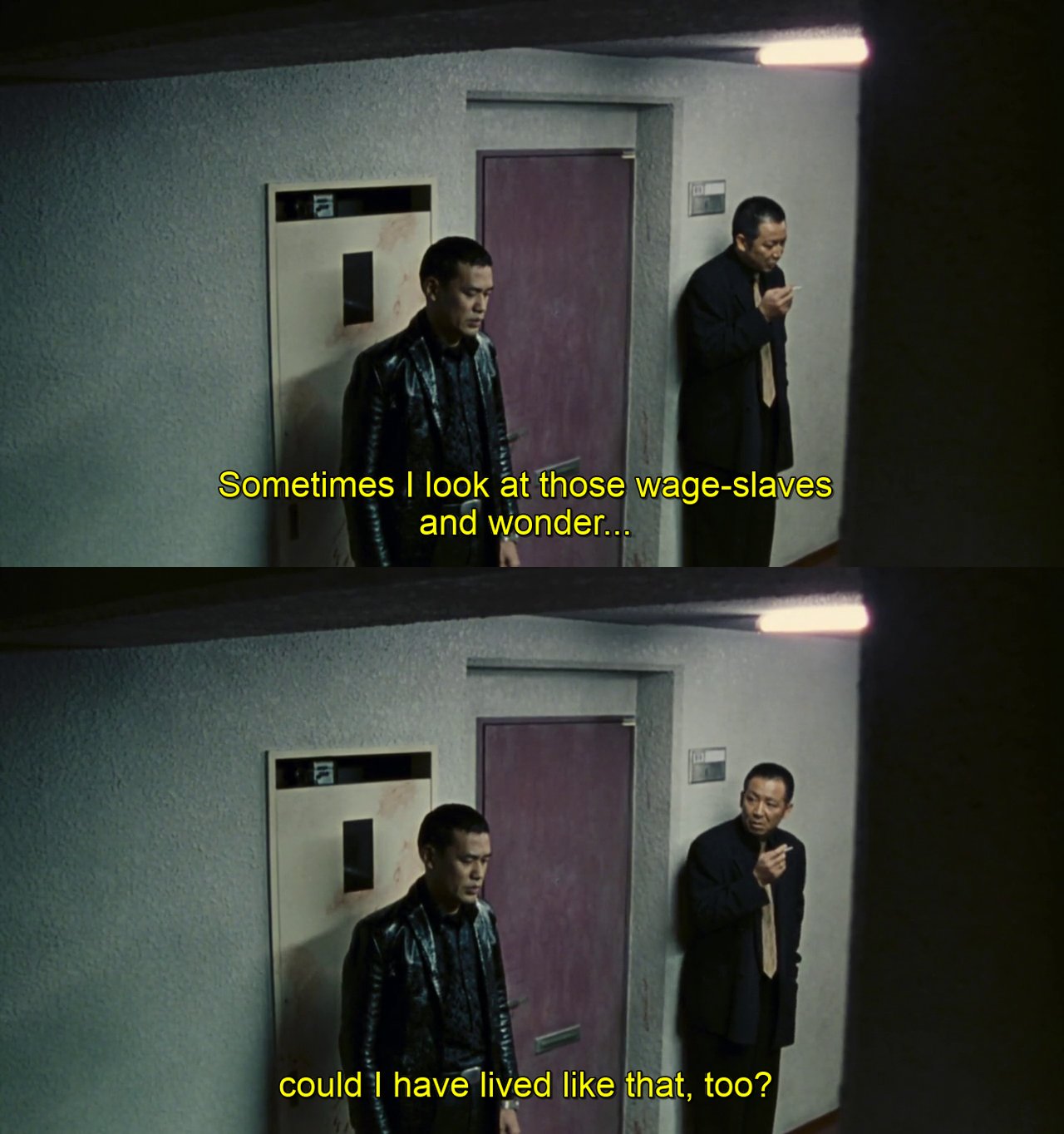
The meme is a quote from the movie "The Bourne Identity" where the character of the villain, the CIA agent, is explaining to the protagonist, the main character, that he could have lived like that too. The quote is a commentary on the idea that the protagonist's life is just like the villain's, and he could have lived like that too. The quote is a commentary on the idea that the protagonist's life is just like the villain's, and he could have lived like that too.
detailed-analysis (gemma3-27b-vision)
Okay, here's an analysis of the image, broken down into the requested theoretical frameworks, only including those that meaningfully apply.
Visual Description
The image is a diptych (two panels) featuring a scene in a dimly lit, institutional hallway. The dominant colors are muted greens, grays, and blacks, contributing to a somber, oppressive atmosphere. The hallway is stark and minimal, emphasizing the coldness of the setting.
In each panel, a solitary man is positioned near a closed door, either contemplating it or facing it. The man is wearing dark clothing (a black coat in the first panel, a black suit in the second). His expression is inward-looking, suggesting contemplation or even sorrow. The lighting is dramatic, casting shadows and highlighting the man's face.
Superimposed over the panels are lines of text: "Sometimes I look at those wage-slaves and wonder…" followed by "could I have lived like that, too?" This text provides context and directs interpretation toward themes of labor, alienation, and perhaps regret. The image evokes a feeling of melancholy, loneliness, and a questioning of life choices.
Foucauldian Genealogical Discourse Analysis
This image lends itself well to a Foucauldian analysis because of its setting, the isolated figure, and the implied narrative about "wage-slaves." Michel Foucault would be interested in how power operates within this seemingly mundane space.
- Discipline and Surveillance: The hallway, with its door, suggests a structure of control. It could be an office building, a bureaucratic institution, or even a prison-like setting. The man, even though seemingly outside the system, is looking at those within it. This gaze hints at how disciplinary power operates – we internalize norms, judge ourselves and others, and are aware of the systems that attempt to govern our behavior. The hallway represents a space of surveillance, not necessarily through direct observation, but through the inherent architecture that imposes order and control.
- Genealogy of the "Wage-Slave": The term "wage-slave" isn't simply a descriptive label. A genealogical approach would trace the historical emergence of this term and the discourse surrounding it. How did the idea of work shift from a necessary means of survival to a source of alienation and oppression? Foucault would look at how this concept has been constructed and contested through historical debates, labor movements, and social criticism. The image is essentially a snapshot of this evolving discourse.
- Power/Knowledge: The man's contemplation of "wage-slaves" implies a knowledge that such a life is dehumanizing. This knowledge itself is produced through power relations. The very act of labeling someone a "wage-slave" demonstrates an understanding of power dynamics and the ways in which individuals are subjugated by economic forces.
Marxist Conflict Theory
The image is strongly aligned with Marxist conflict theory. The phrase "wage-slaves" immediately evokes the central concept of exploitation inherent in capitalism.
- Class Struggle: The image speaks to the alienation of the working class. The man looking in suggests a detachment from this group, but also a questioning of their conditions. He is contemplating the cost of participating in a system that necessitates selling one's labor for a wage.
- Alienation: The somber mood and isolated figure contribute to a sense of alienation. The man appears disconnected from the lives of those he labels "wage-slaves," implying a lack of solidarity or perhaps a guilt over his own position. Alienation is a key concept in Marxist theory, referring to the separation of workers from the products of their labor, from each other, and from their own human potential.
- False Consciousness: The man's contemplation could be interpreted as a sign of overcoming "false consciousness" – the acceptance of the dominant ideology that justifies capitalist exploitation. He is beginning to see the system for what it is. However, it’s also important to consider why he’s only contemplating it, rather than acting upon it. This raises questions about the power of ideology to maintain the status quo.
Critical Theory
This image resonates with broad themes within Critical Theory, particularly those related to modernity, reason, and domination.
- The Rationalized Life: The cold, sterile hallway and the sense of isolation point to the rationalization of modern life, a key theme for Max Weber and the Frankfurt School. The emphasis on efficiency, control, and instrumental reason has led to a dehumanizing effect.
- The Subject & Social Critique: The image engages with the concept of the subjective experience within the larger structures of power. The man is not merely a cog in the machine, but a conscious being capable of reflecting on his own condition and the condition of others. This reflection, however, is tinged with sadness and regret, suggesting a lack of agency or a feeling of powerlessness.
- Domination & Oppression: The image points to the subtle forms of domination that permeate modern society. It is not necessarily about overt force, but about the ways in which individuals are subtly controlled and manipulated by economic and social structures.
Postmodernism
While not the primary lens, aspects of postmodernism can be applied.
- Fragmentation and Alienation: The image’s aesthetic—the stark hallway, the isolated figure—can be read as an expression of the fragmentation and alienation that are central to the postmodern condition. There is a lack of connection, a sense of being adrift in a meaningless world.
- Questioning of Grand Narratives: The image implicitly questions the grand narratives of work, success, and the "American Dream." It suggests that these narratives may be hollow or even oppressive.
- Subjectivity & Relativism: The image acknowledges the subjective experience of alienation. There’s no universal truth here; the man’s contemplation is his own, and others may not share his perspective.
Let me know if you'd like me to expand on any of these interpretations or explore other theoretical frameworks.
simple-description (llama3.2-vision)
This meme is a screenshot from the TV show "Black Mirror" where a character says "I know I'm not a human being and I don't feel anything. Sometimes I look at those wage-slaves and wonder... could I have lived like them?" The quote is then followed by a character saying "I think I could have lived like that, you know?" The meme is often used to express a sense of envy or resentment towards others who seem to have an easier life.
tesseract-ocr
eer oa — —_— | Sin eg at et Rin bei i ve alt 4 ® , EB i "i } i \ \ os ‘| . } RU ads L 4 } ae A A A cdl : BS: Sometimes | look at those wage-slaVes mee + and wonder..! rang + iN { Peers wii RM i me y a - Piya? i ee, no | a O bey 2 r i RAY. , ar a r r it 4 ee L i Vy >, ae \ Re could | alg Thee) ye at, too?