First Seen
2023-05-10T21:03:33+00:00
simple-description (llama3.2-vision_11b)
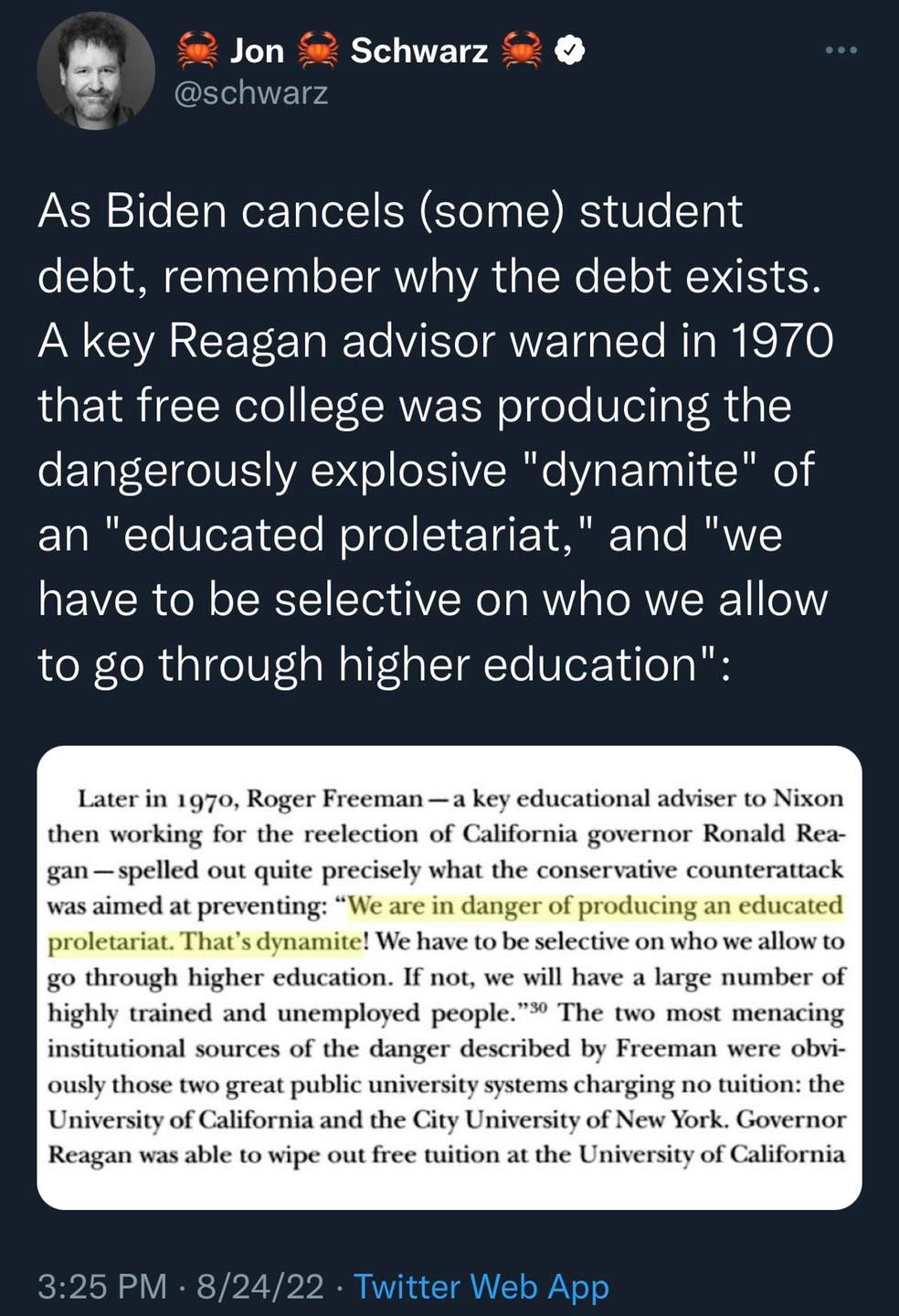
The meme is a screenshot of a quote from a 1970 article by historian and author, J. . The quote is used to highlight the . The quote is a critique of the . The quote is used to highlight the .
detailed-analysis (gemma3-27b-vision)
Here's a breakdown of the Twitter post, analyzed through the requested theoretical lenses. Keep in mind that applying these frameworks can be interpretive; multiple readings are possible.
Visual Description
The image is a screenshot of a Twitter post from user @schwarz, identified as Jon Schwarz. It features a profile picture of a person with a beard and a hat. The post consists of text discussing the historical context of student debt and the warnings from a Reagan advisor about the dangers of "free college" creating an "educated proletariat." A timestamp (3:25 PM, 8/24/22) and the indication it was posted via the Twitter Web App are visible at the bottom. The background is the standard Twitter blue and white. The tone appears to be critical of student debt forgiveness without addressing the root causes of the problem.
Foucauldian Genealogical Discourse Analysis
This post offers rich material for a Foucault-inspired genealogical analysis.
- Discourse & Power: The post highlights how the discourse surrounding higher education has been shaped by power dynamics. The statement from the Reagan advisor isn't merely a prediction; it’s an exercise of power/knowledge. This advisor defines a certain outcome (“educated proletariat”) as dangerous, thereby framing the debate. This framing then justifies policies – like tuition increases – aimed at controlling access to higher education.
- Archaeology & Genealogy: This post pulls back layers of historical context. It isn't just about current student debt; it's about excavating the historical conditions that led to this situation. The post traces a line from a warning in 1970 to the present-day problem of debt, highlighting the continuous operation of power. The genealogy maps how a specific fear (the "educated proletariat") has been articulated and acted upon over time.
- Subjectivation: The fear of the “educated proletariat” speaks to how higher education is used to produce certain types of subjects. Those deemed undesirable (the “proletariat” potentially challenging the status quo) are discouraged or blocked from accessing education, while others are encouraged. The warning reveals a desire to control who becomes educated and how that education shapes their identity and role in society.
Marxist Conflict Theory
This post is very directly amenable to a Marxist analysis.
- Class Struggle: The core of the argument rests on the fear of an "educated proletariat"—a working class with the intellectual tools to challenge the existing power structure. This is classic Marxist conflict—a clash between the interests of the ruling class (those who benefit from the status quo) and the working class.
- Ideology & Hegemony: The advisor’s statement is an example of ideological control. It attempts to shape perception, framing education as a potential threat rather than a social good. This aligns with the concept of hegemony – the dominance of a ruling class’s ideas and values, presented as common sense. By portraying an educated working class as “dynamite,” the advisor legitimizes policies that limit access to education.
- Capitalism & Reproduction: The post suggests that limiting access to higher education is a strategy for maintaining the capitalist system. By controlling who gets educated, the ruling class can ensure a continued supply of exploitable labor and prevent the development of a class-conscious workforce.
Critical Theory
This post lends itself to Critical Theory because it seeks to unveil the hidden power dynamics and ideologies underlying social phenomena.
- Emancipatory Interest: The post implicitly raises an “emancipatory interest” – a desire to understand how power operates so that we can challenge and overcome oppressive structures. By revealing the historical warnings about an educated working class, it suggests a need to re-evaluate the current system and ask who benefits from it.
- Critique of Reason & Enlightenment: The post can be seen as a critique of the uncritical embrace of education as inherently progressive. The advisor’s warning reveals how Enlightenment ideals (access to knowledge) can be perceived as threatening by those in power.
- Totalizing Systems: The post hints at the ways that the system of higher education is part of a larger system of power, control, and economic inequality. It pushes us to consider how education reproduces existing social hierarchies rather than liberating individuals.
It's important to note that these theoretical frameworks aren’t mutually exclusive. They can be combined to offer a more nuanced and comprehensive understanding of the post.
simple-description (llama3.2-vision)
This meme is a humorous take on a quote attributed to a former US President, Ronald Reagan. The image shows a quote from Reagan's 1981 State of the Union address, where he famously declared "Mr. Gorbachev, Mr. Gorbachev, Mr. Gorbachev, we are not going to be satisfied with the fact that the Soviet Union is less than the Soviet Union of 1981". The meme is a play on this quote, replacing "Gorbachev" with "Joe Biden" and "the Soviet Union" with "the national debt".
tesseract-ocr
4 * Jon “& Schwarz S @ " @schwarz As Biden cancels (some) student debt, remember why the debt exists. A key Reagan advisor warned in 1970 that free college was producing the dangerously explosive "dynamite" of an "educated proletariat," and "we have to be selective on who we allow to go through higher education": Later in 1970, Roger Freeman —a key educational adviser to Nixon then working for the reelection of California governor Ronald Rea- gan —spelled out quite precisely what the conservative counterattack was aimed at preventing: “We are in danger of producing an educated proletariat. That's dynamite! We have to be selective on who we allow to go through higher education. If not, we will have a large number of highly trained and unemployed people.”* The two most menacing institutional sources of the danger described by Freeman were obvi- ously those two great public university systems charging no tuition: the University of California and the City University of New York. Governor Reagan was able to wipe out free tuition at the University of California 3:25 PM - 8/24/22 - Twitter Web App