First Seen
2023-05-10T21:03:33+00:00
simple-description (llama3.2-vision_11b)
The meme is a commentary on the nature of capitalism, where the game of Monopoly is used as a metaphor for the exploitation of the working class. The text states that Monopoly ends when no one can afford to live on the board, implying that the game is a representation of the capitalist system's inability to provide for its citizens. The quote is a commentary on the absurdity of the game's rules and the way they reflect the real-world economic system.
detailed-analysis (gemma3-27b-vision)
Okay, here's an analysis of the image and the accompanying tweet, broken down by the requested theoretical frameworks. It's a rich little statement, and several frameworks apply quite well.
Image & Tweet Overview
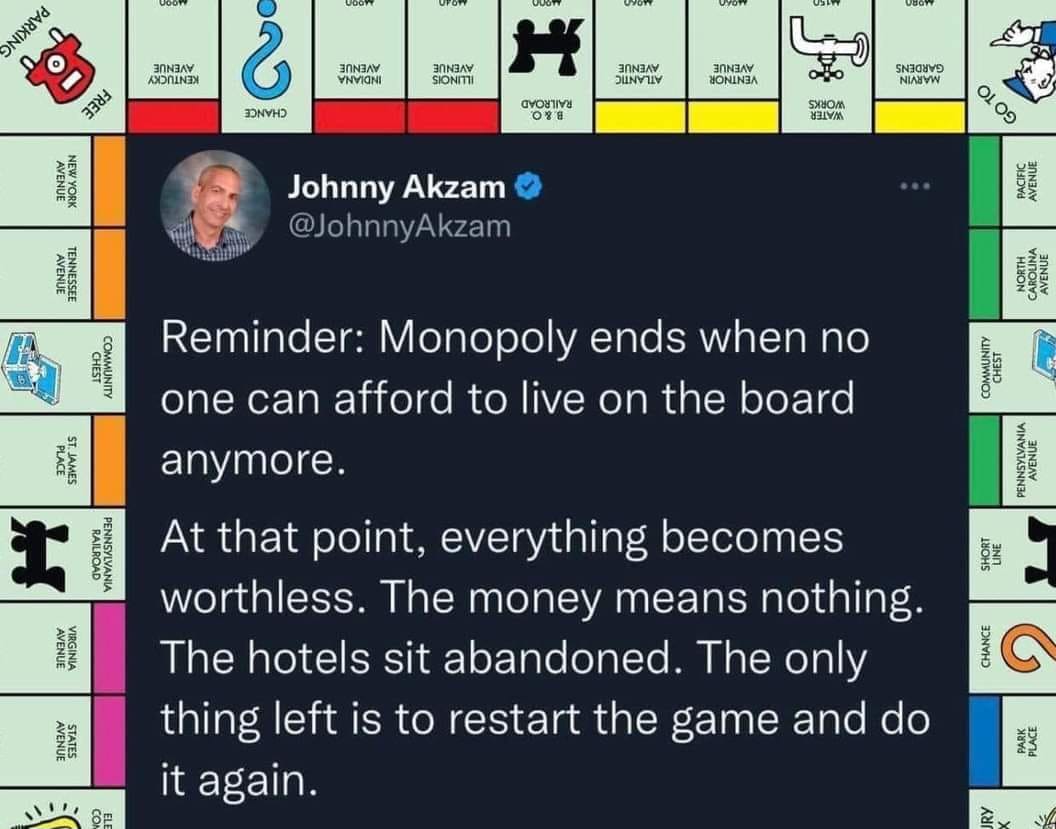
The image is a cropped view of a Monopoly board. We see a section running from "Free Parking" through "St. James Place" and down the right side. The tweet, posted by Johnny Akzam, states that Monopoly “ends when no one can afford to live on the board anymore,” that money becomes worthless, the hotels are abandoned, and all that's left is to restart the game.
Visual Description
The visual is significant because it's a fragmented, partial view of the Monopoly board. This immediately suggests incompleteness and a breaking down of the full system. The vibrant colors and recognizable properties create a sense of nostalgia, or a false promise of security, contrasting with the tweet's bleak assessment. The cropping emphasizes the cycle of acquisition and eventual ruin. We don't see the 'end' of the game in the image, just the point of collapse.
Marxist Conflict Theory
This is perhaps the most readily applicable framework. The tweet perfectly encapsulates the core themes of Marxist conflict theory:
- Capital Accumulation & Crisis: Monopoly is a game about capital accumulation. Players strive to acquire properties and maximize profits. The tweet identifies the inherent logic of the game: endless accumulation until it reaches a point of systemic failure. This mirrors the Marxist prediction of inherent crises within capitalism – overproduction, unequal distribution, and eventual collapse.
- Class Struggle: Within the game, players are inherently in competition. While it's "just a game", the dynamics mimic class conflict—some players inevitably become wealthier than others, driving others into bankruptcy.
- Alienation: As players lose wealth and properties, they become alienated from the fruits of their labor (the properties they initially acquired). The abandonment of the hotels represents the devaluing of investment and the loss of purpose within the system. The tweet points to the emptiness of accumulation once the game reaches its endpoint.
- Cycles of Restart: The statement about having to "restart the game" is a cynical commentary on the cyclical nature of capitalism. Even after a crisis, the system is 'restarted' – inequalities are often perpetuated, and the cycle of accumulation begins again.
Critical Theory
Critical Theory, stemming from the Frankfurt School, focuses on power structures and ideologies. This image and tweet fit this framework in several ways:
- Deconstruction of Ideology: The tweet deconstructs the ideology within the game. Monopoly is often presented as a celebration of capitalism and individual initiative. However, the tweet reveals the game’s actual logic: it’s a zero-sum game where one person's success depends on another's failure.
- Power Dynamics: The game exposes power dynamics between the players. As the game progresses, players with more capital gain leverage, controlling properties and forcing others into debt. The abandonment of hotels, an indicator of wealth, also symbolises a loss of power.
- The Illusion of Control: The tweet challenges the idea of individual agency within the game. Even the most strategic player can be ruined by luck or by the actions of other players. This reflects the Critical Theory assertion that individuals are often subject to systemic forces beyond their control.
Postmodernism
While less direct, a Postmodern reading is possible:
- Simulacrum and Simulation: The Monopoly board itself can be seen as a simulacrum – a copy of reality without an original. The properties are not real places, and the money is not real currency. The tweet underscores this artificiality.
- Deconstruction of Narrative: The traditional narrative of Monopoly is one of upward mobility and financial success. The tweet disrupts this narrative, showing a game ending in complete failure and stagnation.
- Loss of Grand Narratives: The tweet, in its cynicism, suggests a rejection of the “grand narratives” of capitalism. It implies that the promise of endless growth and prosperity is ultimately unsustainable.
Foucauldian Genealogical Discourse Analysis
Michel Foucault’s approach looks at how knowledge and power are intertwined, shaping discourses and practices. Applying this:
- Discourse of Wealth: Monopoly perpetuates a specific discourse around wealth – that it is desirable, attainable, and the ultimate measure of success. The tweet challenges this discourse by showing the emptiness and ruin that can result from pursuing wealth at all costs.
- Power/Knowledge: The rules of the game (knowledge) create power dynamics. Players use the rules (knowledge) to accumulate wealth (power). The tweet suggests that these rules, while seemingly neutral, ultimately lead to unequal outcomes.
- Genealogy of Control: We could trace a genealogy of control through the game. The game’s mechanics encourage players to compete, dominate, and accumulate resources. This can be seen as a microcosm of broader social systems that rely on competition and control.
Queer Feminist Intersectional Analysis (This one is the most strained, but potentially there)
- Unequal Access & Accumulation: While the game doesn’t explicitly address gender, race, or other identity categories, the dynamics of accumulation can be interpreted through an intersectional lens. Some players might start with advantages (e.g., initial capital, strategic positioning), while others might be disadvantaged.
- Critique of Dominant Structures: A Queer Feminist reading could see the game as reinforcing dominant structures of power and wealth. The focus on competition and accumulation aligns with patriarchal and capitalist values.
- Resistance & Subversion: A radical interpretation might suggest that refusing to play the game or deliberately sabotaging the system could be acts of resistance against oppressive structures. (This is a reach, but theoretically possible.)
Let me know if you'd like me to expand on any of these analyses or focus on a specific theoretical framework!
simple-description (llama3.2-vision)
This meme is a humorous take on the classic board game Monopoly. It's a quote from the 1988 film "Wall Street," in which the character Gordon Gekko says, "Greed, for lack of a better word, is good. Greed, is good." However, in this meme, the quote is modified to replace "good" with "Monopoly," and the rest of the quote is rewritten to fit the theme of the game. The quote now reads, "Monopoly, for lack of a better word, is Monopoly. Monopoly, is Monopoly."
tesseract-ocr
%,|=/6|-|-|M|.|./s1.|2 ) anny annsnv ameny anny ancy susawv9 i 28 — 2 % Johnny Akzam @ or + id @JohnnyAkzam 23 bolt a ase | Reminder: Monopoly ends when no mm! one can afford to live on the board _ anymore. At that point, everything becomes 1 z - “ worthless. The money means nothing. all The hotels sit abandoned. The only iS all thing left is to restart the game and do Gg _ alee