First Seen
2023-06-15T02:22:20+00:00
simple-description (qwen3.5_2b-q8_0)
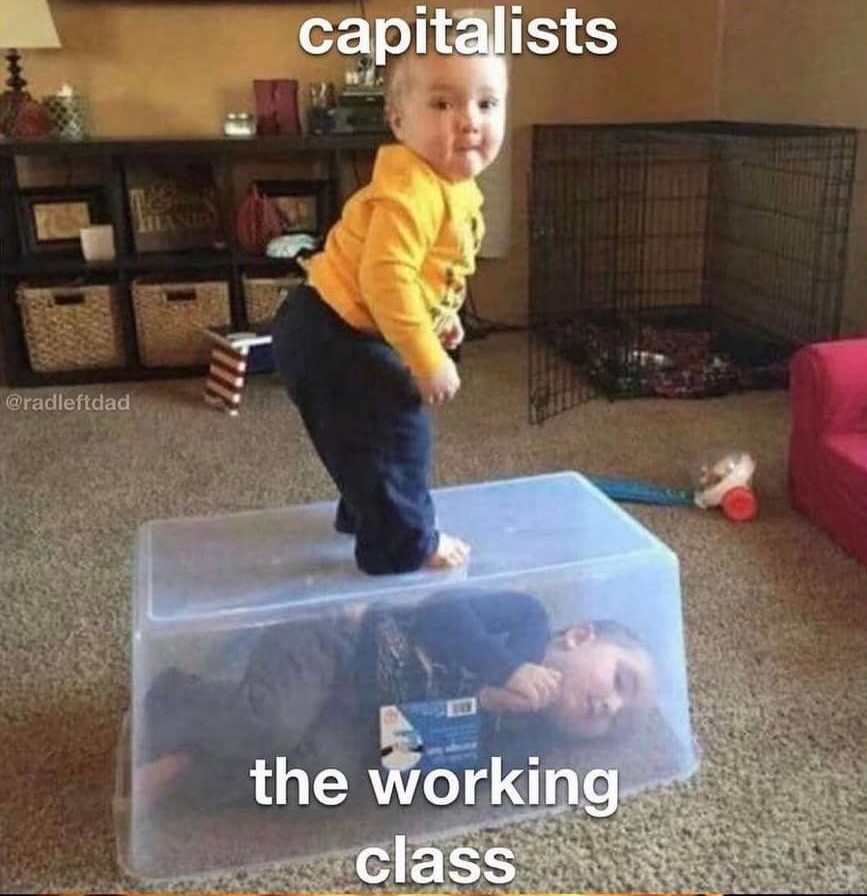
This meme serves as a satirical critique from an anti-capitalist perspective, depicting the "capitalists" (the parents/generation) looking down on the "working class" (the children) to highlight the class divide. It juxtaposes the text "capitalists" at the top with "the working class" at the bottom, while showing a baby standing atop a plastic bin over a child lying underneath. This visual metaphor suggests that the "working class" is being worked for or looked down upon by the "capitalists," reflecting the irony of the "Next Gen" standing on the shoulders of their parents' wealth.
simple-description (llama3.2-vision_11b)
The meme is a playful jab at the idea of the "proletariat" (working class) being the revolutionary force that will overthrow capitalism. The image shows a child playing with a toy, but the caption "proletariat" is juxtaposed with "capitalist" in a way that implies the child is being exploited by the capitalist (the adult) while the child is actually the one in control. The text "I'm the boss" is written above the child's head, implying that the child is the one in charge, while the adult is being oppressed.
detailed-analysis (gemma3-27b-vision)
Okay, let's break down this meme through the requested theoretical lenses. It's important to remember that applying these complex theories to a simple image involves interpretation and can be somewhat subjective. I'll indicate where the fit is strong or more tenuous.
Visual Description
The image depicts a young child (likely a toddler) standing on top of a clear plastic storage container. Another, slightly smaller child is inside the container, mostly obscured, but with legs and a baseball cap visible. Text superimposed on the image labels the child standing on top as "capitalists" and the child inside the container as "the working class." The background shows a domestic interior—a living room or playroom—with toys and furniture. The child on top appears to be looking down, with a somewhat smug or content expression. The lighting is natural and the overall feel is casual and domestic.
Marxist Conflict Theory
This meme is most directly engaged with Marxist conflict theory. The visual metaphor is a clear illustration of class relations as conceived by Marx.
- Bourgeoisie/Proletariat: The child standing atop the container is positioned as the bourgeoisie (the capitalist class) while the child inside is the proletariat (the working class). The height difference physically embodies the power dynamic.
- Means of Production: The plastic container can be interpreted as a representation of the means of production. The 'working class' child is within the means of production, while the 'capitalist' child controls access to and benefits from it.
- Exploitation & Dependency: The 'capitalist' child is elevated by the 'working class' child, illustrating a form of dependence and a clear imbalance of power. The container is literally supporting the child on top. This visually emphasizes the concept of exploitation – the 'capitalist' benefits from the labor/support of the 'working class'.
- Material Conditions: The domestic setting, though seemingly innocuous, also hints at the material conditions shaping class relations. Even in a domestic context, class dynamics are at play.
The image is a simplification, of course, but it powerfully conveys the core Marxist idea of class struggle and unequal power dynamics.
Foucauldian Genealogical Discourse Analysis
While not as direct a fit as Marxist theory, Foucault's ideas can be applied to examine the image.
- Power/Knowledge: The meme itself functions as a discourse about class. It utilizes a visual metaphor to construct and circulate certain ideas about capitalism and class relations. The labeling ('capitalists,' 'working class') is a form of naming and categorization, which is central to Foucault’s concept of power/knowledge. The meme creates meaning through this labeling.
- Discipline and Normalization: The meme implicitly normalizes the idea of class hierarchy, even if presented with a critical intent. It presents the image of one child being 'above' another as a natural, albeit problematic, state of affairs.
- Genealogy: A Foucauldian genealogical approach would examine how the idea of class and the metaphor of someone standing on someone else has evolved historically, tracing the discourses and power relations that have shaped it. This would involve looking at the history of class representations and the ways in which such imagery has been used to legitimize or challenge existing power structures.
- Panopticism (tenuous): One could stretch the interpretation to suggest the child on top embodies a form of surveillance/control (like in the Panopticon), but this connection is weak.
Critical Theory
This meme aligns with some aspects of Critical Theory.
- Ideology Critique: The meme functions as an act of ideology critique, exposing (or attempting to expose) the underlying power dynamics inherent in capitalist systems. It challenges the 'naturalness' of social hierarchies.
- Domination and Oppression: The image illustrates the relationship between domination and oppression. The child on top represents the dominant class, benefiting from the support (and implicit oppression) of the child below.
- Emancipation (potential): The meme, by making this power dynamic visible, could serve as a catalyst for critical consciousness and, potentially, a desire for social change (emancipation). However, as a single meme, its impact is limited.
Postmodernism (weaker fit)
The connection to Postmodernism is the weakest of these frameworks. However:
- Deconstruction of Grand Narratives: The meme implicitly challenges the 'grand narrative' of capitalism as a just or equitable system.
- Playfulness & Irony: There's a degree of playful irony in using a childish image to represent a complex socioeconomic system. This is a common tactic in postmodern art and critique.
- Simulation and Hyperreality: One could argue the meme is a ‘simulation’ of class relations, a simplified representation that doesn't fully capture the complexities of real-world inequality.
Queer Feminist Intersectional Analysis (least applicable)
Applying a Queer Feminist Intersectional analysis is difficult because the image doesn't explicitly address gender, sexuality, or the intersections of multiple identities. However, one could stretch the interpretation to suggest:
- Power Dynamics & Embodiment: The image could be viewed as a representation of broader power dynamics that intersect with gender and sexuality. The child on top is positioned as having power and control, which can be linked to patriarchal structures.
- Vulnerability and Subordination: The child inside the container is in a vulnerable and subordinate position, which could be linked to the experiences of marginalized groups. (This is a very loose connection.)
- Deconstruction of Traditional Hierarchies: The meme, as a critique of class hierarchies, could be seen as part of a broader effort to deconstruct all forms of oppressive hierarchies.
Important Note: These analyses are interpretive. The strength of the connection between the image and each theoretical framework varies. The meme is a simplified representation, and applying complex theory to it requires a degree of extrapolation and assumption.
simple-description (llama3.2-vision)
This meme is a humorous commentary on the relationship between capitalism and the working class. The image depicts a child playing with a doll in a box, with the caption "capitalists" and "the working class" written above and below the child. The joke is that the child is essentially a miniature version of the capitalist exploiting the working class, with the doll in the box representing the exploitation of the working class by the capitalist.
tesseract-ocr
a capitalists rs : Lue i : = Ty | . La ww) | SS —= 3 >. PA in ‘ J @radleftdad . ) oh 2 See r peeks fa Pd ae ee ee Ee tate uy a Be 2S Sr oan ea eh ee SER a 5 ae Bsns AS ee at es Se ae : hie eae SON aan Sacre Vie rai a Rts era ees ‘RINQes Xda q pears Paes SOE See A s - ee i ay = Sea iee MER 6 ot Og fe he Re edhe So yatta 8