First Seen
2023-05-31T05:42:08+00:00
simple-description (qwen3.5_2b-q8_0)
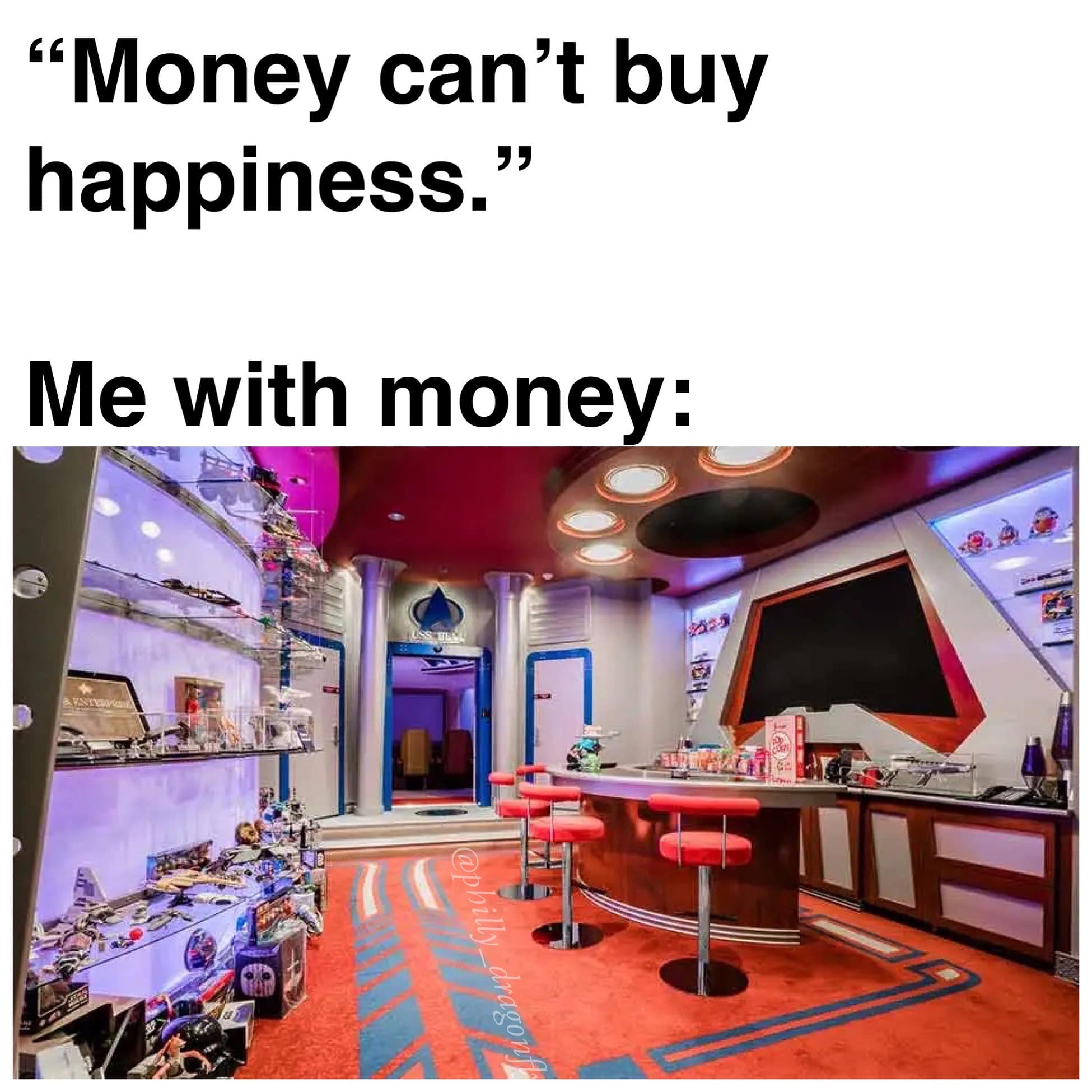
This meme satirizes the capitalist pursuit of accumulation by contrasting the quote "Money can't buy happiness" with a lavish, collectible room. It criticizes the mindset that seeks to maximize wealth through hoarding material goods, such as the extensive shelves of expensive toys and memorabilia seen in the picture. This humorous image suggests that instead of finding happiness with a simple life, the wealthy person has turned their focus toward accumulating layers of material possessions.
simple-description (llama3.2-vision_11b)
The meme is a humorous commentary on the idea that people who are anti-capitalist or critical of consumerism often find joy in experiences or activities that are not materialistic or expensive. The image is likely a photo of a thrift store or a garage sale, with a caption that reads "I'm not rich, but I can buy happiness." The meme pokes fun at the idea that people can find happiness in low-cost or free activities, like thrift shopping, rather than relying on expensive material possessions.
detailed-analysis (gemma3-27b-vision)
Okay, let's break down this image and its accompanying text through several theoretical lenses.
Visual Description
The image depicts a room designed to resemble the bridge of a spaceship, specifically evoking the aesthetic of Star Trek. It's lavishly decorated and appears to be inside a private residence. Key features include:
- Color Scheme: Intense blues and reds dominate, creating a dramatic, almost theatrical effect.
- Furniture: Modern bar stools in bright red are arranged around a curved, illuminated bar.
- Decor: The walls are covered with framed artwork depicting space battles and science fiction imagery. Numerous lights, including neon and LED strips, contribute to the futuristic atmosphere. There's a visible champagne display/cooler.
- Overall Impression: The space is a meticulously crafted "man cave" or hobby room, clearly intended for entertainment and the display of wealth and personal interests. The space is designed to impress and signify a high level of disposable income.
Critical Theory
This image perfectly exemplifies the ideas within critical theory. The “meme” juxtaposes the cliché "money can't buy happiness" with a depiction of conspicuous consumption. Critical theory questions taken-for-granted assumptions and explores the power dynamics embedded within culture. This image does just that. It shows how cultural norms around happiness are undermined by the desire to exhibit status.
The space isn’t about practical use; it's about symbolic use. It's a constructed environment designed to convey a specific message – affluence, leisure, and devotion to a specific cultural fandom. It’s a stage set for performing wealth.
Marxist Conflict Theory
From a Marxist perspective, this image highlights the inherent contradictions of capitalism. While the cliché of "money can't buy happiness" is often touted, this room demonstrates how capital can be used to create artificial environments designed to simulate happiness and fulfillment. The space is a physical manifestation of the commodity fetish – objects are valued not for their use-value, but for their symbolic value in signifying social status.
The construction of this room is a demonstration of capital being deployed to alleviate the alienation inherent in modern life. The owner is creating an environment that allows them to immerse themselves in a fantasy world, distancing themselves from the realities of class struggle and economic inequality.
Postmodernism
The space strongly embodies postmodern sensibilities. There’s a blending of high and low culture – the aspirational science fiction aesthetic is combined with the consumerist display of wealth. The room is a pastiche, a deliberate layering of references to science fiction tropes and popular culture. There’s a playful irony in constructing such an elaborate environment, suggesting a rejection of traditional notions of authenticity and a celebration of simulation.
The space isn’t about achieving a 'genuine' experience; it's about creating a hyperreality – a simulated environment that is more real than real. The owner is constructing a personalized mythos through their consumption.
Foucauldian Genealogical Discourse Analysis
A Foucauldian analysis would focus on the discourses surrounding happiness, wealth, and leisure. The meme itself participates in a discourse that pits genuine fulfillment against material possessions. The image, however, exposes the power dynamics at play within that discourse.
The construction of this room represents a specific form of self-governance. The owner is using their wealth to create an environment that aligns with their desires and fantasies. This is a form of 'technologies of the self' – practices and techniques used to shape the self and regulate behavior. The space isn’t simply a matter of personal preference; it’s a manifestation of a power/knowledge relationship – the owner has the power to shape their environment, and that power is linked to their economic status.
Queer Feminist Intersectional Analysis
While not immediately obvious, a queer feminist intersectional analysis could examine the ways in which this space is likely constructed around a particular (likely male) subject. The "nerd cave" trope is often associated with a masculine identity. The aesthetic choices – the emphasis on technology, space battles, and displays of "power" – could be interpreted as reinforcing traditional masculine ideals.
The image may also implicitly exclude or marginalize other identities. The space is unlikely to be designed with the needs or desires of women, people of color, or LGBTQ+ individuals in mind. The wealth displayed is likely rooted in systems of oppression that benefit certain groups while disadvantaging others. This also touches on the concept of “performative leisure” where leisure activities are used to signal social status and belonging.
I hope this detailed analysis provides a comprehensive understanding of the image through these theoretical lenses. Let me know if you'd like me to elaborate on any specific point.
simple-description (llama3.2-vision)
The meme is a humorous take on the phrase "money can't buy happiness." It features a picture of a luxurious, high-tech room filled with expensive gadgets and toys. The text at the top reads "Money can't buy happiness" and the text below it says "But it can buy a room like this".
tesseract-ocr
46 J Money can’t buy h 7 5 appiness. a Me with money: | SS Vea ; i : 2 : Pe < - PP <-> , | Tys23! \ = ey S : —— ee a " & Ss - : Te < | ) F | oj q ae A a yw ee ern ae | _= 4 ae. | Be io PS SS EE a oy 3B ten bh ie) eg. - a: ; <x A ay 7 re , wey a : i. pee oe a . i a