First Seen
2023-09-02T05:05:24+00:00
simple-description (qwen3.5_2b-q8_0)
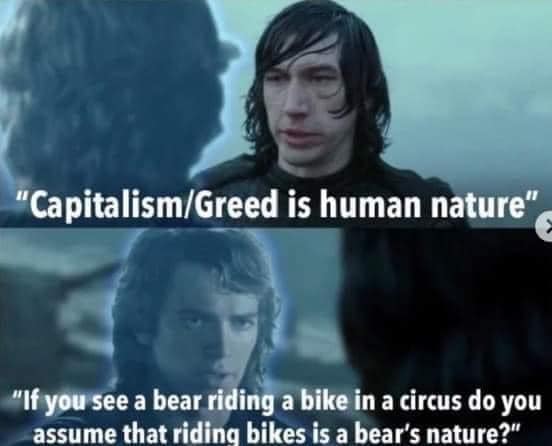
This anti-capitalist meme uses a "double bind" technique to challenge the idea that greed is an inherent human trait. It juxtaposes the claim that "capitalism/greed is human nature" with a logical counter-example: if you saw a bear riding a bike, would you assume that riding bikes is a bear's nature? The bottom text implies that just because individuals do something doesn't mean the action is inherently good or natural, suggesting a flawed logic for justifying capitalism.
simple-description (llama3.2-vision_11b)
The meme is a screenshot from the 2013 film "The Hunger Games: Catching Fire" where Katniss Everdeen (played by Jennifer Lawrence) is asked if she's a "capitalist" or a "communist". In response, she says "I'm neither. I'm the one who lives in the hole in the ground."
The meme is an image of Katniss's response with the text "I'm neither. I'm the one who lives in the hole in the ground" overlaid with the text "When you're asked if you're a capitalist or a communist: 'I'm neither. I'm the one who lives in the hole in the ground'".
detailed-analysis (gemma3-27b-vision)
Okay, let's break down this image and its potential implications through several critical theory lenses.
Visual Description
The image is a two-panel meme constructed from scenes featuring actor Adam Driver (likely from a movie or TV series). Both panels feature a close-up shot of Driver with a serious, somewhat questioning expression. The lighting is cool-toned and moody, contributing to a contemplative atmosphere. The panels contain contrasting text phrases, presented as dialogue. The top panel reads, “Capitalism/Greed is human nature.” The bottom panel presents a rhetorical question: “If you see a bear riding a bike in a circus, do you assume that riding bikes is a bear’s nature?”
Critical Theory
The meme challenges the naturalization of social constructs. Critical theory fundamentally questions assumptions about things being ‘natural’ or inherent, arguing instead that many things we see as natural are actually products of social and historical forces. The bear analogy brilliantly deconstructs the idea that behaviors (like greed) are simply part of "human nature." Just because we observe a behavior doesn't mean it's an essential, innate trait. It suggests learned behavior is often presented as natural. The meme directly challenges a common justification for capitalist systems – that they appeal to a deeply rooted human tendency toward greed. The use of a seemingly absurd analogy (a bear riding a bike) exposes the absurdity of accepting a social construct (capitalism) as natural.
Marxist Conflict Theory
The meme aligns with Marxist thought by highlighting how ideologies serve to justify existing power structures. The assertion that "Capitalism/Greed is human nature" can be interpreted as an ideological justification for the inherent inequalities within a capitalist system. If greed is seen as natural, then the accumulation of wealth and the exploitation of others are presented not as moral failings but as inevitable expressions of human nature. The meme subverts this by asking us to question whether that's actually true. In a Marxist framework, the bear analogy could represent the working class being forced to perform unnatural acts (labor) within the circus (capitalist system) and presenting those unnatural acts as if they are part of the bear's (worker’s) nature.
Foucauldian Genealogical Discourse Analysis
From a Foucauldian perspective, the meme is a miniature genealogy. Michel Foucault explored how concepts like "human nature" are not timeless truths but are constructed through discourse—systems of language, ideas, and practices. The meme suggests that the idea of “human nature” is a product of discourse (e.g., economic, political, philosophical) and that this discourse serves a particular function—in this case, legitimizing capitalism. The bear analogy challenges the 'truth' of “human nature” and reveals how the idea of a "natural" trait is constructed through historical and social forces. It asks us to investigate the power/knowledge relationship that created and maintains the notion that greed is inherent to humanity. Who benefits from the assertion of this claim? What systems are maintained by it?
Postmodernism
The meme has a distinct postmodern sensibility. Postmodern thought is skeptical of grand narratives (like the idea of a universal "human nature") and emphasizes the constructed nature of reality. The absurdity of the bear analogy is inherently postmodern. It uses a nonsensical image to dismantle a taken-for-granted assumption. The meme doesn’t offer a definitive alternative to the idea of “human nature,” but rather exposes the instability of that concept. It suggests that meaning is not inherent but is created through language and cultural context.
Queer Feminist Intersectional Analysis
While the meme doesn't explicitly address gender, sexuality, or race, a queer feminist perspective can still be applied. The notion of "human nature" has historically been used to justify oppression and enforce social norms. Concepts of what is “natural” have been deployed to pathologize queer identities, justify gender roles, and rationalize racial hierarchies. The meme's deconstruction of the concept of "human nature" can thus be seen as a broader critique of naturalizing systems of power that exclude or marginalize certain groups. Furthermore, the analogy of forced performance within the circus (capitalist system) could be interpreted as reflective of the performance of gender or sexuality under oppressive normative structures.
Let me know if you’d like me to expand on any of these analyses or explore other theoretical frameworks!
simple-description (llama3.2-vision)
This meme is a humorous image with two text overlays. The top overlay reads "If you see a bear riding a bike in a circus, do you think he's riding it or the circus is riding him?" The bottom overlay says "If you see a bear riding a bike in a circus, do you think he's riding it or the circus is riding him?" is replaced by "If you see a bear riding a bike in a circus, do you think he's riding it or the circus is riding him?". The image is then replaced by a quote from the movie "The Revenant" where Hugh Glass says "If you see a bear riding a bike in a circus, do you think he's riding it or the circus is riding him?". The image is then replaced by a quote from the movie "The Revenant" where Hugh Glass says "If you see a bear riding a bike in a circus, do you think he's riding it or the circus is riding him?" and is then replaced by a quote from the movie "The Revenant" where Hugh Glass says "If you see a bear riding a bike in a circus, do you think he's riding it or the circus is riding him?".
tesseract-ocr
4 se d bs wa mT ESTE Loe il a sea DT Ey Ens RE cin Ee ORT assume that riding bikes is a bear's nature?”