First Seen
2024-03-15T23:59:51.606253+00:00
simple-description (qwen3.5_2b-q8_0)
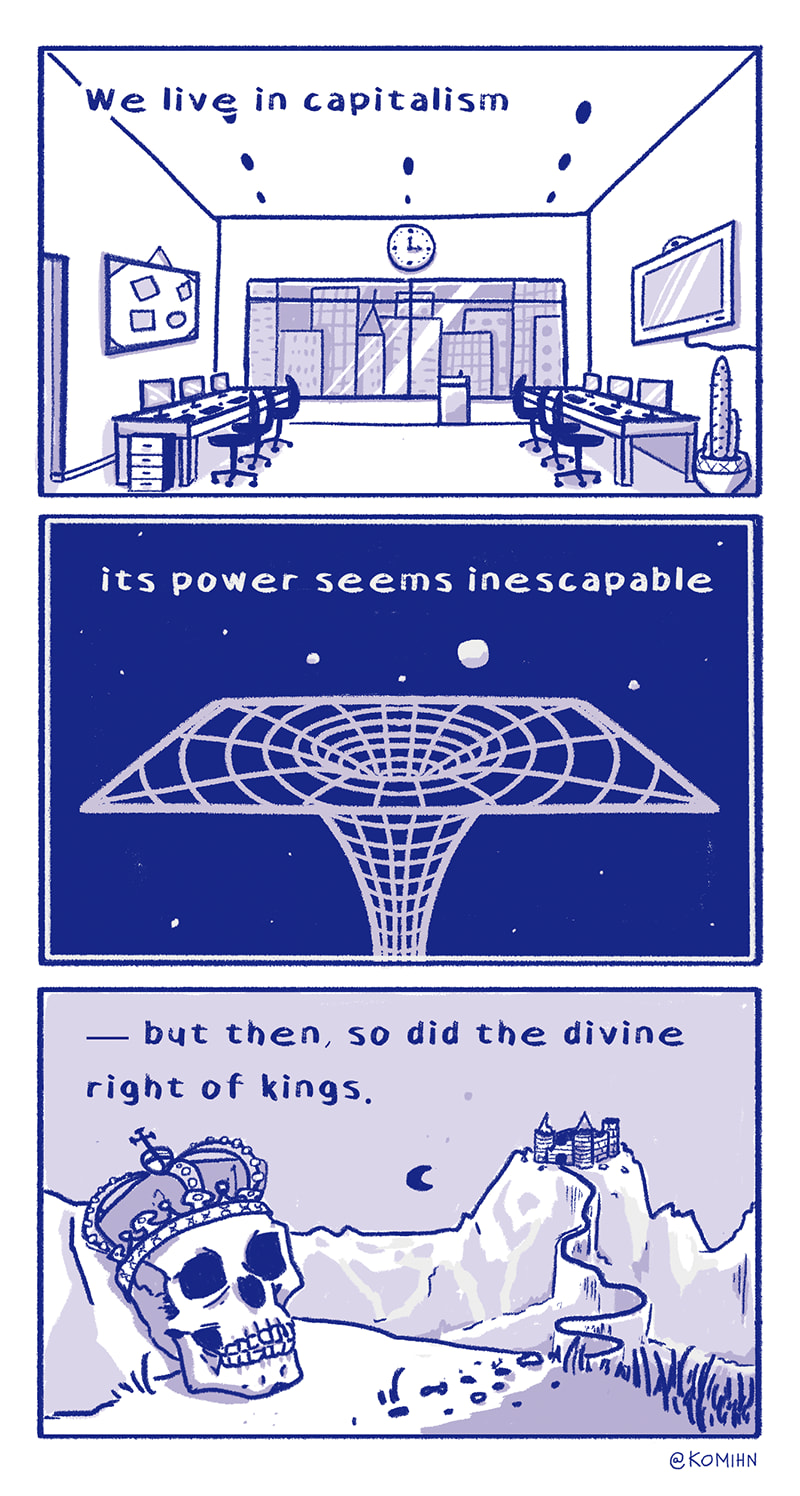
This anti-capitalist meme critiques the overwhelming and inescapable nature of the capitalist system. The image begins by showing a cold, sterile corporate office where "We live in capitalism," suggesting that this ideology has fully colonized daily life. It then illustrates this power like a black hole, an inescapable gravitational force that consumes everything around it. The final image—showing a skull wearing a crown and a castle on a cliff—juxtaposes these modern economic forces with the ancient "divine right of kings," suggesting that traditional monarchy and old ideas of divine rule have been replaced by this cold, calculating machine.
simple-description (llama3.2-vision_11b)
The meme is a satirical commentary on the concept of capitalism, specifically the notion that it is a system where the rich get richer and the poor get poorer. The image shows a person sitting at a desk with a computer, surrounded by expensive gadgets and a large screen displaying a graph of the stock market. The text reads: "We live in capitalism. It is the only way to live if you want to live higher than you live now. Your only problem is how you are going to get through the day. You will be all right. You will be all right."
In the context of anti-capitalism, this meme is a critique of the system's ability to create and maintain wealth for the elite, while leaving the poor and marginalized to struggle. The text is a commentary on the reality of living in a capitalist system, where the focus is on wealth and power, rather than the well-being of the people.
detailed-analysis (gemma3-27b-vision)
Okay, here's an analysis of the image broken down into sections based on the theoretical frameworks you requested. I'll only include sections that seem relevant to the content of the image.
Visual Description
The image is a comic strip composed of three panels rendered in a minimalist, high-contrast blue and white style.
- Panel 1: Depicts a vast, anonymous office space filled with rows of desks, each occupied by a single, faceless figure hunched over a computer. The space is bleak and regimented, with a clock prominently displayed on the wall, emphasizing the passage of time and the monotony of labor.
- Panel 2: Features a geometric, interconnected network of lines creating a kind of cage or encompassing structure. It’s reminiscent of a wireframe or a blueprint, and the lines converge towards a central point, suggesting control or focus.
- Panel 3: Depicts a tumultuous seascape with a crumbling castle on a rocky outcrop. A skull wearing a crown is half-submerged in the waves, symbolizing the downfall of traditional authority. This panel has a much more chaotic and emotional quality than the previous two.
The text progressively shifts, starting with “We live in capitalism, its power seems inescapable,” and culminating in “– but then, so did the divine right of kings.”
Foucauldian Genealogical Discourse Analysis
This image is ripe for a Foucauldian reading. The first panel clearly illustrates what Foucault described as “panopticism.” The office layout, with its rows of desks and implied surveillance, creates a feeling of being constantly watched, leading to self-discipline and conformity. Each worker internalizes the rules and regulations of the capitalist system without needing explicit coercion.
The second panel, with its interlocking structure, can be seen as representing the discourse of capitalism. It’s a network of power/knowledge that shapes our understanding of the world, defining what is considered normal, productive, and desirable. The lines connect and create constraints, demonstrating how we are all interpellated into these systems of meaning.
The shift to the imagery of the crumbling monarchy in the final panel is crucial. It suggests that no power structure is inevitable or eternal. Foucault’s genealogical method is about excavating the historical conditions that give rise to specific discourses and power relations, revealing their contingency and instability. The image demonstrates that the “divine right of kings” – once seen as unchallengeable – was ultimately dismantled, implying that the power of capitalism, despite seeming inescapable, is also susceptible to change. The image suggests that power is not a possession, but a relation, constantly shifting and renegotiated.
Critical Theory
The image embodies core concepts within Critical Theory, particularly those relating to domination and ideology. The first panel portrays the alienating effects of capitalist labor, echoing the Frankfurt School’s critique of instrumental rationality and the “culture industry.” The monotonous office setting and faceless workers represent the dehumanization of individuals under capitalist modes of production.
The second panel’s network could be interpreted as the ideological apparatus that reinforces capitalist hegemony. This network of power relations subtly shapes our beliefs, values, and desires, leading us to accept the status quo as natural or inevitable.
The final panel challenges the notion of historical inevitability, offering a glimmer of hope for social transformation. It implies that even seemingly immutable power structures can be overthrown, suggesting the possibility of creating a more just and equitable society.
Marxist Conflict Theory
The image clearly represents a class struggle, albeit in a more abstract way. The office setting symbolizes the site of exploitation, where workers are alienated from the products of their labor and subjected to the control of capital. The image depicts an environment that is designed to serve the interests of those who own and control the means of production, while the workers remain largely powerless.
The transition to the imagery of the fallen monarchy is significant because it suggests that historical power structures are often the result of conflict and struggle. The overthrow of the monarchy was a revolutionary act that challenged the established order, and the image implies that a similar struggle may be necessary to dismantle the power of capitalism.
The depiction of the decaying castle highlights the inherent contradictions within systems of power. The castle, once a symbol of strength and authority, is now crumbling and being eroded by the forces of nature, suggesting that all power structures are ultimately temporary and subject to decay.
Let me know if you'd like me to elaborate on any of these points or explore additional theoretical perspectives!
simple-description (llama3.2-vision)
The meme is a humorous commentary on the concept of capitalism. It features a series of three panels, each with a different image and caption. The first panel shows a typical office workspace with the caption "We live in capitalism." The second panel depicts a person staring at a black hole with the caption "It's getting harder to breathe." The third panel shows a skull wearing a crown with the caption "But then, so did the divine right of kings."
tesseract-ocr
N We live in capitalism 0 ® e o a . o PQ Ze || ieee ee LL LEE Lee He Ras] ae Se LAE IN its power seems inescapable : . : ; e . (MLS 4eeea= oem Saray, 8 a ae Wy 5 SIF 6 : Wl ; ithe — but then, so did the divine right of kings, Sean (‘es x wy aL / iO ¢ f AM j | = <a a oT ac) 4 aN MA a? Th — al A Lo — NG @KOMIHN