First Seen
2025-07-10T16:29:50+00:00
simple-description (qwen3.5_2b-q8_0)
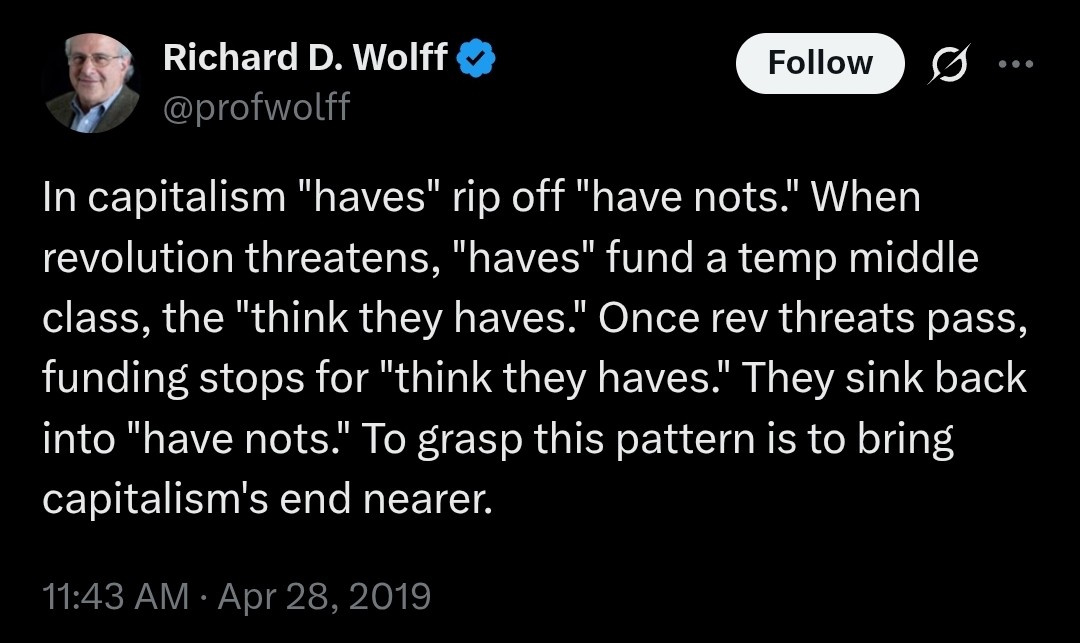
This anti-capitalist text critiques the economic system by explaining how the wealthy maintain control during times of crisis. It argues that when a revolution threatens, the rich "haves" fund a temporary middle class to keep the workforce compliant, then drain their support back into poverty once stability returns. The meme concludes that understanding this cycle is a crucial step toward bringing capitalism's end nearer.
detailed-analysis (gemma3_27b-it-q8_0)
Okay, let's break down this tweet from Richard Wolff (a prominent Marxist economist) through the lens of anti-capitalist thought, addressing the requested analytical frameworks where applicable.
Overall Context: The tweet is a succinct commentary on the cyclical way capitalism absorbs and neutralizes potential threats to its dominance. It hinges on a binary – "haves" and "have-nots" – and how the "haves" strategically manipulate a small segment to maintain power.
Visual Description
The image accompanying the tweet is simply a profile shot of Richard Wolff himself. It’s a fairly standard profile picture, suggesting authority, intellectual gravitas, and a long-standing engagement with socialist/Marxist thought. The visual cues (serious expression, professional attire) establish the credibility of the source and signal that the statement should be taken as a considered, rather than flippant, observation. The tweet itself uses simple, direct language, avoiding visual elements beyond the text, reinforcing the message's focus on systemic analysis rather than emotional appeals.
Marxist Conflict Theory
This is where the tweet primarily operates. It’s a condensed Marxist analysis of class struggle. Here's how:
- "Haves" and "Have-Nots": This is the foundational class division in Marxist theory – the bourgeoisie (those who own the means of production) and the proletariat (those who sell their labor).
- Exploitation & Extraction of Surplus Value: The initial statement ("Haves rip off Have-nots") signifies the core of capitalist exploitation. The "haves" accumulate wealth by extracting surplus value from the labor of the "have-nots."
- The “Think They Haves” & False Consciousness: This is the crucial point. When real class consciousness and revolutionary fervor begin to build among the "have-nots," the "haves" create a temporary, illusory middle class—the “think they haves.” This group is given just enough concessions (higher wages, perceived social mobility) to align their interests with the ruling class, thus creating false consciousness. They believe they're doing well because of the system, not in spite of it.
- Co-optation and Neutralization of Threat: The pattern illustrates how capitalism responds to revolution. It doesn't just suppress it with force (although it does that too); it attempts to absorb and neutralize the threat by creating a buffer class that becomes a conservative force.
- The Cycle Repeats: When the revolutionary threat subsides, the concessions are withdrawn, and the "think they haves" are re-integrated into the "have-nots" – perpetuating the cycle of exploitation.
- Bringing Capitalism’s End Nearer: Wolff argues that understanding this pattern is key to overcoming it. Recognizing the manipulation, the false consciousness, and the cyclical nature of co-optation can fuel genuine class solidarity and ultimately lead to systemic change.
Foucauldian Genealogical Discourse Analysis
While not explicitly the primary focus, a Foucauldian reading adds another layer.
- Power/Knowledge: The “haves” wield power not only through economic control but also through the creation of discourses (ways of understanding and talking about the world) that legitimize their dominance. The notion of the “think they haves” is a product of these discourses – a narrative of meritocracy, upward mobility, and the "American Dream" that obscures the underlying structures of inequality.
- Genealogy of the “Middle Class”: A genealogical approach would trace the historical emergence of the "middle class" not as a natural outcome of economic progress, but as a specifically constructed category designed to manage class conflict and maintain the status quo.
- Normalization: Capitalism normalizes these cyclical patterns of control through the dissemination of its ideology.
Critical Theory
The tweet aligns with core tenets of Critical Theory:
- Critique of Ideology: The “think they haves” are a prime example of how ideology functions to mask power relations and maintain a system of domination.
- Emancipation: The goal, as Wolff states, is to overcome this cycle. Understanding the mechanisms of control is a step toward emancipation – freeing individuals from the constraints of capitalist ideology and enabling them to act in their own interests.
- Reflection: The tweet isn't offering a solution, but rather prompting critical reflection on the dynamics of capitalist power.
Postmodernism
This framework is the least directly applicable. However, one could argue:
- Deconstruction of Metanarratives: The tweet challenges the dominant narrative of capitalism as a system of progress and opportunity for all. It exposes the cracks and contradictions within that narrative.
- Relativizing Truth: The "think they haves" operate within a subjective reality shaped by ideology. Their perception of their own success is a constructed truth, not an objective one.
However, it's important to note that Wolff's position, as a Marxist, is generally critical of the more relativist tendencies within postmodernism, believing in the possibility of objective truth and the need for systemic analysis.
Queer Feminist Intersectional Analysis
This is also a less direct fit but can be relevant.
- Interlocking Systems of Oppression: While the tweet focuses on class, it's important to remember that capitalism intersects with other forms of oppression (race, gender, sexuality, etc.). The “think they haves” category is likely unevenly distributed along these lines—some groups are more easily co-opted or excluded from even this limited form of "success."
- The Illusion of Inclusion: The co-optation of a middle class often relies on the exclusion of others. A "think they have" existence can be built on the continued exploitation and marginalization of racialized, gendered, or queer communities.
In Conclusion:
Wolff's tweet is a powerful and concise distillation of Marxist analysis. It highlights the manipulative and cyclical nature of capitalism's survival strategies, and emphasizes the importance of class consciousness as a pathway to revolutionary change. While other theoretical lenses can provide enriching nuances, it’s fundamentally a statement rooted in a conflict-based understanding of power and exploitation.
simple-description (llama3.2-vision_11b)
The meme is a quote from Richard D. Wolff, a professor and economist, that critiques the concept of "haves" and "have nots" in capitalism. The quote highlights the inequality and exploitation of the working class in the capitalist system, where the "haves" (those with wealth and power) exploit the "have nots" (the working class). The quote is a commentary on the unfairness of the system, where the "haves" profit at the expense of the "have nots", and is often used to criticize the capitalist system and its inequalities.
detailed-analysis (gemma3-27b-vision)
Okay, here's an analysis of the tweet by Richard Wolff, broken down into relevant sections as requested. I'll indicate why certain sections aren't applicable if that's the case.
Visual Description
The image is a screenshot of a Twitter post. It features a profile picture of Richard Wolff, a well-known Marxist economist. The post is text-based, containing his commentary on capitalism, and is dated April 28, 2019. The Twitter interface elements (follow button, timestamps) are visible, suggesting it's a straightforward social media post designed for quick consumption.
Marxist Conflict Theory
This tweet is deeply rooted in Marxist conflict theory. The core argument centers on inherent class struggle within capitalism.
- “Haves” and “Have-Nots”: This immediately establishes the fundamental binary of Marxist analysis: the bourgeoisie (those who own the means of production – the “haves”) and the proletariat (the working class – the “have-nots”).
- Exploitation: The initial statement "haves rip off have-nots" describes the core mechanism of capitalist exploitation—extracting surplus value from labor.
- False Consciousness & Co-option: The concept of funding a “temp middle class” that thinks they "have" is a key insight. This refers to how capitalism creates a buffer class – a sector of relatively privileged workers (often white-collar, managerial) – to create social stability and obscure class lines. It’s a form of ideological control, preventing the full formation of class consciousness. They are “bought off” to prevent them joining with the proletariat.
- Cycle of Co-option and Repression: The tweet outlines a cyclical pattern: when a genuine revolutionary threat emerges, the “haves” temporarily fund this middle layer to defuse the situation. Once the threat subsides, funding is withdrawn, and the middle class reverts to being “have-nots,” further intensifying the inherent contradictions of the system.
- Revolution as an Inevitable Outcome: The concluding statement ("To grasp this pattern is to bring capitalism’s end nearer") suggests that understanding these dynamics can fuel revolutionary consciousness and ultimately lead to the system's demise.
Foucauldian Genealogical Discourse Analysis
While not the primary lens, a Foucauldian reading adds nuance:
- Power/Knowledge: The tweet implies how the “haves” wield power through the production and control of knowledge (or, in this case, disinformation). Creating a “temp middle class” is about shaping perceptions and maintaining a dominant discourse that justifies the existing power structures.
- Discipline & Control: The funding of the middle class isn't just about money; it's a mechanism of social discipline. It incentivizes loyalty to the system and discourages solidarity with the working class.
- Genealogy of "Having": Foucault encourages tracing the historical development of concepts. Here, one could ask: How did the concept of “having” (wealth, status, privilege) become constructed and legitimized within capitalist discourse? How has it been historically used to divide and control populations? This isn't explicitly addressed in the tweet, but it's a direction one could take.
Critical Theory
This tweet aligns with many tenets of Critical Theory, particularly the Frankfurt School:
- Critique of Ideology: The observation about the "temp middle class" is a direct critique of how capitalism produces ideological constructs to mask its exploitative nature. It highlights how the system generates false consciousness.
- Domination & Emancipation: The tweet implicitly calls for emancipation from capitalist domination. By exposing the cyclical patterns of control, it suggests possibilities for disrupting the system and achieving a more just social order.
- Rationality & Control: The funding strategy is a rational (from the perspective of the “haves”) method of control. It represents a calculated effort to maintain the status quo.
Postmodernism
This is where the tweet doesn't readily fit. Postmodernism often emphasizes deconstruction, relativism, and the rejection of grand narratives. While one could theoretically apply a postmodern lens by questioning the very category of "having," the tweet is fundamentally a materialist analysis based on class struggle—a traditional Marxist concern that is often contrasted with postmodernism. There's a clear, albeit simplified, narrative of power relations at play.
Queer Feminist Intersectional Analysis
This is largely not a direct fit, though some connections can be made with effort. The tweet focuses on class as the primary axis of analysis. While a queer feminist intersectional analysis would acknowledge the importance of class, it would emphasize how class intersects with other forms of oppression based on gender, sexuality, race, ability, etc.
However, one could argue that the “temp middle class” is disproportionately composed of privileged groups (e.g., white, heterosexual men), and that their co-option serves to reinforce existing hierarchies of power. This would require further elaboration, as the tweet doesn't explicitly address these intersections. It is a critique of the broader economic system, but does not inherently account for nuanced dimensions of lived experience.
Let me know if you'd like me to elaborate on any of these sections or explore the tweet through a different theoretical lens.
simple-description (llama3.2-vision)
The meme features a quote from Richard D. Wolff, an economics professor, about how in capitalism, the term "haves" and "have nots" often flip. It starts off with "In capitalism 'haves' rip off 'have nots'." It then goes on to say that when revolution is on the horizon, "haves" fund a temporary middle class, the "think they have." Once the revolution is over, funding stops and they return to being "have nots." The final line is, "To grasp this pattern is to bring capitalism's end nearer." The quote is meant to be thought-provoking and … [more]