First Seen
2023-05-10T21:03:33+00:00
simple-description (llama3.2-vision_11b)
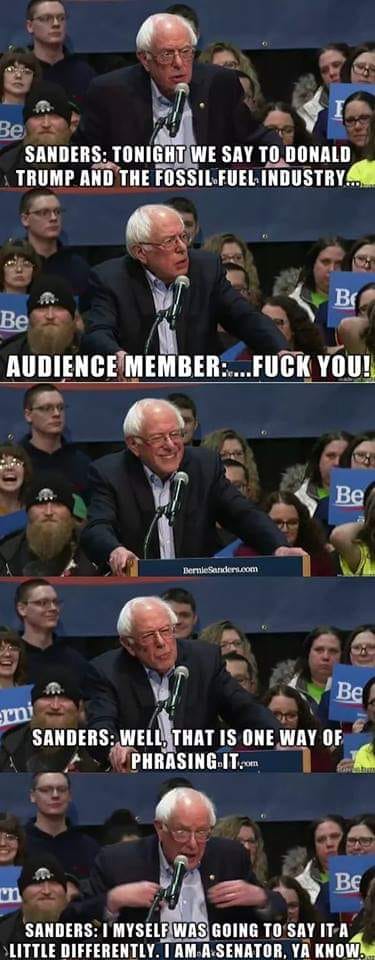
This meme is a screenshot of Bernie Sanders' 2019 CNN town hall meeting, where he is responding to a question about his views on capitalism. The meme shows Sanders' response to a question about the fossil fuel industry, where he uses a profanity to express his frustration with the industry's influence on politics. The meme is captioned "I'm a senator, you know" to highlight the irony of Sanders' response.
detailed-analysis (gemma3-27b-vision)
Okay, here's an analysis of the image, broken down into sections based on the requested theoretical frameworks, focusing on how those frameworks might illuminate meaning within the image. I'll omit sections where the framework doesn't strongly apply.
Visual Description
The image is a meme consisting of four horizontally stacked panels. Each panel shows a close-up of Bernie Sanders speaking at what appears to be a rally or public event. The panels are progressively zoomed in on Sanders’ face. The backdrop features a crowd of people and signs prominently displaying “Be”.
Each panel is overlaid with text that represents a dialogue.
- Panel 1: “Sanders: Tonight we say to Donald Trump and the Fossil Fuel Industry”
- Panel 2: “Audience Member: …FUCK YOU!”
- Panel 3: “Sanders: Well, that is one way of phrasing it.”
- Panel 4: “Sanders: I myself was going to say it a little differently. I am a Senator, ya know.”
The meme structure relies on the unexpected interruption of the supposed “political correctness” and the subsequent “Senator” defense. The image uses a common meme format of building tension through reaction images to comedic effect.
Foucauldian Genealogical Discourse Analysis
This meme can be examined through a Foucauldian lens by analyzing the discourse it constructs around political speech, power, and acceptable expression.
- Discourse of Political Correctness: The meme highlights and mocks the expectation of “proper” political discourse. Sanders is poised to deliver a measured condemnation, while the audience member immediately expresses raw, unfiltered anger. The contrast sets up an implicit tension between "acceptable" and "unacceptable" ways of expressing political dissent.
- Power & Regulation of Speech: The "Senator" remark reveals the power dynamics at play. Sanders, as an elected official, is held to a different standard of speech than a "mere" audience member. His position within the established power structure necessitates a more regulated and "respectful" expression of anger, even if he shares the sentiment. This demonstrates how language and speech are disciplined by power.
- Genealogy of Anger: We could trace a genealogy of anger in political discourse. The meme implies that direct, aggressive expression of anger toward political opponents is suppressed or "disciplined" through norms of civility. The audience member is a moment of resistance to this discipline, but is quickly "corrected" by the Senator’s framing. The meme suggests this dynamic is a modern phenomenon.
Critical Theory
This meme can be viewed through the lens of critical theory, specifically focusing on the critique of ideology and power.
- Ideology of Civility: The meme subtly critiques the ideology of civility as a tool for maintaining the status quo. The expectation of “proper” political language serves to de-escalate conflict and prevent radical change. The audience member's raw outburst disrupts this, highlighting the underlying anger and frustration that are often masked by polite discourse.
- Commodification of Outrage: In the age of social media, outrage is often commodified. This meme participates in that process, turning a potentially serious expression of anger into a source of entertainment and engagement. This can be seen as a way to neutralize or defuse genuine dissent.
- Critique of Representation: The meme uses Sanders as a symbolic representation of the establishment, even while he often positions himself as an outsider. This highlights the complexities of political representation and the ways in which even progressive figures can be co-opted into the existing power structure.
Marxist Conflict Theory
This image is relevant to Marxist conflict theory when viewed in the context of class struggle and the expression of dissent.
- Expression of Proletarian Anger: The audience member’s outburst can be interpreted as a raw expression of anger felt by the working class towards capitalist power structures (represented by Trump and the fossil fuel industry). This anger is unfiltered and directed at the source of perceived oppression.
- Mediation by the Bourgeoisie: Sanders, as a Senator (a member of the political establishment), serves as a mediator of this anger. He acknowledges the sentiment but frames it in a more acceptable, "civil" manner. This can be seen as a way for the bourgeoisie (the ruling class) to co-opt and control the expression of dissent.
- False Consciousness: The "Senator" framing could be seen as a way to create a "false consciousness" in the audience. It diverts attention from the fundamental issues of economic inequality and environmental destruction and focuses instead on the importance of "respectful" discourse.
Postmodernism
This meme demonstrates several postmodern characteristics.
- Intertextuality: The meme draws on familiar formats (reaction images, dialogue structures) and references political figures and events, creating a web of intertextual connections. It relies on the audience’s existing knowledge of these references to generate meaning.
- Irony and Parody: The meme is inherently ironic. It parodies the expectation of political correctness and the tension between authentic expression and “proper” behavior.
- Deconstruction of Meaning: The meme undermines the idea of a stable, coherent political message. The fragmented dialogue and visual structure create a playful and ambiguous meaning. The meme does not offer any firm solutions, and it highlights the complexities of expressing political anger.
Queer Feminist Intersectional Analysis
While not immediately central, an intersectional lens can add layers of meaning.
- Suppression of Rage: From a feminist perspective, rage, especially that experienced by marginalized groups, is often pathologized and suppressed. The audience member's outburst can be seen as a reclaiming of rage as a legitimate and powerful emotion. This resonates with feminist critiques of societal expectations of women to be "nice" and "accommodating."
- The Role of the "Senator": As a male figure in a position of power, Sanders embodies the patriarchal structure that often silences or marginalizes the voices of women and other marginalized groups. His attempt to "correct" the audience member’s outburst reinforces this dynamic.
- Intersectional Anger: Anger can be directed at interlocking systems of oppression (e.g., capitalism, patriarchy, racism). In the context of the fossil fuel industry, climate change disproportionately impacts marginalized communities. The audience member’s anger is likely rooted in the intersection of these issues.
I hope this detailed analysis is helpful. Let me know if you’d like me to expand on any specific point or theoretical framework.
simple-description (llama3.2-vision)
This meme is a parody of a clip from a 2020 Democratic primary debate where Bernie Sanders' response to a question about the Trump administration's policies on fossil fuels is interrupted by an audience member yelling "f*** you" and Sanders responding with a sarcastic comment. The meme shows Sanders' quote "I'm a senator, not a Jedi" in a caption, but the actual quote is not shown in the image. The meme is a humorous take on Sanders' quick-witted response to the outburst.
tesseract-ocr
& ‘ in F c ae eS Ct ee & e ar. oe ee | a see oer Ss a 1 ce en SS. «1 eau) th a a Bic lls oe ae ; sae e es SET eS