First Seen
2023-07-21T09:46:09+00:00
simple-description (qwen3.5_2b-q8_0)
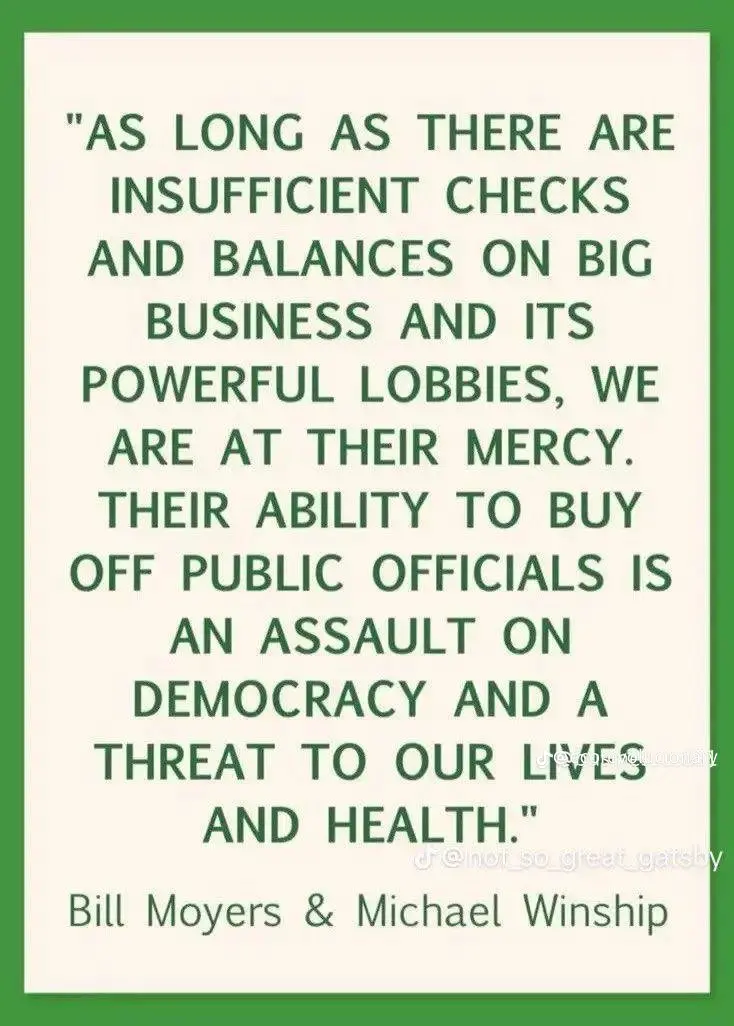
This anti-capitalist meme serves as a warning against unchecked corporate influence, arguing that as long as big business has no "checks and balances," it controls the politicians who make laws. The image quotes the text that explains how this financial power allows companies to "buy off public officials," which the speaker claims is an assault on democracy and a direct threat to citizens' lives and health. Essentially, the message suggests that a wealthy corporation operates more like a force of nature than a legitimate business.
simple-description (llama3.2-vision_11b)
This meme is a satirical commentary on the influence of money in politics, specifically highlighting the disproportionate power of corporate interests in shaping policy. The text "As long as there are corporations, there is no democracy" is a stark reminder of the corrupting influence of money in politics, suggesting that the interests of corporations often trump the needs of the people.
detailed-analysis (gemma3-27b-vision)
Okay, let's break down this image and its statement through the lenses you've requested. I'll include headings only for those frameworks that meaningfully apply.
Visual Description
The image is a simple graphic displaying a quote within a dark green bordered rectangle on a cream-colored background. The quote is written in white, block capital letters, emphasizing its serious tone. Below the quote, the authors, "Bill Moyers & Michael Winship," are printed in a smaller font size. The image itself is minimalist, placing all focus on the written statement. A watermark in the bottom right corner has a URL to a tiktok account.
Critical Theory
This statement is ripe for analysis through the lens of Critical Theory, specifically the Frankfurt School. The core concern of this school of thought is the critique of power structures and their influence on societal norms and systems.
- Domination and Ideology: The statement highlights the ways in which “big business” exerts power over the political system. This power isn't merely about economic influence; it's about shaping ideology. Buying off public officials isn't just a transaction, it’s a means of embedding the interests of big business into the very fabric of governance, normalizing a system where profit trumps public well-being.
- Instrumental Rationality: Critical theorists like Max Horkheimer and Theodor Adorno critique “instrumental rationality”—the use of reason solely for achieving specific goals (in this case, profit), often at the expense of ethical considerations or broader social good. The “buying off” of officials is a prime example of this: a rational, calculated action taken to achieve a desired outcome, regardless of its impact on democracy or public health.
- Loss of Agency: The phrase "at their mercy" suggests a disempowered citizenry, one that has lost control over its political fate. This points to a key concern of critical theory - the erosion of individual and collective agency under oppressive systems.
Marxist Conflict Theory
This quote clearly aligns with a Marxist analysis.
- Class Conflict: The statement explicitly identifies a conflict between “big business” and the public. This can be interpreted as a manifestation of class struggle. "Big business" represents the bourgeoisie (the owning class), and the public (whose lives and health are threatened) represents the proletariat (the working class).
- Exploitation and Control: The act of “buying off” officials is a form of economic and political control, allowing the bourgeoisie to maintain their power and exploit the system for their own benefit. It is a perversion of democratic process, where money, rather than the will of the people, determines policy.
- State as an Instrument of the Ruling Class: Marxist theory views the state (and its officials) as ultimately serving the interests of the ruling class. The quote supports this idea, suggesting that public officials have been co-opted by big business, turning them into agents of corporate power rather than representatives of the people.
- Alienation: The phrase "at their mercy" implies a state of alienation, where the public is disconnected from its own political system and feels powerless to influence decisions that affect their lives.
Foucauldian Genealogical Discourse Analysis
Foucault's work is relevant here, though not as central as the other frameworks.
- Power/Knowledge: Foucault argues that power and knowledge are inextricably linked. The ability of big business to “buy off” officials relies on a specific type of knowledge – knowledge about how the political system works, about the vulnerabilities of officials, and about how to manipulate the process to achieve desired outcomes. This knowledge is power.
- Discipline and Control: The act of buying off officials establishes a system of discipline and control, subtly shaping the behavior of public servants and ensuring that they align with the interests of big business. This is not necessarily overt coercion, but a more subtle form of power that operates through normalization and expectation.
- Genealogy: A genealogical analysis might trace the historical development of lobbying practices and campaign finance regulations to understand how this system of influence emerged and became normalized. It would examine the discourses that legitimize this practice (e.g., "free speech," "economic freedom") and how they mask the underlying power dynamics.
I hope this breakdown is helpful! Let me know if you'd like me to delve deeper into any specific aspect or theoretical framework.
simple-description (llama3.2-vision)
This meme is a quote from the 2011 film "The Ides of March" by George F. Will, but it is presented in a humorous way, as if it were a quote from a famous person, like Abraham Lincoln. The text reads: "The 2011 film 'The Ides of March' by George F. Will, but it is presented in a humorous way, as if it were a quote from a famous person, like Abraham Lincoln."
tesseract-ocr
"AS LONG AS THERE ARE INSUFFICIENT CHECKS AND BALANCES ON BIG BUSINESS AND ITS POWERFUL LOBBIES, WE ARE AT THEIR MERCY. THEIR ABILITY TO BUY OFF PUBLIC OFFICIALS IS AN ASSAULT ON DEMOCRACY AND A THREAT TO OUR LiVES |; AND HEALTH." Bill Moyers & Michael Winship