First Seen
2023-05-10T21:03:33+00:00
simple-description (llama3.2-vision_11b)
The meme is a humorous take on the idea that some of the most successful and intelligent individuals in the world are not actually making money through their own efforts, but rather through the exploitation of others through their jobs as engineers. The meme suggests that these individuals are not making money through their own skills, but through the exploitation of others through their jobs as engineers, and that they are not even getting paid for their work.
detailed-analysis (gemma3-27b-vision)
Okay, let's break down this Twitter post through the requested theoretical lenses. Given the content, several of these frameworks are very applicable.
Visual Description
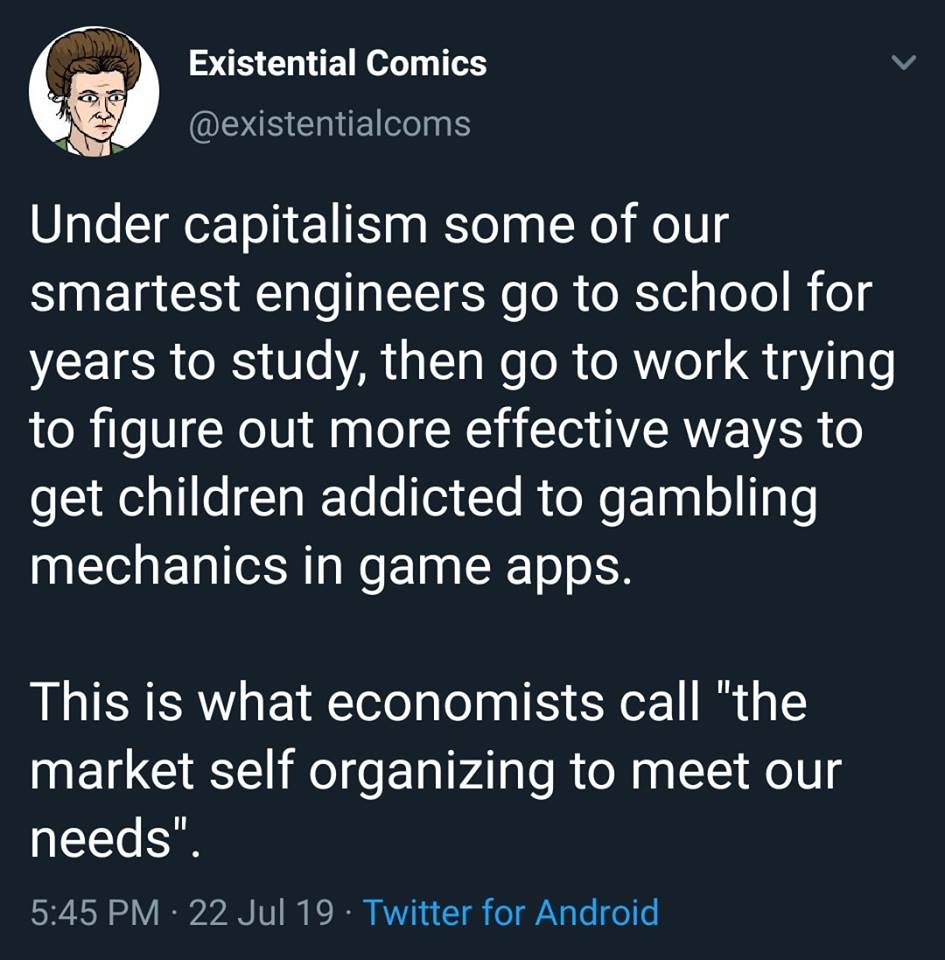
The image is a screenshot of a Twitter post from the account "@existentialcoms". The profile picture is a cartoon depiction of a person with long hair and a beard. The post is text-based, written in white font on a dark black background. It is timestamped July 22, 2019, via Twitter for Android. The graphic design is minimalist and stark, serving to emphasize the text content.
Critical Theory
This post immediately engages with core tenets of Critical Theory, specifically the Frankfurt School's critique of the "culture industry." The tweet highlights how advanced technology and intellectual capital (the "smartest engineers") are deployed not for genuinely beneficial social purposes, but for the cynical pursuit of profit through exploitation (in this case, the addiction of children). This is a prime example of how rationality and knowledge can be instrumentalized to serve the aims of domination and control.
The tweet criticizes the perceived neutrality of technology. It argues that technology isn’t a neutral tool. It's shaped by, and serves, existing power structures. This aligns with Critical Theory's focus on how seemingly objective systems (like economics) actually perpetuate existing inequalities. The post questions the very definition of "need" as presented by economists, implying that it's being manipulated to justify exploitative practices.
Marxist Conflict Theory
This tweet is highly applicable to Marxist Conflict Theory. It showcases a fundamental contradiction within capitalist production: the allocation of skilled labor towards creating and refining methods of exploitation. The "smartest engineers" aren't solving social problems; they're perfecting the mechanisms to extract value from vulnerable populations (children).
The post implicitly points to the concept of surplus value. Addiction to gambling mechanics in games leads to continued spending, generating profit for the developers beyond the actual cost of the game. This profit is extracted from the users, effectively exploiting their susceptibility to addictive designs. There's a clear conflict of interest here between the needs of the developers (profit) and the well-being of the users (children). The tweet exposes the inherent class conflict and the exploitation of the vulnerable.
Foucauldian Genealogical Discourse Analysis
From a Foucauldian perspective, this tweet reveals a “discourse” surrounding the valuation of intelligence and labor in a capitalist society. The post suggests how the concept of "smartness" has been discursively co-opted to justify the application of intellectual skill to morally questionable practices. The genealogy could trace how the concept of “optimization” (a key element in game design) originally intended for positive outcomes, has been repurposed to maximize profit through addictive practices.
The post implicitly speaks to the concepts of power/knowledge and biopower. The “smartest engineers” possess knowledge that gives them power, and this power is being used to shape the behavior of individuals (particularly children) for economic gain. The addiction itself can be seen as a form of biopower - control over the body and its impulses. By tracing how this discourse evolved, we can understand how seemingly neutral concepts have become tools for control and exploitation.
Postmodernism
The tweet's impact draws from postmodern themes of questioning meta-narratives. Traditionally, capitalism has been justified through narratives of progress, innovation, and meeting consumer needs. This tweet directly challenges that narrative, exposing the dark underbelly of profit-driven exploitation. It suggests that these "needs" aren't inherent, but socially constructed and manipulated.
The tweet also highlights the deconstruction of traditional values. The idea that society's brightest minds are employed to deliberately create addictive designs challenges the notion of ethical technological development. It suggests a breakdown of the relationship between knowledge, progress, and the common good.
Queer Feminist Intersectional Analysis
While the post doesn’t explicitly address issues of gender or sexuality, an intersectional lens can illuminate further implications. Children are a particularly vulnerable population, and the post implicitly highlights the exploitation of power dynamics. The manipulation of children through addictive game mechanics can be seen as a form of violence and control.
Moreover, considering the demographics of game players, there might be specific intersections of age, gender, race, or class that make certain children more vulnerable to these exploitative practices. An intersectional analysis would explore how these overlapping identities contribute to the exacerbation of harm. The fact that this exploitation is happening within a largely male-dominated field (game development) adds another layer of complexity, revealing potential gendered power dynamics at play.
I’ve attempted to cover the requested theoretical frameworks as thoroughly as possible. Let me know if you'd like me to elaborate on any specific aspect!
simple-description (llama3.2-vision)
The meme is a humorous take on the concept of capitalism and how it's perceived by people. The text in the image reads: "In a world where the economy is a cruel and unforgiving beast, it's best to assume that the people in charge are either very smart or very lucky." The image is likely a cartoon or illustration of a person, but the text is the main focus.
tesseract-ocr
Existential Comics w (zp @existentialcoms Under capitalism some of our smartest engineers go to school for years to study, then go to work trying to figure out more effective ways to get children addicted to gambling mechanics in game apps. This is what economists call "the market self organizing to meet our needs". 5:45 PM - 22 Jul 19 - Twitter for Android