First Seen
2023-05-10T21:03:33+00:00
simple-description (llama3.2-vision_11b)
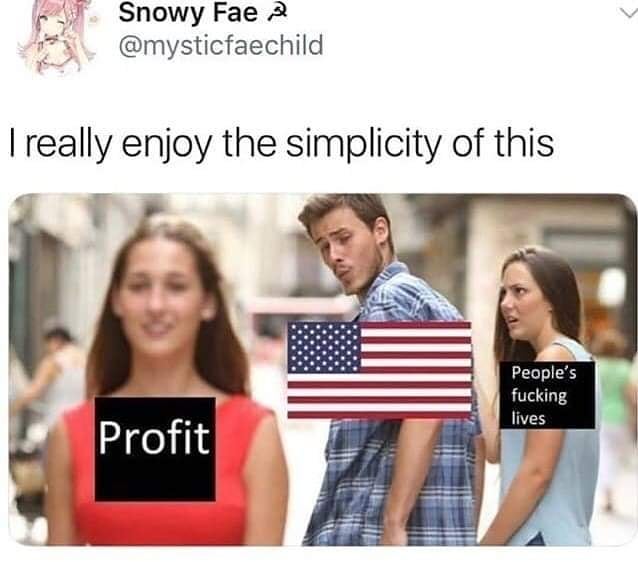
The meme depicts a man looking at a woman with a "profiting" label, implying she's exploiting him for her benefit. The caption "I really enjoy the simplicity of this" suggests the simplicity of the situation, implying that the man is aware of and accepting of the woman's exploitation. The meme is humorous and satirical, poking fun at the idea that some people are willing to accept exploitation in exchange for profit.
detailed-analysis (gemma3-27b-vision)
Okay, let's break down this meme using the requested theoretical lenses. It's a potent image, so several of these frameworks will be highly applicable.
Visual Description
The image is a stock photo or screencap depicting a common triangular relationship scenario: a man looking at another woman while his girlfriend looks on with a somewhat hurt or betrayed expression. However, the subjects have been overlaid with text boxes.
- Left (Woman): The text "Profit" is written over her image. She is smiling.
- Center (Man): He is looking over his shoulder towards the other woman, and is framed with the American flag.
- Right (Other Woman): The text "People's Fucking Lives" is written over her image. She looks stressed or upset.
The meme is overlaid with a Twitter handle/username: @mysticfaechild and the phrase “I really enjoy the simplicity of this”.
Marxist Conflict Theory
This meme is deeply rooted in Marxist conflict theory, representing a cynical critique of capitalist structures and American imperialism.
- Profit as the Driving Force: Placing "Profit" on the smiling woman's image demonstrates how the capitalist system prioritizes monetary gain over the well-being of people. Profit is presented as actively turning away from, and disregarding, the impact on people's lives.
- American Imperialism: The framing of the man with the American flag is significant. The flag represents US political/economic power and its role in creating or exacerbating global inequalities. The man’s gaze towards ‘People’s Lives’ is a symbolic representation of American engagement with other nations/populations – framed as a distraction or an act of exploitation motivated by profit.
- Class Conflict: While not explicitly stated, the meme implies a conflict between those who benefit from the capitalist system (represented by the smiling "Profit" figure) and those who suffer from its consequences. The 'People's Lives' are being disregarded for monetary gains.
- Alienation: The meme can also be read as illustrating the alienation inherent in capitalist society. The emotional distress on the "People's Fucking Lives" figure suggests a disconnection and lack of empathy from the prioritizing of ‘Profit’.
Critical Theory
The meme lends itself strongly to a critical theoretical reading, particularly within the Frankfurt School tradition.
- Critique of Enlightenment Reason: The "simplicity" lauded by the Twitter user is ironic. The meme doesn’t offer solutions but reveals a simple (and disturbing) truth: the prioritization of profit over human well-being. It suggests that the Enlightenment project of rational progress has been co-opted by capitalist interests.
- Culture Industry/Mass Deception: This meme, as a form of online communication, participates in the culture industry. It points to the way seemingly neutral images and narratives can be used to reinforce power structures. By presenting this relationship visually, it makes a complex political statement accessible, but also potentially simplifies it.
- Power Dynamics: The meme unveils power dynamics at play. “Profit” is positioned in a dominant position, seemingly unaffected by the consequences, while ‘People’s Lives’ are suffering.
Foucauldian Genealogical Discourse Analysis
Applying Foucault's method allows us to examine the historical emergence of the relationship between profit, power, and the devaluation of human life.
- Discursive Formation: The meme functions as a condensation of a specific historical discourse. It reveals how the discourse of economic growth, deregulation, and free markets has become normalized, even at the cost of human suffering. The image doesn’t show how this happened, but the meme assumes the audience understands this history.
- Power/Knowledge: The meme illustrates the entanglement of power and knowledge. The prioritization of "Profit" isn't simply a neutral economic calculation; it is a constitutive act of power that defines what is considered valuable and worthy of protection. It establishes a hierarchy of value based on economic considerations.
- Genealogy of Exploitation: A Foucauldian genealogy would investigate the historical roots of this exploitative dynamic – tracing how capitalist logic has evolved over time to justify the prioritization of profit over human well-being. It would look at how this dynamic has been naturalized and legitimized through various institutions and practices.
Postmodernism
While not as central as the previous frameworks, elements of postmodernism are present.
- Irony and Parody: The meme relies on irony and parody. The Twitter user’s statement “I really enjoy the simplicity of this” is a sarcastic comment on the complexity of this dynamic.
- Deconstruction of Grand Narratives: The meme implicitly rejects grand narratives of progress and economic development. It suggests that these narratives often mask exploitative practices and prioritize profit over human well-being.
- Simulacra and Simulation: The meme itself is a simulacrum – a representation of a representation. It's a simplified, digitized image that conveys a complex political message. It’s a sign referring to other signs (the historical context of economic exploitation).
Queer Feminist Intersectional Analysis
This lens offers a nuanced understanding of how power and oppression intersect.
- Intersectionality of Suffering: While the meme doesn't explicitly depict marginalized groups, the ‘People’s Lives’ figure can be interpreted as representing those most affected by economic exploitation – often women, people of color, and other marginalized communities. Intersectionality suggests that these groups face multiple forms of oppression that exacerbate their vulnerability.
- Devaluation of Care Work: The prioritization of "Profit" implicitly devalues care work – often performed by women – which is essential for social reproduction but is often unpaid or underpaid.
- Disrupting the Binary: The meme, in its triangular setup, somewhat disrupts traditional relationship binaries. This can be seen as a subtle challenge to hegemonic norms and an invitation to consider alternative models of power and connection.
In conclusion, this seemingly simple meme is a powerful statement about the relationship between profit, power, and the devaluation of human life. Its impact stems from its ability to condense complex political ideas into a visually accessible form. The different theoretical frameworks offer ways to unpack its meaning and explore its implications.
simple-description (llama3.2-vision)
This meme is a humorous commentary on the relationship between the US government and its citizens. The image depicts a classic "distracted boyfriend" scenario, with a man looking at another woman while his girlfriend looks on in disapproval. The text overlays on the image read "I love you" (the girlfriend), "I love you too" (the other woman), and "But my money is on you" (the man), implying that his loyalty is with the US government, not his girlfriend.
tesseract-ocr
pr.) Snowy Fae 2 v #3. @mysticfaechild | really enjoy the simplicity of this qf Cy ; - —~ ie iM e e et — § | Re ———) ie - 7 terns \ — ss Mic 5 9 (ee it a ] | a? EO | Pe —— , ee ,