First Seen
2023-05-10T21:03:33+00:00
simple-description (llama3.2-vision_11b)
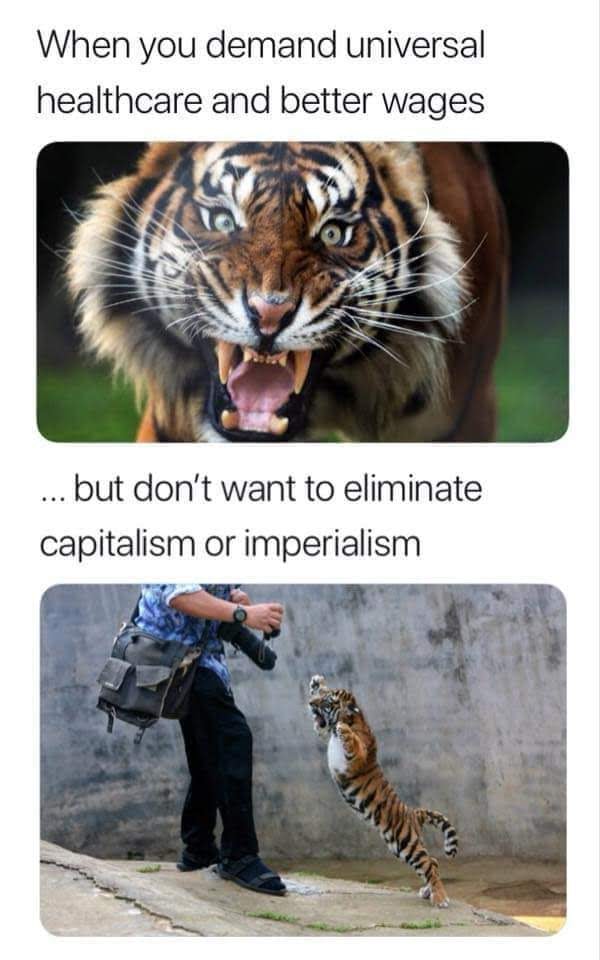
The meme is a humorous take on the idea that some people's desire for universal healthcare and better wages is actually a form of anti-capitalism. The image shows a tiger with its mouth open, ready to attack, with the caption "When you demand universal healthcare and better wages... but don't want to eliminate capitalism or imperialism". The meme is poking fun at the idea that some people are only willing to make demands for better living conditions, but are not willing to challenge the existing power structures that are causing those problems.
detailed-analysis (gemma3-27b-vision)
Okay, let's break down this meme using the requested theoretical frameworks.
Visual Description
The meme utilizes a two-panel format with contrasting imagery.
- Top Panel: A close-up image of a tiger roaring aggressively. Its teeth are bared, and its expression is intensely fierce. This is positioned above the text "When you demand universal healthcare and better wages."
- Bottom Panel: An image of a person, appearing as a park ranger or keeper, holding a tranquilizer gun aimed at a tiger. The tiger is mid-leap, in a vulnerable and potentially painful position. The text beneath reads “…but don’t want to eliminate capitalism or imperialism.”
The juxtaposition intends to create an ironic or satirical effect, suggesting a disconnect between demanding reforms within a system and not challenging the system itself.
Marxist Conflict Theory
This meme is highly relevant to Marxist Conflict Theory. The imagery and text are a metaphor for the inherent contradictions within capitalism.
- The Roaring Tiger: Represents the justified demands of the working class for better living conditions – universal healthcare, better wages. This represents the forces of production demanding more for their labor.
- The Tranquilizer Gun: Symbolizes the forces of the ruling class (represented by the figure with the gun) maintaining control and suppressing radical change. Instead of addressing the root causes of inequality (capitalism and imperialism), the ruling class simply "tranquilizes" or manages the symptoms (demands for reform) to preserve the status quo.
- The Implied Violence: The act of tranquilizing a powerful predator suggests a violent suppression of legitimate grievances. The meme implicitly argues that demanding reforms within the system is futile because the system itself will always work to neutralize any threat to its power. The meme suggests that the "demands" are acceptable only if they don’t challenge the system.
The meme highlights the inherent class conflict at the heart of capitalism. It frames demands for healthcare and wages as reasonable but ultimately insufficient without dismantling the system that creates inequality in the first place.
Critical Theory
From a Critical Theory perspective, this meme operates as a critique of “false consciousness.”
- The Illusion of Progress: The meme suggests that demanding reforms within capitalism creates the illusion of progress. It is a "systemic pacification", as if addressing symptoms (healthcare, wages) can solve the underlying systemic problems.
- Ideological Control: The person with the tranquilizer gun can be seen as representing the ideological forces that work to maintain the status quo. These forces don’t necessarily suppress demands directly, but they frame the conversation in a way that limits the scope of possible solutions.
- Critique of Reformism: This meme presents a direct challenge to reformist approaches to social justice. It argues that true change requires a more radical transformation of society, not simply tinkering with the existing system.
- Power Dynamics: The meme demonstrates a stark power dynamic. One entity (the ruling class/system) possesses the means to control and subdue the other (the working class/demands for change).
Foucauldian Genealogical Discourse Analysis
Applying a Foucauldian framework, we can analyze how power operates through discourse and knowledge.
- Discipline & Control: The tranquilizer gun is not merely a physical tool but a mechanism of discipline. It represents the ways in which power operates to normalize certain behaviors and suppress others. It's not about open repression, but about managing resistance.
- The Production of "Acceptable" Demands: The imagery suggests that the system produces the categories of "acceptable" demands. Demanding better healthcare and wages is allowed, because it doesn't threaten the fundamental structures of power. But challenging capitalism itself is seen as "outside the bounds" of acceptable discourse.
- Genealogy of "Reform": A genealogical analysis might trace the historical development of the concept of "reform" and how it has been used to manage and contain social unrest. The meme suggests that the idea of reform has become a tool for maintaining the status quo.
- Knowledge/Power: The meme implies that the discourse around capitalism and imperialism creates a "knowledge" that legitimizes their continuation. This knowledge is not neutral; it is intertwined with power relations.
Postmodernism
A Postmodern reading could focus on the deconstruction of grand narratives and the rejection of totalizing explanations.
- Rejection of Systemic Solutions: The meme implicitly critiques the idea that there is a single, universal solution to social problems. It suggests that systemic solutions like abolishing capitalism may be naive or overly simplistic.
- Ambiguity and Irony: The meme relies heavily on irony and visual juxtaposition to convey its message. This is characteristic of Postmodern aesthetics, which often challenge traditional forms of representation.
- The Illusion of Control: The meme can be interpreted as a commentary on the illusion of control in a complex and fragmented world. It suggests that even the most powerful forces (represented by the person with the gun) are ultimately limited in their ability to shape reality.
Queer Feminist Intersectional Analysis (less directly applicable, but possible)
While not the primary focus of the meme, a Queer Feminist Intersectional analysis could add nuance.
- The Intersection of Oppressions: The image could be seen as a metaphor for how various forms of oppression intersect. Capitalism and imperialism are not neutral forces; they disproportionately impact marginalized communities. The "tranquilizing" of demands could be seen as a way of silencing the voices of those most affected by these systems.
- Challenging Dominant Narratives: A Queer Feminist perspective would challenge the dominant narratives that justify capitalism and imperialism. It would highlight the ways in which these systems rely on and perpetuate inequalities based on race, gender, sexuality, and other social categories.
- Rejecting Reformist Approaches: A radical Queer Feminist analysis would likely reject reformist approaches to social justice, arguing that true liberation requires a fundamental transformation of society.
Important Note: These are just interpretations, and the meme is open to multiple readings. The strength of these analyses depends on the context in which the meme is used and the intended audience.
simple-description (llama3.2-vision)
This meme is a humorous commentary on the concept of "democratic socialism" or "socialism in one country" as a way to reconcile the goals of socialism with the limitations of a single country's economy. The image shows a tiger, which is often associated with power and strength, but is also depicted as being held back by a leash, implying that its power is being restrained. The text above the image reads "When you demand universal healthcare and a living wage but don't want to give up your guns or your freedom" and below it says "In that case, you're just a capitalist in denial".
tesseract-ocr
When you demand universal healthcare and better wages ANY Sy) . rs ID GAN Ne x ig Za . Vv hy 4 ... but don't want to eliminate capitalism or imperialism (ig =) a ys > eek : .