First Seen
2023-05-10T20:59:59+00:00
simple-description (llama3.2-vision_11b)
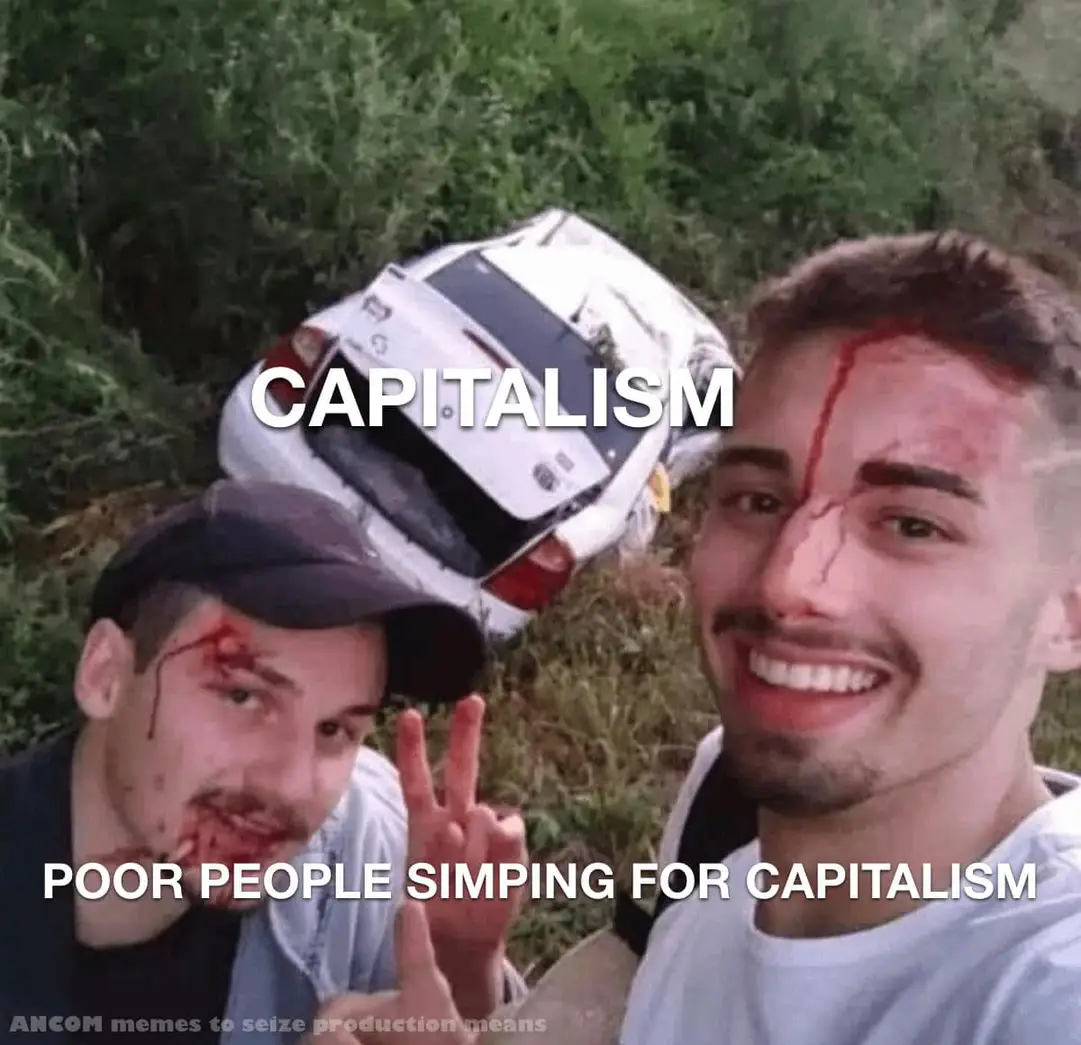
The meme is a screenshot of two people with blood on their faces, with the caption "capitalism" and "poor people simping for capitalism". The image is a commentary on the exploitation of the working class by the wealthy, with the "poor people" being those who are struggling to make ends meet while the wealthy are enjoying the benefits of capitalism. The meme is a satirical critique of the capitalist system, highlighting the inequality and exploitation that it perpetuates.
detailed-analysis (gemma3-27b-vision)
Okay, let's break down this meme through several theoretical lenses. It's a dense image with layers of meaning, so we'll go into detail.
Visual Description
The image is a still from the 1993 film Free Willy depicting a young boy (Jesse) excitedly pointing at a whale breaching the water. The scene is emotionally charged; Jesse is filled with joy and hope, a moment of connection with a powerful creature. Overlaid on the image are the texts: "CAPITALISM" (above the whale) and "POOR PEOPLE SIMPING FOR CAPITALISM" (below Jesse's head). The bottom text reads "ANCOM memes to seize production means”. The color palette is natural, with green foliage and blue water dominating. The composition centers on the emotional reaction of the boy, and the focus is clearly on Jesse.
Foucauldian Genealogical Discourse Analysis
This meme can be analyzed through a Foucauldian lens as a disruption of a seemingly “natural” or “innocent” discourse. Foucault emphasizes how knowledge and power are intertwined. In this case, the meme deconstructs the typically positive image of a child’s joyful connection with nature.
- Discourse: The dominant discourse associates environmentalism and compassion with positive values. The image initially leverages this.
- Genealogy: The meme performs a "genealogical" investigation by tracing the history of how that discourse is implicated in the maintenance of power structures. It points to the way this emotional connection (to animals, to “nature”) is used to mask the exploitative foundations of capitalism. It suggests the "joy" is a distraction from the systemic forces that create poverty and environmental degradation.
- Power/Knowledge: The meme demonstrates how the seemingly innocent connection of a child to a wild animal is leveraged in marketing and branding, reinforcing capitalist narratives about consumerism and connection to nature, while obscuring the harm done by the system itself.
Marxist Conflict Theory
This meme is strongly rooted in Marxist Conflict Theory.
- Class Struggle: The central argument of the meme is that those who are most harmed by capitalism ("poor people") are ironically the most likely to uphold its ideology. The phrase "simping" is a contemporary internet slang term for expressing excessive adoration/support, often unreciprocated. Applying it here suggests a desperate, uncritical investment in a system that inherently exploits them.
- False Consciousness: The meme directly accuses individuals of "false consciousness" – being unaware of the true nature of their social and economic circumstances. The emotional response to the whale symbolizes a distraction from the material realities of class oppression.
- Ideology: Capitalism functions through ideology, or a set of beliefs that justifies its structures. The image suggests that even seemingly benign or emotional connections (like animal welfare) are part of the ideological machinery.
- Exploitation: The whale itself could be seen as a metaphor for exploited resources. Capitalism appropriates nature (including majestic creatures) and commodifies it, often to the detriment of both the environment and the communities that depend on it.
Postmodernism
The meme exhibits elements of postmodernism through its use of irony, intertextuality, and its questioning of grand narratives.
- Irony & Parody: The meme’s core joke relies on ironic juxtaposition. The heartwarming scene is subverted by the cynical text, creating a sense of dissonance.
- Deconstruction of Meaning: The meme deconstructs the “naturalness” of emotional responses. It suggests that even seemingly genuine feelings are constructed through social and economic forces.
- Rejection of Metanarratives: The meme implies a rejection of the “grand narrative” of capitalism as inherently positive or benevolent. It highlights the contradictions and exploitative aspects of the system.
- Intertextuality: The use of a recognizable movie scene (Free Willy) is an example of intertextuality. The meme leverages the emotional weight and cultural associations of the film to amplify its message.
Queer Feminist Intersectional Analysis
While not the primary focus, there are ways to analyze this meme through a queer feminist intersectional lens:
- Exploitation & Vulnerability: The metaphor of the whale as exploited resources can also be extended to consider the disproportionate vulnerability of marginalized groups (women, LGBTQ+ individuals, people of color) to environmental damage and economic exploitation.
- Emotional Labor: The concept of “simping” can be linked to the emotional labor often expected of marginalized groups – a constant need to reassure and support systems that don’t reciprocate.
- Systems of Oppression: The meme’s critique of capitalism can be expanded to recognize how it intersects with other forms of oppression (patriarchy, racism, homophobia) to create complex and intersecting systems of power. A truly intersectional analysis would acknowledge that the "poor people" in this meme aren't a homogenous group, and that their experiences are shaped by multiple, interlocking forms of discrimination.
In conclusion, this meme is a complex and layered piece of visual commentary. It effectively employs irony and metaphor to critique capitalism and challenge viewers to question their own relationship to the system. It’s a pointed statement about the power of ideology, the dangers of false consciousness, and the need for critical awareness.
simple-description (llama3.2-vision)
This meme features two men, one with a bloody face, who are making a "peace" gesture with their hands. The text "capitalism" is written in bold letters above them, while "poor people" is written in smaller letters below. The image is a humorous commentary on the idea that capitalism is a system that exploits and hurts the poor, with the phrase "poor people" being a sarcastic acknowledgment of the system's flaws.
tesseract-ocr
et Nm Wee, Sd oe i Pee ee Se ae ~“ Pp : Fallin ma % tS oe | Pn < | ame ANY ff. - f . a Teal . Y Se ) % . — K a A iA POOR P i SIMPING FORICAPITALISM Ary