First Seen
2023-05-10T21:03:33+00:00
simple-description (llama3.2-vision_11b)
This meme is a commentary on the 2020 US presidential election, specifically the debate between Joe Biden and Donald Trump. The image shows a character from the anime series "Lupin III" with a caption that reads: "Liberals: Is this vicious attack by the reason we'll lose in 2020?" The meme is poking fun at the idea that liberals are questioning the election results and the reasons for the loss. The text is likely a satirical take on the liberal perspective of the 2020 election.
detailed-analysis (gemma3-27b-vision)
Okay, let's break down this meme through a few theoretical lenses. Here’s an analysis structured as requested.
Visual Description
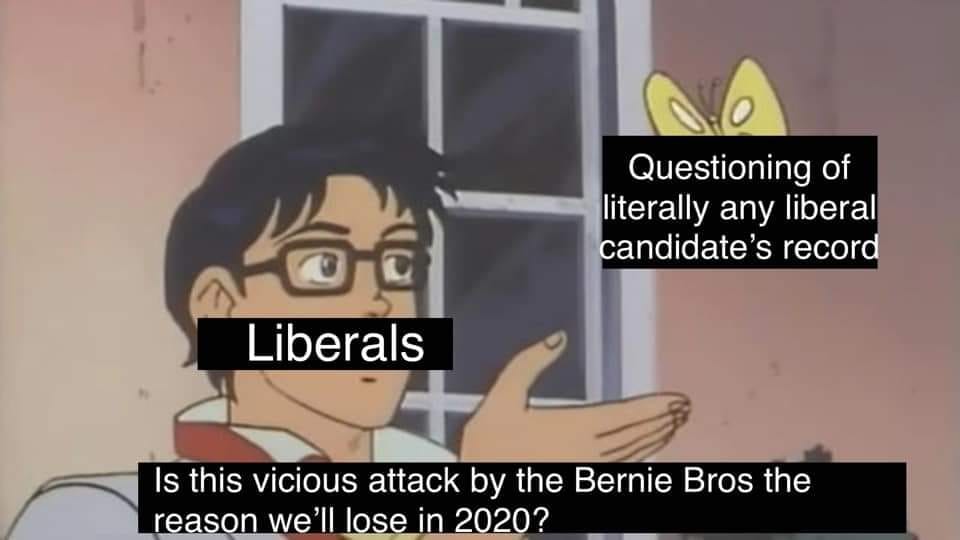
The image is a screen capture from the animated television series The Simpsons. It features Bart Simpson, depicted in a dramatic pose, looking toward a window. He’s gesturing outwards with one hand. Text has been added to the image in the typical meme format. The text labeling Bart reads "Liberals." Above Bart, above the window is a small yellow bird and the text “Questioning literally any liberal candidate's record.” Below Bart is a black box with white text “Is this vicious attack by the Bernie Bros the reason we'll lose in 2020?” The overall tone is satirical, presenting the questioning of a liberal candidate's record as an “attack” and framing it as the reason for potential electoral loss. The meme uses the visual of Bart as a mischievous figure to paint liberals as being overly sensitive to criticism.
Foucauldian Genealogical Discourse Analysis
This meme is highly relevant to a Foucauldian analysis. Foucault’s work emphasizes how power operates through discourse – the ways we talk about things, the language we use, and the systems of knowledge that are produced.
- Discourse and Power: The meme constructs a discourse around the questioning of a political candidate. It doesn’t treat this questioning as legitimate political debate, but reframes it as a “vicious attack.” This immediately establishes a power dynamic – those asking the questions are cast as aggressors, and the liberal candidate is positioned as a victim.
- Genealogy: A genealogical approach would examine how this way of framing political critique emerged. Why is questioning a candidate’s record presented as a threat? This meme implies an emerging narrative within the 2020 Democratic primary context where fervent supporters of Bernie Sanders (the “Bernie Bros”) were perceived as overly aggressive and hostile towards anyone critical of their candidate. This meme participates in the construction of that narrative.
- Disciplinary Power: The framing suggests a disciplinary mechanism at play. The meme subtly encourages self-censorship: questioning the candidate's record is presented as detrimental to the overall cause, thus discouraging genuine debate.
- Knowledge/Power: The meme creates a specific “truth” – that questioning a liberal candidate is inherently damaging – and connects it to the idea of electoral success. This positions knowledge about what will “win” as a tool of power, used to control the discourse and silence dissent.
Critical Theory
This meme aligns with aspects of the Frankfurt School's Critical Theory, particularly concerning the culture industry and the manipulation of public opinion.
- Mass Culture & Ideology: The meme is a piece of mass culture, circulating on social media. It contributes to the broader ideological landscape by presenting a particular framing of political debate. It promotes the idea that “unity” and avoiding criticism are paramount, potentially at the expense of genuine discussion and accountability.
- Commodification of Politics: The meme reduces a complex political issue to a simple, easily digestible format for social media consumption. This is a hallmark of the commodification of politics, where ideas and debates are streamlined for maximum engagement, often at the cost of nuance.
- One-Dimensional Man: The meme subtly discourages critical thinking by presenting a binary: either you support the candidate unquestioningly or you are a threat to electoral victory. This aligns with Herbert Marcuse’s concept of “One-Dimensional Man,” where critical thought is suppressed in favor of conformity and acceptance of the status quo.
Marxist Conflict Theory
While not a central focus, Marxist Conflict Theory can provide a lens to understand the underlying tensions.
- Class Struggle: Within the Democratic party, there's a recognizable tension between different factions (e.g., moderates vs. progressives). The meme highlights a conflict between those who prioritize party unity and electoral success and those who believe in holding candidates accountable, regardless of the potential consequences.
- Ideological Hegemony: The meme reinforces a particular ideology – that winning elections is the ultimate goal, justifying any behavior that might contribute to that end. This can be seen as a form of ideological hegemony, where dominant beliefs are normalized and taken for granted.
- False Consciousness: The idea that asking questions is an attack on the candidate and a reason for failure can be seen as a form of false consciousness. The meme attempts to shape a viewpoint, where those asking questions are seen as working against the interests of the collective (victory) when, perhaps, the collective interests are better served through open debate and consideration of ideas.
Postmodernism
From a Postmodern perspective, this meme demonstrates several key characteristics.
- Simulation & Hyperreality: The meme isn’t about the actual questioning of a candidate’s record. It's about the representation of that questioning, presented as a harmful “attack.” This contributes to a hyperreal environment where representations often become more important than reality.
- Deconstruction of Truth: The meme challenges the notion of objective truth. It presents “questioning a candidate’s record” as inherently negative, rather than as a legitimate part of the political process. This deconstructs the idea that critical inquiry is always beneficial.
- Irony and Satire: The meme employs irony and satire to convey its message. The use of Bart Simpson, a known troublemaker, underscores the idea that questioning the candidate is a mischievous and potentially harmful act.
Queer Feminist Intersectional Analysis
This meme doesn't explicitly engage with Queer Feminist Intersectional Analysis, but we can explore potential connections, especially through the concept of silencing.
- Silencing and Power Dynamics: The framing of questioning a candidate as an “attack” can be seen as a tactic to silence dissent, particularly from marginalized groups. Critiques of a candidate's record, especially from those most affected by their policies, are often dismissed or framed as disloyalty.
- Internalized Oppression: The meme subtly implies that those questioning the candidate are contributing to a larger problem (losing the election), potentially leading to self-censorship from individuals who fear being labeled as “divisive” or “unhelpful.” This dynamic can reinforce internalized oppression and discourage individuals from speaking truth to power.
- Intersectionality (Indirectly): While not directly addressing intersectionality, the meme highlights how power operates within a specific context (the 2020 Democratic primary). The silencing of critical voices can disproportionately affect marginalized groups, whose concerns are often already underrepresented in the political process.
Let me know if you'd like me to elaborate on any of these theoretical lenses or explore other interpretations!
simple-description (llama3.2-vision)
This meme is a humorous take on a 2020 presidential election debate between Joe Biden and Donald Trump. The image depicts a character from the anime "Dr. Stone" with a shocked expression, overlaid with a quote from a 2020 presidential debate between Joe Biden and Donald Trump. The text "Liberals" is written in a caption box, followed by the quote "I want to make one thing very clear. Everyone wants to make money, everyone wants to get rich, everyone wants to get rich quick. That's why I like Donald Trump. He’s a winner, he’s a champion, and we need to get him in the White House, we need to get him in the White House, we need to get him in the White House so we can make America great again."
tesseract-ocr
a a : Questioning of ye literally any liberal @ c] andidate’s record Liberals Cl tne y donammtaes: g BESSA ele ale] Se)’ talom 1-10 nl (om cece Ua reason we'll lose in 2020?