First Seen
2023-05-10T21:03:33+00:00
simple-description (llama3.2-vision_11b)
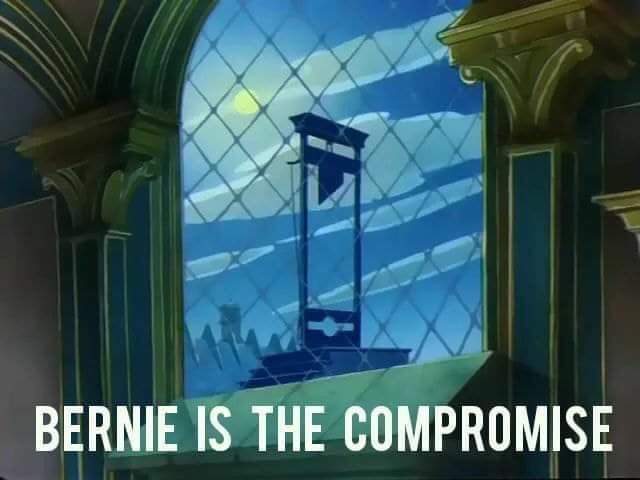
The meme is a play on the infamous execution scene from the 2017 film "The Guillotine" where the main character, a young boy, is forced to execute a person. The image shows a guillotine in the background with the text "Bernie is the Guillotine" and "Bernie is the Compromise". The meme is a reference to the 2017 film "The Guillotine" and the 2018 film "The Compromise" where the main character is forced to execute a person.
detailed-analysis (gemma3-27b-vision)
Okay, let's break down this image with the requested analytical frameworks. It's a striking image, and has a lot of potential for layered interpretations.
Visual Description
The image depicts a stylized, cartoonish rendering of a guillotine positioned within an ornate architectural frame. The guillotine itself is a dark blue, set against a hazy, light-blue background suggesting either sky or distant buildings. The frame is a dark teal, with gold trim that feels reminiscent of classical European architecture, potentially evocative of palaces or government buildings. The style is reminiscent of early Disney or Fleischer Studios animation. Beneath the image, in large, bold white font, is the phrase "BERNIE IS THE COMPROMISE." The overall aesthetic blends danger (the guillotine) with the seemingly innocuous, almost childish style of animation.
Foucauldian Genealogical Discourse Analysis
This image heavily lends itself to a Foucauldian reading. The guillotine is not merely a tool of execution, but a discourse – a system of thought, language, and practice that produced particular truths about power, punishment, and the body.
- Power/Knowledge: The image suggests that even ostensibly radical figures (implied by "Bernie") become incorporated into existing power structures. "The Compromise" implies a negotiation within the system, rather than its outright dismantling. Power isn't solely repressive, it's productive – it shapes the very terms of opposition. Bernie, even if advocating for change, is positioned as acceptable to the powers that be, thus perpetuating their control.
- Genealogy of Punishment: Historically, the guillotine represented a shift in modes of punishment – from public, torturous displays of power to a seemingly "humane" (though swift and total) form of execution. The cartoonish style ironically presents this violent history in a sanitized, palatable way, suggesting that contemporary compromises also disguise the violence inherent in the system.
- Disciplinary Power: The image subtly implies that even in a supposed "revolution", power is not destroyed, but reconfigured. The framing of the guillotine within an opulent structure suggests that it is a feature of, not a challenge to, the existing order.
Critical Theory
From a Critical Theory perspective (drawing heavily on the Frankfurt School), the image critiques the inherent contradictions of late-stage capitalism and the co-optation of dissent.
- Culture Industry: The cartoonish style suggests that even radical ideas are absorbed and commodified by the “culture industry.” The image about revolution becomes another image consumed by the masses, thereby neutralizing its potential for genuine change.
- False Consciousness: The image implies that many who believe they are enacting revolutionary change are, in fact, merely reinforcing the status quo. The phrase “Bernie is the compromise” suggests that settling for incremental change within the existing system is a form of ideological acceptance.
- Critique of Enlightenment Reason: The guillotine, a symbol of the French Revolution, is often associated with Enlightenment ideals of reason and progress. However, the image subtly suggests that these ideals can be turned towards oppression. The cartoonish presentation undermines the "rationality" of the system, hinting at its inherent irrationality and violence.
Marxist Conflict Theory
A Marxist reading centers on class struggle and the perpetuation of capitalist power dynamics.
- The State as an Instrument of Class Rule: The opulent frame around the guillotine can be interpreted as representing the state – an instrument used by the ruling class to maintain its dominance. The guillotine, despite its revolutionary origins, becomes a tool within that state apparatus.
- False Opposition: "Bernie is the compromise" suggests that even seemingly progressive politicians operate within the constraints of the capitalist system and cannot fundamentally challenge it. Bernie becomes a mechanism to manage dissent and prevent more radical alternatives from gaining traction.
- Ideology and Hegemony: The cartoonish style, and the framing of the message, function as ideological tools. They present a complex and potentially threatening message in a palatable, non-threatening way, subtly reinforcing the existing power structure.
Postmodernism
A postmodern analysis would focus on the image's self-reflexivity, its fragmentation of meaning, and its critique of grand narratives.
- Simulacra and Simulation: The cartoon style creates a simulacrum of revolution—a copy without an original. It is a representation of revolution that is divorced from any concrete reality. The message itself (“Bernie is the Compromise”) is a further layer of simulation – a meta-commentary on political discourse.
- Deconstruction of Meaning: The image is open to multiple interpretations. Is it advocating for Bernie? Criticizing him? The lack of a clear message is intentional. The image subverts the traditional notion of a straightforward political message.
- Rejection of Grand Narratives: The image implicitly critiques the idea that any single figure or movement can bring about true revolution. It suggests that revolutions are complex, messy, and often co-opted by the very forces they seek to overthrow.
Queer Feminist Intersectional Analysis
While not immediately obvious, this image lends itself to an intersectional reading by suggesting how revolutionary promises often exclude marginalized groups.
- Critique of Universalizing Claims: The focus on a single figure (“Bernie”) implicitly ignores the complex and diverse needs of different communities. The “compromise” may be acceptable to some, but detrimental to others.
- The Violence of Compromise: For marginalized groups, compromise often means sacrificing their own needs and safety. The guillotine, as a symbol of state violence, can be seen as representing the ways in which the state has historically oppressed and continues to harm vulnerable communities.
- Deconstruction of "Progress": The image questions the notion of "progress" within a system built on exploitation and oppression. “Bernie is the compromise” suggests that even incremental change may not address the root causes of systemic injustice, and may even reinforce them.
In summary, the image is a multi-layered critique of power, ideology, and the limitations of reformist politics. It suggests that even the most radical promises can be co-opted and turned into instruments of control, and that true liberation requires more than just compromise.
Let me know if you'd like me to elaborate on any particular analysis.
simple-description (llama3.2-vision)
This meme features a picture of a guillotine, a medieval execution device. The text "Bernie is the Guillotine" appears in the image, implying that Bernie Sanders, a politician, is like a deadly and feared instrument of punishment. The image is likely used to humorously suggest that Bernie Sanders is so unpopular or threatening that he's like a deadly tool of execution, ready to strike at any moment.
tesseract-ocr
\ j Cae : a ae | KX Se = a | Fa UN